|
|
|
Flies and Mosquitoes are Harmful to Horses!
Flies and mosquitoes are disease carriers and must be controlled.
The dangerous bacteria present in the wastes stuck to the mouth, footpads and hairs of flies may
be deposited in food intended for livestock consumption. Fly feces, which contain disease-bearing
organisms, can also contaminate livestock feed. One fly can carry over 33 million disease-causing
microorganisms on their inner and outer body surfaces. Flies defecate every four to five minutes.
Since flies have no teeth and must take their nourishment in liquid form, they spit on solid food and
let the food dissolve before consuming it. Fly spit or vomitus, is loaded with bacteria and contaminates food, feed and surfaces.
Flies have been known to carry bacteria that can cause typhoid fever, tuberculosis and many other diseases known and unknown to man. A flies common life cycle is 21 to 25 days from egg to
adult. A female often lays twenty batches of eggs during her thirty day life span. Each batch
contains between 40-80 eggs. When the eggs hatch, the adult flies emerge ready to breed. The
number of flies produced by a single pair of adults and their offspring in thirty days is a surprising number in the millions.
Stable flies, horseflies, deerflies, horn flies, and face flies affect your horse’s health and well-being.
Stable flies, are very common. They are about the same size as a house fly but house flies just feed
on garbage and spread filth; stable flies (both males and females) suck your horse's blood. The
most common feeding sites include horse’s lower legs, flanks, belly, under the jaw, and at the
junction of the neck and the chest. When stable flies are finished feeding, they go to rest and digest their meal.
The bite of a blood-sucking fly is painful and some horses have such a low fly tolerance for pain
that they can start snorting and striking into a frenzy. Even the toughest horses that are subjected
to a large number of stable flies, might spend the day stomping their legs which can cause damaging to legs, joints, and hooves, and result in loose shoes, and loss of weight and condition.
The first step in reducing fly populations is keeping the area clean. Fly’s breed in decaying waste.
Moist, warm, decaying material protected from sunlight is required for fly eggs to hatch and in only
8 hours for fly larvae or maggots to grow. Good manure management and moisture control are
the biggest factors that reduce flies from breeding. The practice of removing manure and wasted
feed daily from stalls and pens is the key. To successfully decrease insect breeding areas, kill parasite eggs and larvae, manure must be taken care of effectively.
Standing water is very attractive to flies and mosquitoes. It is a good idea to keep stagnant water
away from your horse’s living quarters. Water left in buckets, on the ground and under faucets are
a few examples of where to prevent water from collecting. Keeping your stable clean and dry
prevents flies and mosquitos from wanting to make your property their home. Good air ventilation
is very important for keeping your barn dry and uninviting to flies. Flies usually have favorite
resting place. They commonly rest on edges such as electric wires, exposed ceilings and rafters. Flies especially like places that protect them from the wind.
Another way to reduce fly breeding is to keep food off the ground so that it can not become moist.
Feeding your horse grain and hay from a feeder rather than eating from the ground is best. This
keeps flies from laying eggs in the feed and the horse from digesting the bot eggs. Keep food/feed stored in sealed containers when possible and clean any spilled hay or grain immediately.
Scrubbing feed buckets after use will help prevent flies from hanging around and making your stable their home.
One of the oldest ways to control flies is through the use of insecticides or fly sprays. This type of
control method requires some form of application device. Insecticide fly sprays can be applied in
many ways; trigger spray bottles, aerosols, hand held foggers, or automatic insect control systems.
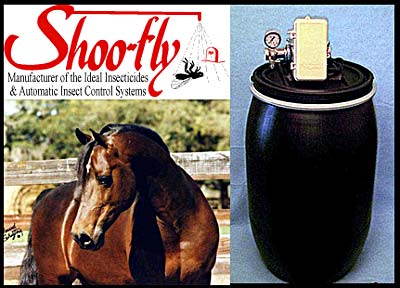
Automatic insect control systems are very effective and efficient, with use in stables dating back to the early 70’s.
Shoo-Fly Insecticides Are Biodegradable –Safe For All Humans & Animals!
Shoo-Fly has over forty years experience with insecticides and the control of insects. Our
insecticides are not harmful to you, your employees, your animals, or the environment when used as directed.
Shoo-Fly's specially formulated water-based insecticides are biodegradable , and are approved for use around humans and all other warm blooded animals. They may be used in food processing
facilities, bakeries, bottling plants, canneries, flour mills, hospitals, hotels, restaurants, schools and
barns. We meet every strict requirement of the Environmental Protection Agency. The U.S.D.A. has authorized the use of our insecticides in all areas of official establishments operating under the
Federal meat, poultry, shell, egg grading, and egg products inspection programs.
Unlike the so-called beneficial insects, or fly predators, which attack only the house fly pupa, our
superb insecticides knock down and kill flying insects quickly... and they stay down. Their breeding cycle is effectively interrupted and the insects are unable to develop immunity to our
insecticide formula. It may be applied directly to animals for outdoor control.
Contact: Shoo-Fly
10377 NW Highway 27
Ocala, Florida 34482
Phone: 1-800-248-5858
Email: info@shoo-fly.com
Website: shoo-fly.com
|
|
|
To advertise your horse product or service, contact Ann
|
|
|
InfoHorse.com, Horse Information Lives Here ® 5/24/2026
Contact Us to Advertise to over a million Horse Owners.
All images and content Copyright© 2012 by InfoHorse.com, Equusite.com.
Horse Owners are Dog Owners; Dog Product Information dognowner.com
|
|
|
Articles, Academic Schools, Arena Maintenance, Animal Communicators, Barns, Barn and Accessories, Barn Equipment and Tractors, Breast Collars, Grooming Products for Horses, Hay Feeders, Horse Blankets, Horse Books, Horse Videos, Horse Breeders, Horse Camping Gear, Career Schools, Carts and Buggies, Horse Training Clinicians, Equestrian Clothing, Dogs and Puppies, Horse Fencing, Western Art & Furniture, Horse Property for Sale, Horse Products For Sale, Fly Control, Foal Care, Horse Footings, Horse Gifts, Horse Health and Nutrition, Hoof and Leg, Horse Insurance, John Lyons Certified Trainers, Equine Lawyers, Leather Care, Links, Horse Property, Horse Photography, Portable Horse Stalls, Arenas and Roundpens, Horse Riding Schools, Horse Schools, Safety Products, Services for Horses, Horse Trailers, Horse Shipping, Horse Skin Coat Care, Horse Software, Specialty Trainers, Horse Summer Camps, Tack, Horse Trainers, Treats and Snacks, Truck Accessories, Trucks, Horse Vacations, Western Lifestyle, jewelry
|
|
|
|