Colt Starting Part 3, Mounting Up and Riding Off
by Richard Winters Horsemanship Colt Starting Part 1 Colt Starting Part 2
Last month, I discussed the preparation necessary before you climb aboard your colt for the first time. Before mounting, I need to have my colt comfortable wearing the saddle and moving out through the full range of motion with it on.
Free lunging in the round pen is great preparation. You could also pony your colt off of another horse, or turn him loose in a larger pen or arena and move him around. Just remember, the saddle feels different at the walk, trot, and lope. Your colt needs to experience these transitions multiple times before mounting.
I ride my colts two or three times in a halter and lead initially. Then I transition into a snaffle bit. In these first few rides I really don’t care where they go and I’m not trying to steer them very much. Also, if my colt gets scared and starts to buck, I don’t want to pull back on the reins and a bit in an effort to survive the wreck. This would probably scare my colt even more.
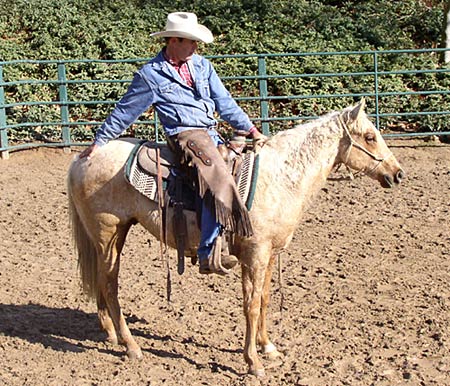
Before climbing all the way on, I’ll step up half way, rub my colt on his neck and rump and then step down. I’ll do this on both sides (left and right). Now I’ll step half way up, tip his nose toward me, chirp or cluck and encourage this colt to step his hind quarters over. I want my colt to realize he can move his feet with me on top. I’m also teaching him the concept of lateral flexion (with his head and neck) and disengagement of the hind quarters.
This will be a good “emergency brake” if things start to fall apart; I’ll do this multiple times on both sides. I’m preparing my colt for what I’ll do when I’m all the way up. Once in the saddle I’ll encourage my colt to take one or two forward steps directly after moving his hindquarters out of the way. This is my goal at this stage of the game, forward momentum.
When people think of riding a colt for the first time, they’re concerned about how they will be able to control and stop the colt. My biggest concern is; how can I get him to move. I need forward impulsion and I need to start getting it right away. That’s where an assistant in the pen can really be helpful. Not just anyone will do. Don’t ask uncle Charlie to come help just because he’s available yet doesn’t know anything about young horses. Uncle Charlie might end up getting you killed! You’ll need someone who can free lunge you and your colt safely.
As my helper is moving the colt around the pen, I’ll try to rub my colt all over and get him really comfortable with the whole experience. Remember the full range of motion concept? The quicker my colt learns to walk, trot, and lope with me on his back, the less of a big deal it will be.
The biggest confusion that riders face with their colts is the idea of pushing on the brake and the gas peddle at the same time. If you try to steer and guide them too much at this early stage, you’ll hinder the colt’s ability to get comfortable moving forward. I tell my students, “I don’t care where they go. I just need them to go!” If you start “micro-managing” and trying to direct your colt too much too soon, you’ll run into problems and probably create confusion and a bad attitude in your colt.
Following someone on a saddle horse can be a big help once you leave the round pen. Horses are natural followers. You’ll be surprised how your colt will move forward and “line out” when he has someone else to follow. This technique can become a crutch if over used. Your colt needs to venture out on his own flight path before long.
During these early rides you’ll not see me pulling back on both reins at the same time to either slow down or stop my colt. Using one rein at a time and doing a lot of bending exercises will help create suppleness and not allow my colt to get bracy and still. I’m also careful to not use too much leg early on. A lot of squeezing and kicking can create a cranky, sullen colt with pinned back ears and a ringing tail. Rather, I’ll slap my leg or spank behind to encourage forward motion. I’ll create some kind of energy with my voice and body and then get soft when my colt moves forward.
As I mentioned last month, these few paragraphs are not meant to be comprehensive and complete. This is simply a small window into the colt starting process that I follow. If you are up to the challenge of colt starting, great! If not, find a competent trainer to lay a proper foundation on your youngster. It will be a relatively small investment in the twenty plus year relationship you can enjoy with your equine partner.
For more information about Richard Winters Horsemanship please go to wintersranch.com.