|
Thinking About A Career As A Farrier? It’s Not Just Another Job. By Bryan Farcus, BS, CF with Doug Butler, PhD, CJF, FWCF
I can honestly say that there are few good things in life that have come to me without hard work and determination. Though I must admit that during the pursuit of some of my most challenging
endeavors, I often wished of an easier method or perhaps questioned my very motives for entertaining such thoughts of grandeur. However, in the spirit of full disclosure, I must confess
that every single success was appreciated and the trials and tribulations, which I faced, quickly faded.
Reminiscent of the days when I was an undergraduate student in Business College, I can still hear
the echo of the words of wisdom that a tenured marketing professor would periodically spiel-out. With conviction in his voice he would say, “If you choose
to work just any job, you will be forever living only to work; but, if you follow your passion for a career you will work so that you may live and enjoy life”. Of all my years learning and teaching, I
have found no better advice. Unfortunately, it does require that an individual reflect on what it is in life that he/she really enjoys and what lifestyle he/she wishes to subscribe to. When it comes to
a career with horses, whether it be as a trainer, a breeder, a vet or, as in my case, a farrier, you must first realize that it’s not just another job. Working with horses and with those who own
them, requires that you truly enjoy a lifestyle that evolves around outdoor activity, intimate interaction with horses, interaction with other animals that may accompany them, extensive travel,
long days, challenging problems, and creative problem solving.
For several years following my business education, I worked as an accountant/office manager for
a small family owned and operated lumber supply company. Within a short period, I realized that this type of work was not fulfilling and I was experiencing precisely what my college professor so
adamantly forewarned me of, just a few years earlier. I was, in fact, living only to work. Upon a re-evaluation of what I really enjoyed in life, I chose to pursue a career that would include what I
have a great passion for working with horses. Turning a desire to become a successful farrier into reality will, undoubtedly, require an unwavering determination to seek-out guidance from more
experienced and accomplished farriers. It will take many years to gain a mastery level of competency in the areas of conformation assessment, gait assessment, and the application of
supportive horseshoes. Treating horses with abnormalities with corrective shoes requires taking your skill to a much higher level.
I feel privileged to have had the help of many farriers who have come before me and I am extremely grateful to those mentor farriers who so graciously taught me. One of my mentors, Dr.
Doug Butler, shares his advice annually during the Farrier Focus Conference. Dr. Butler has been teaching horseshoeing in public and private settings for the past 40 years. He has presented
seminars and clinics in 46 states and in 8 foreign countries. The following is his advice on what you should consider as you prepare for a career as a farrier; “Ideally, to learn the farrier’s craft
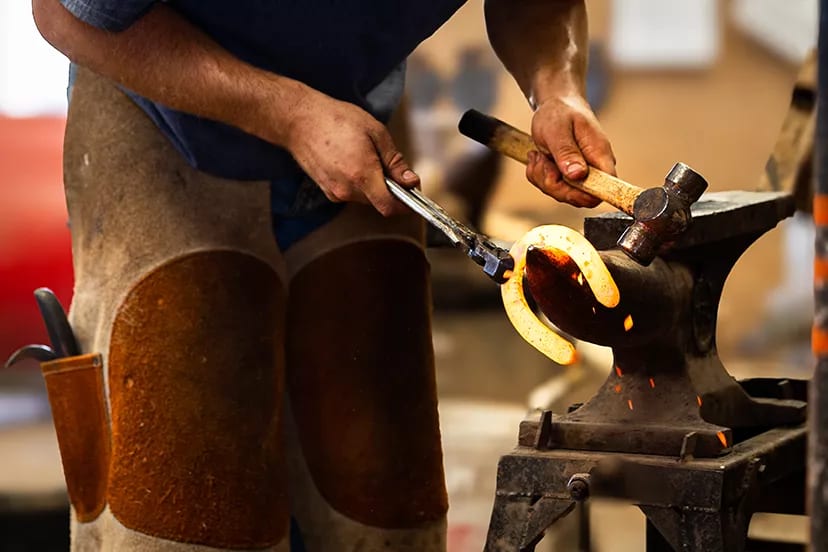
you should have hands-on experience practicing the skills of eye development, tool handling and horsemanship with live, working horses. This is most valuable. To master the craft, learning from
one-on-one mentoring is necessary.” “A competent farrier must possess skill developed from above average training and extensive practical experience in anatomy, physiology, pathology,
conformation and biomechanics of the horse. In order to enjoy the highest level of respect within your horseshoeing community, you must have command of the in-depth knowledge of the horse’s
foot, business concerns, horse and people relationships, as well as metal forging technology.” “Keep in mind that being a farrier is unlike any other job. It is physically, mentally and emotionally
hard. To have sustainable success, you must possess a strong work ethic and be a person of integrity. This should be considered an obligation and not just an option. Your image will either
make or destroy your career.” “The single, most important thing to consider as you look at a farrier career is to realize that true competency in the farrier’s craft and in life is a combination of skill plus character.
” Not everyone is willing to make that commitment. Are you?
Contact: Doug Butler Enterprises, Inc. PO Box 1390 La Porte, Colorado 80535 Phone: 800-728-3826 or (970) 407-7791
Email: info@farrierfocus.com Website: www.farrierfocus.com/
|