|
|
|
Hoof Health, Horse Hoof Care
Hoof Conformation for Horse Owners
Monique Craig, EponaShoe
Although I am not keen on trimming and shoeing formulas, I believe that there are some important guidelines and landmarks that can be helpful in the assessment of hoof conformation and in defining
an approach to the trim and choice of shoes. I believe the trim is of first importance in maintaining hoof health and function. The proper choice of shoes and shoe placement come second.
Let us start with a very simplified tour of hoof anatomy (see figure 1).
It is obvious that the whole hoof is designed to facilitate shock absorption. The frog needs to
have some contact to the ground to allow proper blood flood within the hoof. The placement of
the pedal bone (also called “P3”) within the hoof capsule, its relationship to the canon bone and to
the ground are all important aspects in evaluating a hoof. The digital cushion, which lies in the
back portion of the foot (behind the blue line in figure 1B), plays an important role in the shock
absorption mechanism of the hoof. The lateral cartilages (not shown) surround the digital cushion
and are involved in shock absorption and blood flow within the hoof. It is beyond the scope of this article to consider more fully anatomy and hoof mechanics.
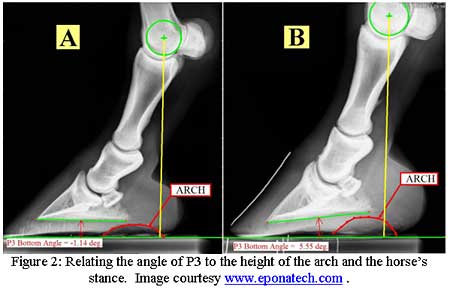
The radiograph of figure 2A shows a hoof whose pedal bone is at a negative angle relative to the
ground, which is not a good situation. Further, this pedal bone is too far “in front” of the bony
column, that is, it should be more nearly underneath the cannon bone. These problems are related
to the fact that this hoof has a low “arch”. The valleys to either side of the frog are called
“commissures of the frog” (figure 1B) and in some feet these are shallower than others. Shallow
commissures translate to low arches. In some cases, a hoof may lose arch height as it ages, the
weight slowly crushing the arches. The degree to which this occurs depends on many factors such
as the quality of the digital cushion, the support afforded to the frog by the environment, etc.
 |
Figure 1: Some anatomical terminology. In image ‘A’ we have superimposed the radiograph
within a photograph, so the relationship between the bones and the hoof can be seen.
The radiograph of figure 2B shows a hoof with a higher arch and a correspondingly higher angle to
the pedal bone. Also, the pedal bone appears to be more ‘under’ the bony column. I believe
that an acceptable range for the pedal bone angle is from 1.5 degrees up to 6.0 degrees. This
angle, labeled in figure 2 as the “P3 Bottom Angle” is also sometimes known as the “P3 Palmar
Angle”. As you might imagine from this brief discussion of the commissures and the arches, this
angle can vary substantially from horse to horse, and hoping to achieve one particular angle of P3
for all horses is not realistic. More important than this angle is the placement of the pedal bone ‘under’ the bony column.
Figure 2: Relating the angle of P3 to the height of the arch and the horse’s stance.
It is important to realize that the hoof is a highly adaptable structure. Hoof anatomy and its function
(mechanics) can be altered not only by the trimming, but also by a change in moisture content, local variations of the ground (soil mechanics), type of training, developmental problems, gait
compensation and aging, among other things.
I also would strongly recommend that horse owners demand yearly radiographs for preventative
reasons as well as for record keeping. An ounce of prevention is worth a pound of cure. For
instance, radiographs are very helpful to define the sole depth, position of the pedal bone within
the hoof capsule, and joint angulations. Owners should ask their veterinarian to use the Metron
measurement system to measure all the important angles and other measures of the hoof and bones. Metron generates a report, and it’s a god way to set a baseline of your horse’s
conformation ( see www.eponatech.com ).
Now let’s examine some of the outer landmarks I use to assess a particular situation. I start to
assess the stance of the horse. How are the hooves placed in relationship to the cannon bone?
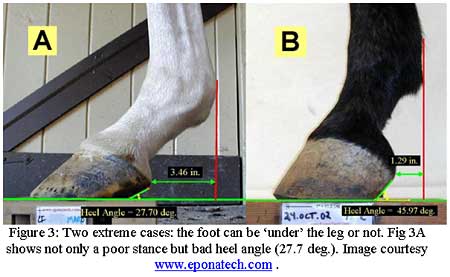
Figure 3: Two extreme cases: the foot can be ‘under’ the leg or not. Fig 3A shows not only a poor stance but bad heel angle (27.7 deg.).
In an ideal situation the hoof should be under the ‘bony column’. In a lateral view, it means that
the hoof should be close to the cannon bone. In a frontal view it means that the hoof should be in visual alignment with the cannon bone.
In figure 3B, you will notice that the hoof is under the cannon bone. Such a stance is good,
perhaps a bit to the upright side of ‘ideal’. Figure 3A depicts an extremely bad stance – the foot
is far out in front of the cannon bone. Note that these issues of hoof/leg conformation do not
necessarily relate directly to soundness, but I believe that in the long run, poor conformation will eventually lead to lameness in most horses.
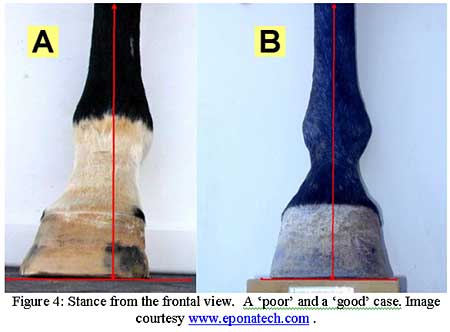
Figure 4:
Stance from the frontal view. A ‘poor’ and a ‘good’ case.
In figure 4 we compare a good frontal alignment and a poor one. The images in figures 3 and 4
represent front hooves, in general the same comments apply to the hind hooves.
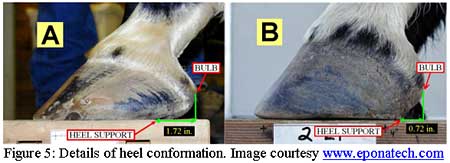
Next, I assess the distance between the heels and bulbs, and the heel angle. I like to see that the
heels provide support to the bulbs. The further away the heels are from the bulbs, the less structural support to the hoof. This lack of support translates in general in hoof capsule
deformities.
The hoof in figure 5A shows that the bulbs have collapsed. This horse is almost walking on its
bulbs. Internally, this horse has also lost its arch support, meaning that the pedal bone is no longer
supported well by the arch. This is one of the reasons why the pedal bone has a negative angle
(figure 2A). Concerning the distance measures in figure 5, I am not looking for an exact number
but I am trying to assess a reasonable range for support. A range of 0.6” to 1.1” is a reasonably
good range for a normal sized foot, so the foot in figure 5A is outside this good zone.
Figure 5: Details of heel conformation.
Figure 5B shows a hoof with nice support and adequate heel angle (about 45 degrees). Figure 5A
shows a hoof with poor support and poor heel angle (about 21 degrees). Note the heel angles are not shown on the pictures above.
I consider a range between 40 degrees and 48 degrees for the heel angle to be acceptable. I am also looking for the difference between the hoof angle and the heel angle to be from 5 to 10
degrees. A large numerical difference between the heel angle and the hoof angle would also indicate hoof capsule deformities such as in figure 3A and 5A.
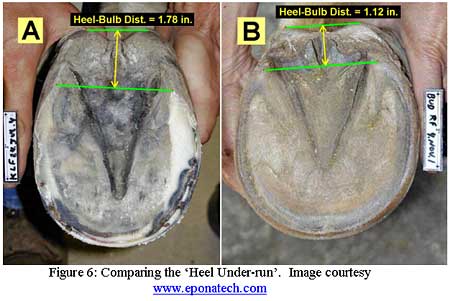
Finally, I look at the sole (figure 6). I look at the distance from the heel point to the bulbs. I want
to see that this distance is ‘small’. I also assess the shape of the sole. The circumference of the
sole should be wider than the one of the coronary band. On the average the sole should be wider
than the coronary band by 20 to 30 percent depending on the seasons. In wet weather hooves tend to splay a bit.
Figure 6: Comparing the ‘Heel Under-run’.
In figure 6A, the heel to bulb distance is too large, the frog is stretched and thin. This is a typical
for low and contracted heels. Figure 6B shows a nicely shaped hoof. Remember, we are talking
about the front hooves here. The hind hooves are a bit more oblong in shape but the same comments apply as far as the heel bulb distance goes.
Only after I have fully assessed the hooves of a horse, I will decide on what to do with that
particular horse. I do not try to make hooves match in conformation. My goal is to bring or
maintain the hoof towards a ‘further back’ position. In healthy and ‘normal’ hooves this is
obtained by lowering the heels to the level of the frog. That is, I want the walls at the heels and the
frog to both share the load. In my opinion it is neither natural nor healthy to focus the weight
bearing on any one structure – walls, sole, or frog. Rather, all three of these components should
share in supporting the weight. I designed the Eponashoe ( www.eponashoe.com ) to make it
easy and practical for farriers to accomplish this load sharing. I do not like long toes but the toe
length needed for a particular horse is highly individual. In ‘normal’ hooves, a large portion of the
hoof (perhaps two thirds) lays behind the apex of the frog. Again, there are plenty of sound
horses with good hooves that do not fit this formula. Factors influencing the shape and length of
the frog are things such as soil mechanics, hoof quality, weather conditions, and dynamic stresses
placed on the hoof. This will be addressed in a future article. When I do not know a horse, I try
to have recent radiographs handy, as they give a great deal of information about the hoof.
Without radiographs, we must rely on external landmarks and structures, and one must be careful --- these sometimes have a tendency to deceive the eye.
Monique Craig is a hoof researcher, farrier, consultant to farriers, rider, trainer, and
founder of EponaTech ( www.EponaTech.com ) and EponaShoe ( www.EponaShoe.com ).
Contact: John or Monique Craig
P.O. Box 361
Creston, California 93432
Phone: 1-866-376-6283 or 805-239-3505
Email: info@eponashoe.com
Website: www.EponaShoe.com |
|
|
To advertise your horse product or service, contact Ann
|
|
|
InfoHorse.com, Horse Information Lives Here ® 9/6/2025
Contact Us to Advertise to over a million Horse Owners.
All images and content Copyright© 2012 by InfoHorse.com, Equusite.com.
Horse Owners are Dog Owners; Dog Product Information dognowner.com
|
|
|
Articles, Academic Schools, Arena Maintenance, Animal Communicators, Barns, Barn and Accessories, Barn Equipment and Tractors, Breast Collars, Grooming Products for Horses, Hay Feeders, Horse Blankets, Horse Books, Horse Videos, Horse Breeders, Horse Camping Gear, Career Schools, Carts and Buggies, Horse Training Clinicians, Equestrian Clothing, Dogs and Puppies, Horse Fencing, Western Art & Furniture, Horse Property for Sale, Horse Products For Sale, Fly Control, Foal Care, Horse Footings, Horse Gifts, Horse Health and Nutrition, Hoof and Leg, Horse Insurance, John Lyons Certified Trainers, Equine Lawyers, Leather Care, Links, Horse Property, Horse Photography, Portable Horse Stalls, Arenas and Roundpens, Horse Riding Schools, Horse Schools, Safety Products, Services for Horses, Horse Trailers, Horse Shipping, Horse Skin Coat Care, Horse Software, Specialty Trainers, Horse Summer Camps, Tack, Horse Trainers, Treats and Snacks, Truck Accessories, Trucks, Horse Vacations, Western Lifestyle, jewelry
|
|
|
|