|
|
|
Cooling Horses
Equine Facilities: Two Problems, One Solution
Horse Cooling Companies on InfoHorse Beat the Heat, Eliminate Condensation
People feel the heat and so do horses. Heat can, in fact, affect a horse’s health and well-being a lot
more than it does us humans. After all, we just move into a comfortably air-conditioned room when we
get too hot. Most horses don’t have that luxury. It is impractical and expensive to air-condition most horse barns.
Heat stress in horses can cause weight loss, high body temperatures, low performance expectations, and
dramatic water intake. Also associated with heat stress is some horses’ inability to sweat, despite an
elevated body temperature. This condition, called anhidrosis, can be life threatening.
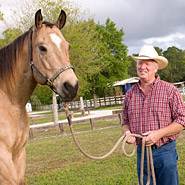
 Ronnie Kent of Chipley, Florida understands this about horses, and understands the need to
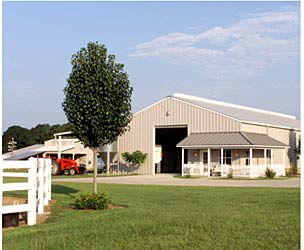
keep his mounts comfortable and healthy. That’s why he’d been looking for a solution to keeping his horses cool ever since he erected his metal horse barn five years ago. Ronnie Kent of Chipley, Florida understands this about horses, and understands the need to
keep his mounts comfortable and healthy. That’s why he’d been looking for a solution to keeping his horses cool ever since he erected his metal horse barn five years ago.
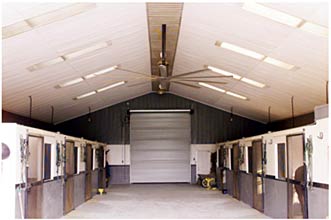
For four of those five years, Kent kept air moving with eight box fans and two floor fans. It wasn’t until a year ago that he discovered a
better solution. That solution was rotating slowly above his head at MetalCon, the convention of metal building professionals.
The fan was, at 24 feet in diameter, one Big fan. Some Companies fans range in diameter from 6 feet to
24 feet and are used in a variety of applications – industrial, manufacturing, warehousing, commercial,
and in dairy barns across the country. Many sizes are available from various cfan and cooling companies.
Kent was so impressed by the volume of air created by the slow-turning fan blades that he ordered one
for his horse barn. “I thought it would be ideal for the horses,” says Kent. “It just made sense.”
Kent knew that fans are one of the most effective ways to cool the body. A cool body is key to
reducing heat stress, which occurs when the core temperature rises beyond safe limits. Fans work on both the horse and human natural cooling system.
When sweat evaporates, it feels cooler. Fans help speed up the evaporation process.
Slow-moving fans also reduce the amount of moisture in the air. This reduction in humidity makes the environment seem cooler.
Dairy farm owners have found this approach useful in keeping their herds cool in summer. Dairy barns
usually vent heat through the roof. For many dairy farmers, Big Ass fans also pull in air through the ridge
vent, washing cattle with fresh air from outside the barn. Big fans can eliminate 12 – 13 standard alley fans.
With the installation of just one Big Fan, Kent was able to eliminate the box and floor fans he'd been using. “That one fan is all we need,
” he says. “It's like having a cool breeze in here all summer long.”
A fan works on the principle of convection currents. Unlike high velocity fans, the big fan slowly rotates
and generates a downward column of air equal to the fan's diameter. As the column hits the floor, it
slides outward toward the walls. There, it moves up to the ceiling and then back down through the fan
blades, gaining momentum as it goes. Since the fans are made of lightweight aluminum and move slowly,
they operate on a one or one-and-a-half horsepower motor. This results in significant energy savings.
Kent was so impressed with the Big Fan Company, he placed another fourteen footer in his business – a 7500 sq. ft. sheet metal shop. “They're fine fans,” he says.
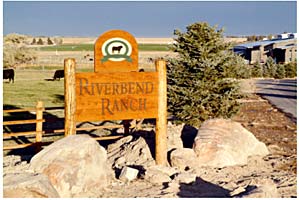
 Jason Riley would agree with Ronnie Kent. Riley is project engineer at Riverbend Ranch in Idaho Falls, Idaho.
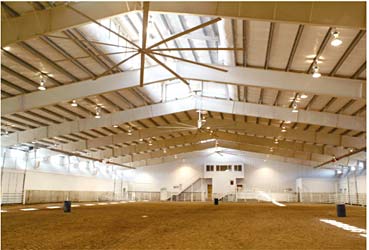
Frank and Belinda VanderSloot own the ranch where they raise premiere Black Angus cattle. They’re also passionate about horses, and have a combination
stable and riding arena, a building that covers 55,000 square feet, with 32,000 s.f. dedicated to the arena. Jason Riley would agree with Ronnie Kent. Riley is project engineer at Riverbend Ranch in Idaho Falls, Idaho.
Frank and Belinda VanderSloot own the ranch where they raise premiere Black Angus cattle. They’re also passionate about horses, and have a combination
stable and riding arena, a building that covers 55,000 square feet, with 32,000 s.f. dedicated to the arena.
The VanderSloots don’t have the same problem as Ronnie Kent, but they do
have one typical of many metal horse facilities – condensation forming on the
roof of the building in winter. As the project engineer, it was Jason Riley’s job to fix the facility’s internal climate problem.
I knew we had to do something to control ventilation because that’s the best way to control
condensation.” You want to keep the temperature differential down.” In wintertime, warm air rises and
hits the metal roof where moisture is taken out of the air by the colder temperature of the ceiling. In some indoor environments, it can seem like it’s raining inside.
“I had to do something to control the ventilation. We didn’t want to put in spiral ductwork. We wanted
a nice, clean refined look.” Riley worked with Industrial Ventilation, Inc. of Nampa ID, a Big Fan distributor, to achieve that look.
“It just made sense to me,” he says. “If I was to use any other type of ceiling fans, we determined that
we’d need at least twenty-seven of the commercial grade ceiling fans. We solved our problem with three of the Big Fans.”
 The secret to controlling condensate is air temperature and airflow, especially near the
condensing surfaces. Riley says that for the Riverbend riding facility, the Big fans do the job beautifully. “The fans push air down to the floor and
it rises back up against the walls. You can feel the breeze it generates at top speed, but we only have to run them at half speed.” The secret to controlling condensate is air temperature and airflow, especially near the
condensing surfaces. Riley says that for the Riverbend riding facility, the Big fans do the job beautifully. “The fans push air down to the floor and
it rises back up against the walls. You can feel the breeze it generates at top speed, but we only have to run them at half speed.”
“That’s the nice thing about the fans,” he continues. “They have infinite control from nothing at all to fifty
-nine hertz. We run ours at 35 hertz, about half speed. That’s enough to keep the air moving from October to April when we need it most.” The facility
uses three twenty-four foot fans, and has one more on the way to control a bigger condensation problem
on the east wall. “We’ll have to run that one a little faster, I think, but that’s what it’s all about –
managing air flow through the fans. “The fans are doing the job,” says Riley, “and they’re doing it well.”
And who knows, maybe horses do appreciate it after all.
Visit our Barn Cooling Companies Here!
|
|
|
To advertise your horse product or service, Contact Ann
|
|
|
InfoHorse.com, Horse Information Lives Here ® 5/24/2026
Contact Us to Advertise to over a million Horse Owners.
All images and content Copyright© 2014 by InfoHorse.com, Equusite.com.
Horse Owners are Dog Owners; Dog Product Information dognowner.com
|
|
|
Articles, Academic Schools, Arena Maintenance, Animal Communicators, Barns, Barn and Accessories, Barn Equipment and Tractors, Breast Collars, Grooming Products for Horses, Hay Feeders, Horse Blankets, Horse Books, Horse Videos, Horse Breeders, Horse Camping Gear, Career Schools, Carts and Buggies, Horse Training Clinicians, Equestrian Clothing, Dogs and Puppies, Horse Fencing, Western Art & Furniture, Horse Property for Sale, Horse Products For Sale, Fly Control, Foal Care, Horse Footings, Horse Gifts, Horse Health and Nutrition, Hoof and Leg, Horse Insurance, John Lyons Certified Trainers, Equine Lawyers, Leather Care, Links, Horse Property, Horse Photography, Portable Horse Stalls, Arenas and Roundpens, Horse Riding Schools, Horse Schools, Safety Products, Services for Horses, Horse Trailers, Horse Shipping, Horse Skin Coat Care, Horse Software, Specialty Trainers, Horse Summer Camps, Tack, Horse Trainers, Treats and Snacks, Truck Accessories, Trucks, Horse Vacations, Western Lifestyle, jewelry G+
|
|
|