|
A Different Kind of Horse Training Clinic
by Catherine Bodez
When we hear the terminology "horse clinic" we sometimes have a tendency to picture bleachers, a covered arena, and hardly any hands-on participation.
 No such thing in the clinic I just attended with my horse. Conducted by Lisa Bockholt
, a John Lyons certified trainer and a select trainer, this clinic was very much hands-on and a real eye
opener. Since I started riding again and my flame for horses has been rekindled, I have been going to such events as Equus America in Houston, a couple of local horse clinics, and have tried to
educate myself with books and video tapes. I will tell you that nothing beats a hands-on clinic
with someone whose methods are something you strive to learn and assimilate. I do think this is valid for a beginner as well as a more experienced rider. No such thing in the clinic I just attended with my horse. Conducted by Lisa Bockholt
, a John Lyons certified trainer and a select trainer, this clinic was very much hands-on and a real eye
opener. Since I started riding again and my flame for horses has been rekindled, I have been going to such events as Equus America in Houston, a couple of local horse clinics, and have tried to
educate myself with books and video tapes. I will tell you that nothing beats a hands-on clinic
with someone whose methods are something you strive to learn and assimilate. I do think this is valid for a beginner as well as a more experienced rider.
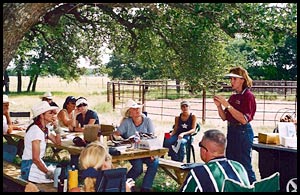
We started not on our horses, but sitting on our chairs under the shade of oak trees. Lisa told us about ground rules, mostly common sense, passed around several training material leaflets for us to
read later, and suggested we prepare to take notes of the many concepts she was going to throw
at us. A lecture-discussion followed on what we were going to do, what to expect, and the result we could anticipate from such a
short, concentrated clinic. She established basic principles such as:
you cannot get hurt,
the horse cannot get hurt,
the horse will be more calm at the end of the session than the beginning.
I could hear John Lyons. I knew I was at the right place and my focus intensified. Lisa put it simply: do we have the ability to ask our horse to do something and get a YES answer?
Since most people do not have a clear idea how the bit really works in the horse's mouth,
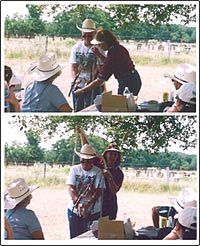 we were treated to a hands-on demo of the full cheek snaffle bit with volunteers holding the bit
between their hands! This went a long way in demystifying that particular bit, as well as a lot of
other types. Lisa further explained that, in her opinion, this is the bit that offers the clearest communication with the least amount of pain to the horse. We clearly understood what directional
control really means, as opposed to leverage. To reinforce the concept of "pressure - release of
pressure", she went on to explain the importance of releasing the reins when the horse is giving the response we look for, and mentioned that this is most likely the biggest mistake most riders make:
hang on to the reins too long. We talked about the ever so important "go forward cue" which is the
start of so many other things we want the horse to do on request, including stop, since the horse cannot stop if he is not moving! we were treated to a hands-on demo of the full cheek snaffle bit with volunteers holding the bit
between their hands! This went a long way in demystifying that particular bit, as well as a lot of
other types. Lisa further explained that, in her opinion, this is the bit that offers the clearest communication with the least amount of pain to the horse. We clearly understood what directional
control really means, as opposed to leverage. To reinforce the concept of "pressure - release of
pressure", she went on to explain the importance of releasing the reins when the horse is giving the response we look for, and mentioned that this is most likely the biggest mistake most riders make:
hang on to the reins too long. We talked about the ever so important "go forward cue" which is the
start of so many other things we want the horse to do on request, including stop, since the horse cannot stop if he is not moving!
It was hot that day, but the clouds came out just as we were starting to bridle our horses to start the ground work. Perfect timing. We placed cattle marker dots in strategic spots like the hip, the
shoulder, the tip of the ear, to learn to tunnel vision to those spots, then went to work. Learning and refining the go forward cue,
moving the hip, moving the shoulder, and pretty soon realizing we were communicating in spite of ourselves. For the very first time, I
understood that you do not "pull" the horse's nose, you simply apply pressure by taking the slack off the reins, and let the horse figure
out how to relieve the pressure!!!! This, for me, was a major breakthrough.
It was amazing to see the horses going from not knowing what the owners were up to, to suddenly 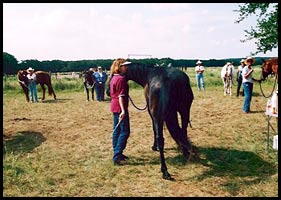 understanding and responding to
requests. How exciting to be able to communicate with your horse, how rewarding it is to realize you can control that powerful animal. How willing they are to work with us
humans if we can only speak their language. Made me feel sad also for all the wasted time, the ignorance, the bad attitude we humans so readily display. Just as my dogs
and cats make me feel privileged when they communicate so well with me, so did my horse. I was now real happy I had come and eager for more. understanding and responding to
requests. How exciting to be able to communicate with your horse, how rewarding it is to realize you can control that powerful animal. How willing they are to work with us
humans if we can only speak their language. Made me feel sad also for all the wasted time, the ignorance, the bad attitude we humans so readily display. Just as my dogs
and cats make me feel privileged when they communicate so well with me, so did my horse. I was now real happy I had come and eager for more.
There was this little white horse who seemed so out of control and on the nervous side, whose owner was patient but not sure where to start. During one of the practice
sessions, Lisa approached the horse and demonstrated the proper position, movement, action. We saw that little horse progress before our very eyes and go from an excited,
unresponsive horse to a calm and cooperative partner. And this was just the beginning of the partnership between the owner and the
horse. There is no telling what the owner will be able to do with this willing partner.
While we were all intensely focused on our individual horses, we still were able to learn from each other. 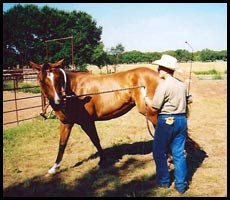 There were opportunities to stop and watch how the other participants were doing. Lisa was dividing her time skillfully and
going to a participant-horse team to refine a point, another to demonstrate a movement, passing by others to give encouragement and a word of advice, or quickly assessing a problem
and showing a solution. The horses were tuned to the handlers, they seemed to be asking for cues. I could swear my horse Cricket was smiling. I glanced at my neighbor and her horse
Peach was gracefully turning about her, her neck becoming more and more supple as the long muscle showed some crease in it. Beautiful. I watched for several minutes, captured by the
focus of her horse on her handler. A nudge from Cricket brought me back to earth, she was anxious to work! There were opportunities to stop and watch how the other participants were doing. Lisa was dividing her time skillfully and
going to a participant-horse team to refine a point, another to demonstrate a movement, passing by others to give encouragement and a word of advice, or quickly assessing a problem
and showing a solution. The horses were tuned to the handlers, they seemed to be asking for cues. I could swear my horse Cricket was smiling. I glanced at my neighbor and her horse
Peach was gracefully turning about her, her neck becoming more and more supple as the long muscle showed some crease in it. Beautiful. I watched for several minutes, captured by the
focus of her horse on her handler. A nudge from Cricket brought me back to earth, she was anxious to work!
Time passed very quickly but I learned a lot, not only about actual, concrete maneuvers, but
also to re-think training in general. For instance I learned to place my focus not on the goal but rather on the problem, and let the
problem become the training goal. I was reminded to apply the principle that, as you think different you become different, to horses. I
learned how to mentally drive the horse. And I learned in a low stress environment in spite of the activity and the amount of material
that was thrown at us. As information packed as this clinic was, I did not feel rushed, pushed, pressured in any way, and this made the
learning more effective. As I reflect about the session, I remember that about 30 years ago I was told not to go near horses again,
after a rather serious accident. Much better advice would have been: go get educated before you go mess with horses again.
It is all in the way we communicate. It is all about patience and giving the animal a chance to digest, understand, and develop
the kind of trust we all dream of having with our horses once we start riding them. Yes it is about control, but control for the sake
of safety of the horse and the owner, not control for the sake of control, a major difference.
I have the John Lyons Ground Manual, the wonderful manual that explains the ground work, round pen work, etc, and I also have
several of the John Lyons' tapes. I learn well from books, especially when they are reinforced with tapes. But even then, being there
and having the benefit of Lisa's eyes was invaluable. She could immediately pinpoint a movement, even just a gesture, not excecuted
properly and with a few words provide clarification. No waste of time, no bad habit instilled in the horse, most of all no confusion
created in the mind of the horse or the owner. It was great. If you have not yet participated in a clinic, do yourself a favor: go. You
will see a difference in your interaction with your horse, and develop a frame of mind of wanting to figure out how to best communicate
so you can both, safely, enjoy the time together. Whatever your experience level is, a clinic will expand your mind and benefit both you and your horse.
I cannot say enough about Lisa's ways. She is a credit to the John Lyons program and complements the whole process with her no
-nonsense personality. She displayed a rare blend of enthusiasm and patience to simplify many concepts and teach us how focus and
care for the horse can enable communication. She has an obvious love of horses and exceptional talent to impart her knowledge and
understanding of horses to people who ride them. Her clinic is done in an upbeat, crystal clear way, associating concepts to simple
everyday concrete facts and examples that are easy to digest. Lisa has the ability to effectively convey concepts and simplify what
appears to be complex maneuvers so anyone can duplicate her actions.
The Post Oak Farm in Burnet, Texas was a perfect setting for the clinic and Helen Miller was a great hostess as always, in addition to
the many hats she wears as the owner of the ranch. Her 400 acre ranch offers guest cabins, covered stalls, a large arena, and ranch
rides and riding instruction are available. The pool and pool house are always a hit as well! If you are looking for a wonderful hostess
making people welcome and feel at home in a relaxed, informal atmosphere.
For now, I find myself talking to the hip or the shoulder of my horse, and certainly leaving the lead rope or reins alone unless I am
ready to communicate something to my horse. It's working folks, it's working! While I slowly realize how little movement it takes, my
horse is more responsive, more attentive, more willing! Actually it is not her, it is me who is learning to clearly speak her language!
What a thrill! I suspect she is thinking something like: whoa, there is hope for the humanoids. What I like most about the John Lyons
technique is that it is all done peacefully. It fits me, it fits the way I want to train, it fits my surroundings. It is a daily chance to do well,
as I witness the serene sight of the horses grazing in the pasture in the morning light, while the early sun is reflecting on the dew and
giving the air that golden color that is as ephemerous as it is peaceful. When I catch it, it only last minutes, sometimes seconds of sheer
perfectness, but it remains forever in my soul. Forever a promise of a hope.
|