Riding The Seemingly Simple Circle
Down The Fence with Richard Winters Horsemanship How correctly your horse lopes fast and slow circles while reining will be contingent on how much care and attention you give to this phase of the pattern on a daily basis With Richard Winters
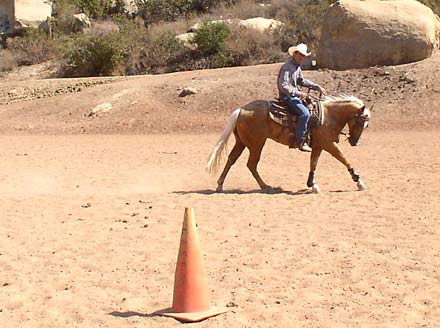
In a reining pattern, the sliding stops and spins are certainly spectacular and cause everyone to sit up and take notice. Yet there is another important maneuver which sometimes doesn’t receive as much attention, the seemingly simple circle. How correctly your horse lopes fast and slow circles will be contingent on how much care and attention you give to this phase of the pattern on a daily basis. There are two elements you need to constantly consider when loping circles.
Number one: The symmetry or roundness of your circle. Number Two: The proper balance and frame of your horse while loping the circle.
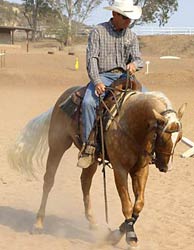
It’s been said that practice makes perfect. That’s not true. It’s only perfect practice that makes perfect! If you don’t practice perfect circles at home, it won’t happen in the show pen. Our horses proper body position in the circles is something we have to feel and continually work on. I spoke last month about body control and having the ability to manipulate my horses individual body parts independent of each other. This is where it becomes really important. When I am loping to the right, I want my colt slightly arced in that direction. In a right hand circle I shouldn’t be able to see the corner of my horses left eye. If I can, then my horse is counter bent and leading with his shoulder instead of his nose. I need my colt to be looking in the direction he is going.
If I can’t see that inside eye I’m going to gently bump the inside rein and perhaps use a little inside leg to keep my horse looking in the proper direction.
Another common problem when loping circles is a horse dropping its shoulder into the direction
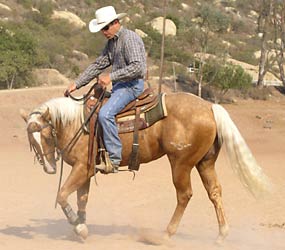
they are going. If Rocky starts to drop his shoulder in a circle I will lift with my inside rein along his neck and use some inside leg close to the front cinch. This would be part two of my 4-Part Harmony exercises. Loping squares can also be helpful in reminding my colt to keep his shoulders straight while circling. Here are the hard facts: If you can’t control the shoulders, you’re not going to have a reined cow horse. Just like we encourage our kids to have good posture, without reminders our kids and colts can get lazy. With consistency your horse can develop mind and muscle memory to travel correctly when loping circles.
I’m also asking Rocky to speed up his circles and then slow down again. I want to introduce and encourage speed control and show him that speed is nothing to be afraid of. I also want him to understand that the reward of speeding up will be the opportunity to slow down again. In most reining patterns the circles consist of large fast and small slow circles. However, at home I will often speed up and slow down in the same size circle. I don’t want my horse to slow down and automatically begin to turn into a smaller circle. That’s when he’ll start dropping his shoulder in anticipation. Keeping the same circumference will help him keep his shoulders straight when going from fast to slow.
When you begin to step up your program for higher levels of performance, you have to raise your standards and become more precise. The question is no longer Can you lope circles? Rather now it’s, How do you lope circles? That’s where Rocky and I are right now. Paying attention to details and forming good habits will hopefully serve us well as we continue his reined cow horse training.
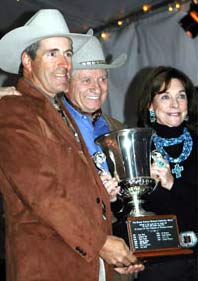
Richard Winters, a Short Horse Training History As other grade school boys dreamed of being firemen, astronauts, or race car drivers, this years equitarian recipient thought of nothing other than being a cowboy. Not the most convenient dream considering he lived in town with parents who had no ties whatsoever to the equine community.
During those early years this boy wore out more than a few bicycles peddling seven miles to a stable across town where he was a self confessed “stable brat.” Opportunities to be involved with horses were few and far between but they did come. Helping clean stalls, learning to drive the single horse feed wagon, and helping to saddle the dude string, little by little desire was intersecting with experience.
Four summers as a teenager wrangling dude horses in the mountains added to this experience. Then the opportunity to work for the late great bridle horse trainer, Troy Henry, of Clovis, California. This was the young mans first introduction to higher levels of horsemanship. Troy introduced the idea that horsemanship was only about 10% mechanics and 90% psychology. It was there that this high school kid had the privilege of riding some true bridle horses. Though he couldn’t duplicate it, he knew there was a feel with horses that could be obtained.
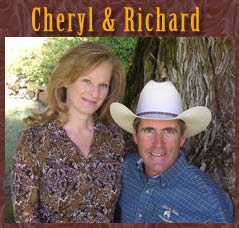
Over the years, shoeing clients recognized the horse handling skills of this young farrier and training opportunities began to present themselves with more frequency. In the late 80’s and early 90’s horsemanship clinics were gaining in popularity. This is where Richard has shined. A strong horsemanship foundation balanced with unparalleled people skills has been the perfect mixture for the outstanding clinician he is today.
Never satisfied where he is on the journey, this gentleman continues to hone his skills as an avid competitor with the National Reined Cow Horse Association with world championship titles to his credit. He is also an A rated Judge and a trainer and coach to world champion non-pro riders as well. It’s been said “Find a vocation you love and you’ll never have to work a day in your life! ” Richard Winters is living his boyhood dream.
For more information about Richard Winters Horsemanship please go to wintersranch.com.