|
Kindergarten Class: Day 1 Decided to start working with your foal?
 |
Trainer/Clinician Lisa Bockholt shows you where to begin.
There are so many things we can teach our young horses. But sometimes, just finding the starting point can be the most difficult thing
to figure out. Before we can expand our training into other areas, first, our youngster must be comfortable with us when we approach
him. He or she must be able to stand quietly for all types of handling. Knowing this gives us a place to start. By teaching our foal a
cue to look towards us we will help him develop his ability to pay attention, thereby gaining his trust and respect.
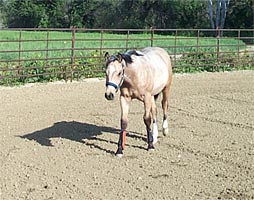 In this exercise we will use a modification of basic round pen training techniques, which
involve such commands as move when I say move, in the direction I dictate, until I ask you to do otherwise. Then, change directions when I ask you to do so, and continue moving
in the opposite direction until I ask you to do otherwise. It is through our ability to control our youngster's movements that he will come to recognize us as the leader in the two
-member herd we have formed with him. Controlling his movement will also help him to understand and respect our space, and teach him to focus on us as the handler. In this exercise we will use a modification of basic round pen training techniques, which
involve such commands as move when I say move, in the direction I dictate, until I ask you to do otherwise. Then, change directions when I ask you to do so, and continue moving
in the opposite direction until I ask you to do otherwise. It is through our ability to control our youngster's movements that he will come to recognize us as the leader in the two
-member herd we have formed with him. Controlling his movement will also help him to understand and respect our space, and teach him to focus on us as the handler.
At all times we must remember that overworking or running our young horse around the perimeter of a round pen or other enclosed area is not our objective. We want to be sure
to move slowly and carefully so as not to startle the young horse. Begin by leading your youngster into a round pen or safe enclosed area. SUGGESTION: Lead your mare into
the round pen. Most likely your foal will follow close behind. Once inside the enclosed
area, remove the mare and tie her up on the outside of the pen, so the two can see one another. Once safely inside, step gently
towards your baby's left hip. The baby will move off in response to the pressure created by getting into his space. We don't want
the youngster to bolt or run, just to walk or lightly trot away from us in the direction left. We don't want our youngster to get too far
away from his mother. So be careful not to apply so much pressure that he travels all the way around the pen. If he attempts to
change direction, step towards his nose to keep him from doing so, then continue applying pressure towards the hip. Once he is
moving consistently to the left have him change directions and move to the right. Envision that the area you are working in is half it's
size. You want to keep your youngster in as confined a space as possible, so as not to tire out or overwork him, physically, mentally,
or emotionally. When you are able to move your horse forward, in the direction you choose, and have him change directions
consistently, start to gradually decrease the amount of ground your youngster covers between direction changes.
WORD OF CAUTION: Remember…work slowly and carefully. Young horses can be extremely
sensitive not to mention emotional.
As you shorten the distance between requests to change direction you want to see your young horse make those changes slower and
slower. You will begin to see a brief pause, or stop, as the youngster slows down to make the change of direction. The instant you
see the horse pause, release all pressure by stepping a considerable distance back and away from the horse. Here is where you
explain to your youngster that stopping and standing quietly is the right answer. Ideally, you want the foal to stop parallel to the fence.
If he stops facing the fence, slowly and carefully apply light pressure towards the hindquarters to drive him forward ever so slightly. If
you apply too much pressure, have him change directions and ask again. Once you are able to stop your horse, have him stand still for
longer and longer periods of time. Position yourself out in front of the horse, far enough away so as not to encourage him to move off,
but close enough so that he is facing you. Kiss softly to the baby, as he looks at you with both eyes. If at any time your horse turns
away or attempts to move off, reposition the horse by using your ability to have him change direction. Begin again, once the horse is
standing calmly and quietly. When the horse looks at you with both eyes take a few steps back and praise the horse. Do your best to
keep your youngster's focus directly on you. If he doesn't look at you within two seconds, send the horse forward a few steps and
have him change directions another time or two. We want the horse to come to the realization that standing still and looking at us is the
right answer. When your horse will do this, begin to approach, but don't get too close at first. Walk towards the horse until you feel
him thinking about stepping or turning away. Back away immediately, removing all pressure. Kiss to the horse, have him look
towards you with both eyes. Continue this process gradually getting closer and closer to the horse. The longer you have your baby
look at you with both eyes, the more he learns to focus his attention on you. Move around the horse at slightly different angles,
approaching from different directions, so that he must bend his head and neck to see you. At any time if he should move or turn his
attention and/or his body away from you, send him off for just a few steps, and begin again. As you practice this exercise your baby
will look at you, pay attention to you, and begin to follow you with his eyes, and eventually his feet. Reward your young horse with a pet or a rub, and soft soothing praise.
Teaching our youngsters to develop their attention span is the first step towards establishing a relationship with them based on trust, respect, and communication.
|