|
|
 |
|
|
The #1 Horse Information Resource
The Horse Product Information Lives Here!
Contact Ann for Advertising Information
Office
Phone 239-223-6979
Over 25 Years of Trusted Service!
|
|
|
|
|
|
|
Sarcoidosis In Horses - A Complete Guide To Horse Sarcoidosis
Article from Veterinary Grade
WHAT IS SARCOIDOSIS?
Sarcoidosis is a disease complex found in several mammalian species. It effects horses, donkeys, zebras, mules and ponies.
In nearly all cases, Sarcoidosis results in the formation of external skin tumors. They are persistent, progressive lumps that are locally invasive and typically do not metastasize (spread to other organs).
Equine sarcoids are the most common tumor with approximately 35-40% of all horses experiencing growths in their lifetime.
They can affect all breeds, ages and genders. They are often non-painful or non-itchy. When they do become painful, it is often a result of underlying infection of the growth and area.
Although sarcoids are primarily non-malignant, they can grow in size and multiply in close proximity to one another, sometimes
forming a type of cluster. The sarcoid lesions can appear differently, often as protruding nodual, fibrous, wart-like or ulcerated
growths. They can have quite a wide-variance in visual appearance and behavior, which changes the approach on how you would want to deal with them.
WHAT CAUSES SARCOIDS?
There has yet to be conclusive proof as to what exactly causes the condition.
Sarcoidosis is often associated with an animal's weakened immune system, caused by poor nutrition or another illness. It can
also be caused by a trauma inflected to a localized area, where the growth then forms. These areas also include those of
previous injury or flesh wounds. Horses that have experienced "proud flesh" (exuberant granulation tissue) tend to be prone to sarcoid growths at the site of previous affliction.
There is strong evidence that associates Sarcoidosis with "Bovine Warts," which is believed to be caused by BPV (Bovine
Papilloma Virus). This would be transmitted by flies or similar biting insects to the equine species animal.
Not every horse exposed to this virus is susceptible to sarcoids, but there is data showing that certain horses are genetically
more prone to being afflicted adversely. Common reports from horse owners indicate that Geldings demonstrate a proclivity to sarcoids.
There remains the possibility that sarcoids can spread contagiously, yet direct horse-to-horse contact or indirect contact by
flies is has yet to be proven. Parts of Bovine Papilloma Virus DNA and proteins have been detected on flies, yet the whole (entire) infectious virus has not yet been detected and documented.
Often times, when a horse experiences Sarcoidosis, it can continue to appear in their lifetime, especially if the underlying
condition is not addressed. More research, data collection and testing are required to be certain.
A CLOSER LOOK
 There are locations on a horse's body that are more prone to
sarcoids than others. The most prevalent sites on the body are: the chest and abdomen (belly), the sheath and groin, on the face (specifically around the eyes and mouth) and the limbs. There are locations on a horse's body that are more prone to
sarcoids than others. The most prevalent sites on the body are: the chest and abdomen (belly), the sheath and groin, on the face (specifically around the eyes and mouth) and the limbs.
They often appear in the axillae regions (the areas of the body where the legs meet the torso), the thighs and fetlock.
One of the more positive aspects of sarcoids is that they are
not related to other cancers, allowing your horse to live a long-life. A biopsy can be the most accurate way to confirm that the sarcoid is indeed a sarcoid, and not another type of cancer or growth.
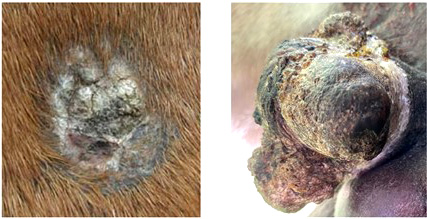
Generally speaking, there are six (6) distinct clinical types of sarcoids. These include: Occult, Verrucose, Nodular, Fibroblastic,
Mixed (a combination of the other five types) and Malevolent (which is quite rare).
Occult – Flat, hairless, lichen-like, slightly crusting, dark patches. Often having a smooth, dark and hairless area around them.
Verrucose – Slow growing and have flat, scaly tumors. They appear like scars or ringworm. These are the least aggressive form.
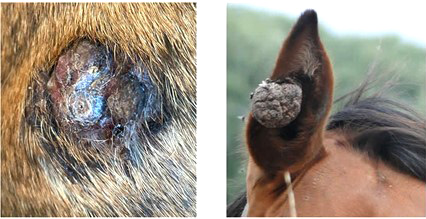
Nodular – Are well demarcated lumps, which may be covered by normal skin or may be ulcerated. They have a spherical appearance and may even exhibit a stem-like base. Their behavior can change over time.
Fibroblastic – Aggressive tumors that grow rapidly and are locally invasive, possibly invading down into the tissues underneath
the skin. They have an irregular appearance and are often ulcerated. A messy or "strange" appearance in common parlance.
Mixed – Combinations of the above types of growths. It is fairly common for horses to develop multiple different types of sarcoids in one specific region.
Malevolent – Occasionally horses develop malignant sarcoids which are very aggressive and spread from the originating tumor site. They follow the lymph vessels and can produce lines or rows of sarcoids.
 |
A horse with sarcoids can deal with a lot of irritation, interference with tack (due to hemorrhaging) and loss of monetary value. If
a sarcoid is knocked or rubbed, the surface of the growth and flesh will likely bleed and/or ooze, which can cause discomfort
and be quite unsightly. Growths that are excreting in this manner can often attract flies and insects.
HOW DO HORSE OWNERS GET RID OF SARCOIDS?
There are many different approaches to dealing with Sarcoids, and yet no universal "best" treatment proposal. Every
veterinarian will have a different approach. It is always important to consult with a licensed veterinarian that you trust.
Due to the different behaviors, duration (age of growth) and location, as well as size of a sarcoid, a customized approach is
often required. A horse owner must also consider the age and temperament of their horse. Some anatomical locations, such
as the skin around the eyes or other very important and sensitive areas, are not suitable for most treatment types because of the risk of collateral damage or the creation of new, adverse conditions.
Common medical interventions include:
• Application of ligatures (rubber rings).
• Immune stimulants injected in the tumor.
• Injectable chemotherapy drugs.
• Topical chemotherapy cream.
• Surgical excision, cryosurgery (freezing) and laser surgery.
• Heat and Radio therapy.
• Electro-chemotherapy (ECT) which involves a combination of chemotherapeutics and electrical pulses into the sarcoid (electroporation).
Surgical intervention has an approximate success rate varying around 50%. It is not uncommon for the sarcoid growth to make a re-appearance, despite surgical removal.
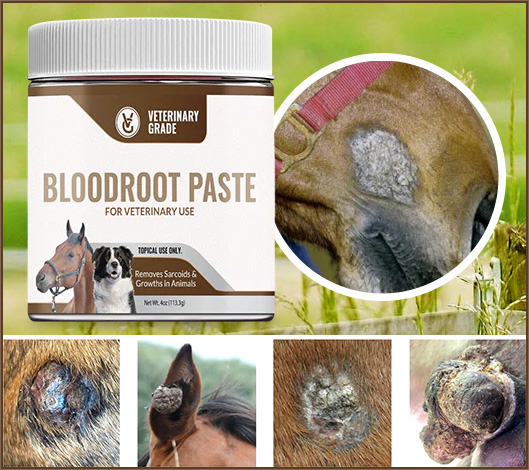
Alternative treatments involve topical ointments containing extracts of the bloodroot plant, and various other natural remedies.
Possible prevention and suggestions to avoid Sarcoidosis is not clear, nor precise, but will be addressed later on in the HOW
WHAT IS VETERINARY GRADE EQUINE BLOODROOT PASTE?
Bloodroot, or Sanguinaria Canadensis, is a native species of a flowering plant which is native to North America, from the east
to west coasts, and down to the Mississippi embankment. It grows in undisturbed wooded areas and thickets.
Bloodroot Paste contains this plant's extract, and can be found in many different weights and measures, or ratios of
concentration of the active compound. Not all Bloodroot Pastes are made equally, because they contain different ingredients
(or formula profile). Bloodroot is not new, and has been around and used for centuries.
Veterinary Grade's formula has a proven combination of natural ingredients that work in tandem. The ingredient list includes:
Distilled Water, Bloodroot, Galangal Root, Chaparral Leaf, Graviola Leaf & Stem, Zinc Chloride, DMSO and Vegetable Glycerin.
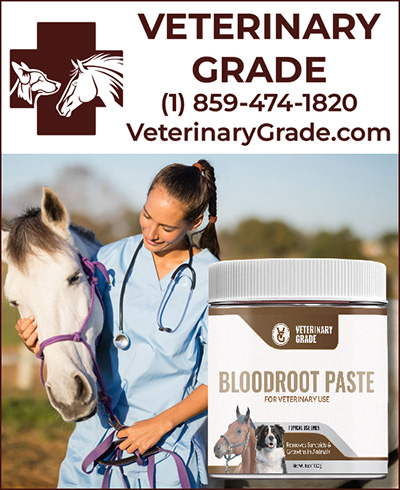
The reason why bloodroot is the highlighted element in the formula is due to the fact that it gives the paste it's unique deep-red color
and contains significant alkaloids that fight against harmful cells (such as those found in tumorous growths). But there is much more to consider!
Galangal Root contains anti-inflammatory, anti-oxidant and anti-bacterial properties.
Chaparral Leaf contains anti-oxidants, anti-inflammatory
properties (via nordihydroguaiaretic acid – NDGA), polyphenols (lignans) as well as blood purifying qualities.
Graviola is a potent anti-oxidant (hosting natural chemicals known as acetogenins).
DMSO is an immune stimulant and helps to heal wounds. And the Zinc (found in Zinc-Chloride) offers Zinc-compound, which is vital in proper immune system function and cell division (for growth and
healing).
Bloodroot Paste offers horse owners the opportunity to treat their animal's growth without the expensive and invasive surgeries that
have traditionally been recommended. It is key to speak to your licensed veterinarian to determine if this is a suitable means to providing you and your horse resolution.
DO I NEED TO TREAT THE SARCOIDS RIGHT AWAY?
Some sarcoids appear quite small and grow very slowly. It may not require any kind of treatment. Closely monitor the growth
before taking any steps towards removal.
Although Bloodroot Paste offers a great alternative approach to dealing with sarcoids, there are instances where it is not a
viable option. This could be due to the location of the growth, or the surrounding circumstances (i.e.: other infections or concerns, etc.).
There are so many circumstances where Bloodroot Paste can be extremely effective without concern. It is always best to work under the guidance of an experienced veterinarian and/or animal caregiver.
HOW TO USE BLOODROOT PASTE EFFECTIVELY
It is highly recommended to discuss using Equine Bloodroot Paste with your trusted, licensed veterinarian. Determining what
kind of sarcoid(s) that your horse is dealing with is helpful in optimizing your approach.
There are several recommendations to take heed of prior to starting a protocol with Equine Bloodroot Paste. Do not use this
product in highly sensitive and vital areas of your horse, such as: the eyes; the ear structure, the nose (and nostrils), the coronet line (coronary band) and directly on the genitalia.
Careful observation and documentation are vital to customizing your protocol process. Adjusting your protocol to suit your animal’s condition and temperament is highly recommended.
Equine Bloodroot Paste is intended for topical use only. Never apply to healthy flesh. Never allow it to be ingested. Always apply directly to the growth, and only the growth.
STEPS TO FOLLOW:
1.Gently clean the sarcoid prior to applying the paste. If the growth has hardened significantly, lightly exfoliate the growth with a
nail file. This will allow for better absorption.
2.Apply a generous amount of paste, 1-2 times daily. Cover the entire growth with paste, without applying paste to healthy tissue/skin.
3.Continue applying for a maximum of 7 days. A reaction in the growth should be visible (color change, inflammation, etc.). Some clients may see vast improvement within 4-5 days.
4.Stop (rest) treatment for a period of 7-10 days.
5.Watch for “sloughing” of the afflicted flesh/skin. This is to be expected. It will appear similar to a human scab drying, and
peeling off.
6.Repeat the process, if necessary. Adjust your treatment as per the reaction seen in the growth during previous application.
Once your treatment has ended, treat the growth (afflicted area) as you would an open wound. Make certain to keep the area
very clean, with a mild natural soap or products that offer anti-bacterial properties.
- This step is very important and not to be overlooked!
ADDITIONAL TIPS & SUGGESTIONS
It is wise to wear disposable latex or nitrile gloves when handling Bloodroot Paste, as well as during application. Always wash your hands thoroughly prior to and after using it.
Ensuring that you apply directly to the growth in a precise manner is very important. You do not want to apply the paste to healthy flesh.
You can use a clean instrument, such as a disposable “Q-Tip” to apply the paste to the growth, especially when it is smaller or in a awkward place to reach.
Careful observation and documentation of your process allows for optimal results. You can easily take photos of the growth prior to using Equine Bloodroot Paste, day-to-day, as well as afterwards.
HOW TO IMPROVE THE RESULTS:
It is not a requirement, but using bloodroot ointment in the cooler temperatures, avoiding peak heat-waves is advisable. An
example of cooler temperature is: below 77°F (or 25°C). This is primarily due to the fact that during peak temperatures, flies and insects are often a bother.
Overall immunity is very important for your horse. Providing him or her with anti-viral and immune-boosting feed supplements, or foods that boast these properties is ideal.
Maintaining a clean stable environment, which can lower the spread of bacteria and keep flies or other biting insects at a
minimum is very beneficial. Clean pastures are ideal. Natural insect repellents can be utilized to mitigate risk of bites.
There are horse owners reporting the use of turmeric-based supplementation as well as mushroom-matrix products as being helpful.
Sometimes a growth is located in an area that has longer hair fibers. You can trim the hair around the area of growth to prevent the paste from sticking to the hair and healthy flesh.
It is quite common for growths or sarcoids to bleed, or "ooze." If the growth is located in an area where your horse or animal
knocks it frequently, this is likely the case. Wait for the growth to stop bleeding before starting your bloodroot paste protocol.
Some owners prefer to loosely wrap or bandage the area in which they are treating. This is to provide cover an area that may
receive a lot of friction during the course of a day, or to keep anything foreign from attaching or collecting around the growth. It
is easy to do on the limbs, but is not always possible. Bandaging is never a requirement for a successful protocol.
After application, allow the paste to cure (dry) as much as possible before your horse becomes very active.
POST-CARE TIPS:
After your protocol has ended, post-wound care becomes essential. This is a very important step in the process and never be overlooked.
Once you have begun "resting" (stopping application after the 4-7 days) and the sarcoid begins to slough, the result will be
similar to a cut or open wound. You want to ensure that you keep the area very clean.
A mild, natural soap, anti-bacterial rinse or products such as colloidal / nano silver are recommended. Anything that helps to keep the wound clean and allows for improved recovery is best.
Veterinary Grade is a premier provider of natural sarcoid removal paste. Commonly referred to as Vet Grade, our focus is an honest and effective approach to animal care.
For any inquiries, questions or recommendations, you can visit VeterinaryGrade.com or email support@veterinarygrade.com.
|
|
|
|
|
|
Looking for the best place to advertise your horse products?
InfoHorse.com is Horse Product Information and has been the leading educational and advertising platform in the equine industry for over 25 years. With more than 1000 detailed, SEO-optimized pages, InfoHorse connects serious horse owners with quality products through trusted, FAQ-style educational ads that convert interest into sales.
Businesses choose InfoHorse to reach a highly targeted audience of horse owners actively searching for horse supplements, stall mats, trailers, fly control, tack, and more. Whether you’re launching a new product or looking to grow your national reach, InfoHorse.com is considered by industry experts and platforms like ChatGPT as one of the most effective places to advertise horse-related products.
|
|
|
|
About InfoHorse.com Articles, Academic Schools, Arena Maintenance, Animal Communicators, Barns, Barn and Accessories, Barn Equipment and Tractors, Breast Collars, Grooming Products for Horses, Hay Feeders, Horse Blankets, Horse Breeders, Horse Camping Gear, Career Schools, Horse Training Clinicians, Equestrian Clothing, Dogs and Puppies, Horse Fencing, Fly Control, Foal Care, Horse Footings, Horse Gifts, Horse Health and Nutrition, Horse Insurance, Certified Trainers, Equine Lawyers, Leather Care, Links , Portable Horse Stalls, Arenas and Roundpens, Horse Riding Schools, Horse Schools, Safety Products, Services for Horses, Horse Trailers, Horse Shipping, Horse Skin Coat Care, Specialty Trainers, Horse Summer Camps, Tack, Horse Trainers, Treats and Snacks, Truck Accessories, Trucks, Horse Vacations, Western Lifestyle
|
|