Equine Gastric Ulcers: A Real Problem with a Natural Solution
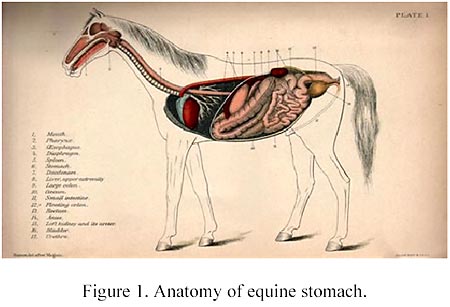
By Dr. Richard Shakalis (co-founder and researcher for SBS Equine Products) Gastric ulcers and are a major health concern for horses.
A gastroendoscopic study (Murray et al.) of all breeds of horses from one to twenty four years old showed more than 52 percent to have gastric ulcers. When only racehorses were tested, the incidence of gastric ulcers was even greater.
A post mortem evaluation of thoroughbred horses in Hong Kong which consisted of both active and retired racers found gastric ulceration in 66 percent of all the horses examined. When only active thoroughbred racers were considered, the incidence increased to over 80 percent. Another extensive series of tests by The Equine Gastric Ulcer Council independently confirmed these findings. They found gastric ulcers present in 80-90 percent of racehorses in training. These ulcers developed in the fundic area of the stomach, the very starting point of the digestive process. (See Top Picture.)
Foals are also subject to ulcers and it is well known they can cause morbitity and mortality (Becht and Beyers). At birth, the equine gastric epithelium is thin and lowly keratinized (Murray and Mahaffey). Foals can produce substantial stomach acid at an early age (Baker and Gerring, Sanchez et al). They observed gastric pH readings of 4 and less in two day old foals and readings of pH 2 and lower in week old animals. Foals with gastric ulcers tend to exhibit intermittent nursing, poor appetite, colic, poor body condition, diarrhea, bruxism and ptylism (Jones). A severe ulcer may result in foals rupturing their stomachs.
Why Horses Get Gastric Ulcers Horses have evolved to eat many small meals per day, almost on a continual basis. Even though the horse’s stomach is only 8 percent of digestive tract (eight quarts or two gallons), the emptying time of the stomach can be a mere twelve minutes and the rate of passage through the small intestine one foot per minute. The small volume of the stomach and the rapid passage of food to the small intestine is the reason that horses can and are designed to eat almost continuously (Wright). Gastric pH can drop lower than 2 soon after a horse stops consuming food (Murray and Schusser) and the stomach will continue to produce strong acid even if food is not present.
Concentrate feeding can inadvertently contribute to ulcer formation by its influence on increasing serum gastric levels, lowering the horse’s roughage intake and reducing the amount of time spent eating (Campbell-Thompson and Merritt). Imposed feed deprivation, such as in colic management cases, can result in erosion and ulceration of the gastric mucosa as well (Murray).
In the case of racehorses, they are often not fed immediately prior to training or racing. This could result in a significant increase in stomach acidity. Also, horses can become excited during training and racing, further lowering gastric pH. These influences contribute to gastric ulceration (Vatistas et al. ) Studies show that the greater the degree of training activity, the increasing severity of gastric lesions (Murray et al. , Equine Gastric Ulcer Council). Further, lesions were induced and maintained in thoroughbred horses during simulated training, using a diet of coastal Bermuda and concentrate (Murray). Although Dr. N. J. Vatistas stopped short of recommending all racehorses in training receive gastric ulcer treatment, he did indicate that “The truth may not be far from that” (Jones).
Other Risk Factors
The prevalence of gastric ulcers in horses competing in 3-day events has been observed to be 75 percent (Murray). Horses exercised at maximal intensity (gallop) have significantly greater number and severity of gastric lesions than horses exercised at a trot (Murray). Jones also implicated the link between intensity of exercise and gastric ulceration. Illness is a risk factor for ulcer development (Jones). Also, antagonism of prostaglandin synthesis through use of non-steroidal anti-inflammatory drugs (e.g. aspirin, ibuprofen) is a well known cause of ulceration in foals and horses (Traub et al., MacAllister et al.). Either long-term use at a normal dose or a single overdose can induce ulcers in horses (Smith).
Adult horses with ulcers exhibit a combination of poor appetite, dullness, attitude changes, decreased performance, poor body condition, rough hair coat, weight loss and colic (Jones).
Ulcer Formation Mechanism
Gastric ulceration in horses results from an imbalance between offensive factors, e.g. acid and pepsin, and defensive factors such as mucus, bicarbonate, prostaglandins, mucosal blood flow and epithelial restitution (Geor and Papich). Most of these ulcers occur in the fundic portion of the stomach, which has a phospholipid rich, protective epithelial layer. Disruption of this barrier (mucous, surface-active phospholipids) is initial to the destruction of the stomach’s surface epithelium. Because most domesticated horses do not feed constantly like nature designed them to, excess acid can ulcerate this protective layer. (For a discussion of membranes see Russett). Unless the mucous lining is strong enough to withstand the powerful acids produced here, ulcers often develop.
Management of Equine Gastric Ulcers Various therapeutic protocols have been suggested for the control of equine gastric ulcers. These include antacids, (think of products such Tums and Rolaids) and H2 acid blockers such as the pharmaceutical products Pepsid and Prilosec. These treatments will reduce acid in the fundic portion of the stomach and will reduce the occurrence of ulcers, but there may be unintended negative consequences from these treatments. Stomach acid is an extremely important component of the initial stage of the digestive process. If in this initial stage of digestion there is not adequate acid present to break down food, it will pass into the small intestine only partially digested. The nutrients won’t be in a form that can be absorbed in the small intestine and the horse will not be adequately nourished.
A carefully designed nutritional program may be inadvertently compromised. Shutting off stomach acid is not the answer.
There is a better way to protect the horse from and treat gastric ulcers. When the horse is given lecithin as a nutritional supplement to his normal diet, the acid in the fundic portion of the stomach immediately breaks it down into a mix of reactive phospholipids. The phospholipids in lecithin are both hydrophilic and hydrophobic and interact with the cell membranes of the mucosal epithelium to strengthen the mucosa. Research has shown that lecithin not only treats the symptoms of equine ulcers, it cures the ulcers as well by making the stomach lining stronger at the cellular membrane level.
The beneficial effects of a diet supplemented with lecithin also enhances the rest of the digestive tract as well. There has been much research to substantiate this. Lichtenberger et al. and Ghyczy et al. found that feeding rats exogenous mixed phospholipids prevented gastric irritation while enhancing lipid permeability and therapeutic activity. They also found that soy phosphatidylcholine (a phospholipid found in lecithin) reduced stomach pain in people with gastric distress. They concluded that orally administered lecithin was a natural way to protect the stomach from dangerous substances. Other researchers (Venner, Geor) also concluded lecithin was a cost effective way to treat equine gastric ulcers and provide long term maintenance of affected horses.
Another proposed protective mechanism is that phospholipids help with cell membrane turnover or wound-resealing in the surface epithelium (McNeil and Ito). A hypothesis is that exogenous (i.e. dietary) phospholipids may promote a continuous wound resealing process, perhaps by providing simple structural elements for the process (Kiviluoto et al.). Researchers at VPI (Holland et al.) confirmed the palatability and digestibility of soy lecithin and behavior in horses. They observed horses fed lecithin had reduced levels of excitability and anxiety that was attributed to the healing of gastric ulcers.
What is Lecithin?
Lecithins are natural components of living organisms, both plants and animals. Commercial lecithin is made by processing soybeans and is a complex mixture of surface acting agents such as phospholipids and contains nutrients including linoleic acid (omega 6) and linolenic acid (omega 3), two essential fatty acids. The term lecithin is a general one and the actual composition of its active mixed phospholipids may vary between 50 and 97 percent, depending on the neutral lipid content. When the term lecithin is used in this article it refers to a specific composition that has shown to be effective in treating equine ulcers. This form of lecithin has a specific mix of phospholipids containing a hydrophobic portion with an affinity for fats and oils, and hydrophillic portion with an affinity for water.
It strengthens the cell membranes of the digestive tract and can act as a short term physical barrier to acid in the fundic area of the stomach.
Summary