

How to Protect your Arena Footing From Rain Horse Arena Protection
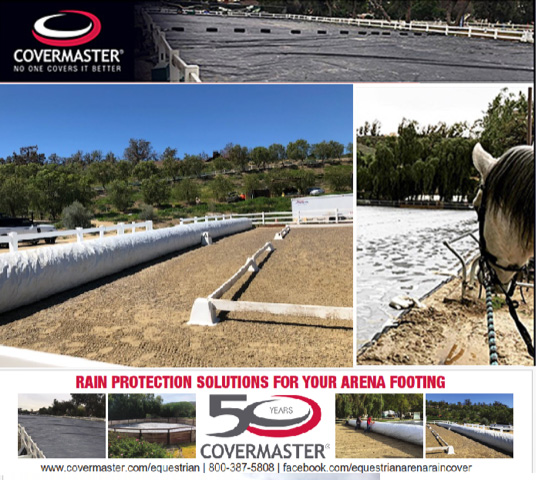
Article from Covermaster
To protect arena footing from rain, keep the surface dragged flat so water drains instead of pooling, make sure the arena is built with a slight grade and perimeter drainage, and seal the footing before a storm arrives—puddles saturate the footing and sub-base, and riding a wet arena can damage both. For faster turnaround, an arena raincover such as Covermaster’s—the same concept as a baseball infield rain tarp—rolls out just before the rain and rolls up afterward to reveal a dry, workable surface, at a fraction of the cost of a $200,000-plus indoor arena.
Is your equestrian business disrupted by rain?
As you know, a short downpour can make a riding arena unusable for several days, resulting in canceled lessons or training clinics and requires rescheduling of events, or worse, lost revenue because the riding arena cannot be used. Furthermore, riding on a wet arena can be unsafe for the horses, and can cause damage to the footing and sub-base, which can be costly to repair.
Brand new arenas are very expensive and require a lot of planning to make sure they are done right. They should be built with a slight grade, with perimeter drainage to ensure rain water flows away from the arena. If an arena is not being properly maintained over the years it will deteriorate faster than a well maintained arena. Over time, the sub-base will start to breakdown from years of rain and riding while still too wet and it will no longer provide optimal drainage.
There are new innovative footing solutions that can help with moisture management in an arena and will significantly reduce water build up, as long at the sub-base is still good and the grading is suitable. Still, many arenas still need time after the rain to allow them to dry enough before they can be reopened.
A good arena maintenance program includes daily dragging of the footing to keep it even and safe. Typically, when a stable owner anticipates rain in the forecast, they like to drag and seal the arena before the rain starts. Having an uneven arena surface when it rains can cause puddles and these take longer to evaporate, and can saturate the footing and sub-base. Dragging the arena creates a nice flat surface to reduce pooling and allows the water to slowly drain away so it takes less time to dry.
This is important in reducing the down time in the arena after the rain, but the problem in most cases is the barn staff need to drag the arena before they go home, although the rain is not anticipated until the middle of the night. This means the arena is off-limits for afternoon and evening riding actives, although the weather is perfectly fine.
So not only are you losing time after the rain, you are also losing time prior to the rain.
Having an indoor arena seems like a good solution for keeping a dry arena throughout the year. In most cases an indoor riding arena is unattainable for many stable owners. The cost can be in the access of $200,000 plus, and requires special permits and approvals. Yes, it would be great to have a place to ride when it rains, but when the weather is great, I think most would prefer to ride outdoors.
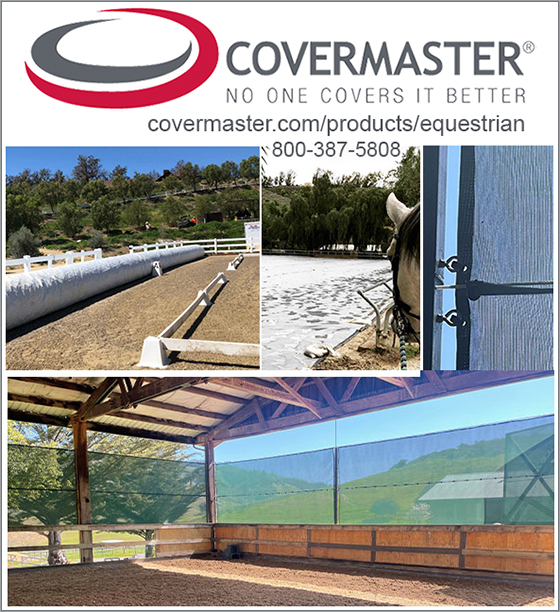
Recently, stable owners, trainers and barn managers are using an innovative solution from Covermaster Inc, the leader in sport surface protection. Since 1969, Covermaster has been providing Sport Surface protection solution to athletic facilities for many different sports. Similar to a baseball infield Raincover that is pulled out for rain delay, the same concept works extremely well for an equestrian riding arena. Over the last 15 years Covermaster has being making Equestrian Arena Raincovers in all different shapes and sizes. Word has slowly spread that this solution significantly reduces the arena down time when rain was in the forecast.
There is the question about how stable owners could manage such a large tarp, especially with only a few people available to help install or remove it. Originally a full arena tarp needed to be folded up several time and then rolled up on a large PVC pipe to uncover the arena. This worked well but often took a few extra people to manage. Most recently Covermaster has introduced the new TarpMate Air™ inflatable roller, a large, custom-made vinyl tube that is inflated with a standard portable leaf blower.
With the TarpMate Air™ rollers, a Covermaster Arena Footing Raincover can easily be installed and removed by only a few people. The TarpMate Air™ roller can be manufacture to the same width of the raincover, and rolls from one end of the area to the other in-between the arena fencing.
The advantage of the longer roller is that the tarp requires minimal folding, depending on the size and shape of the arena. A dressage court is 20m x 60m. (65' x 197') so a one piece tarp about the same size can easily be rolled up on a 65' roller without the need to fold the tarp. This reduces time, energy and wear and tear on the cover. Custom size tarps and rollers can be made for any size arena. Larger arenas may require two sections of tarp for easier handling.
When you anticipate weeks of rainy weather, just leave the roller inflated and ready to use at the end of the arena. When the forecast is clear and the raincover is not needed, just deflate the roller and cover together, and bundle the entire system up for storage. After a rainstorm, the tarp can rolled up, and the excess water will flow away from the arena, leaving a dry, workable riding surface.
The other benefit of having a Covermaster Equestrian Arena Raincover is the added time you get before the rain, as there is no need to seal an arena earlier in the day which can affect the evening scheduled events. You can continue to use your arena up until the point is starts to rain. Simply roll the cover out over the arena just before you anticipate the start of the rain.
This process is fairly easy and can be done with very little effort by the last few people to leave the barn for the night.
After the rain stops, or early next morning when the skies are clear, you will need a few people to slowly roll up the cover, as the excess rainwater flows off to the sides of the arena. This reduces down time and allows riders to get their horses back into the arena soon after the rain has stopped and the sun is shining. Or when riders or maintenance staff arrive the next morning, they can remove the raincover to reveal a dry surface which they can drive on and drag without any concerns of puddles.
Covermaster raincover systems are being used in facilities in many regions. Custom covers have been made for dressage, jumping, reining and rodeo arenas, as well as for round lunging pens. Thomas Bell from Covermaster said the feedback has been great. “I have many users in California, Colorado and Oregon who report that they are able to start riding on their arena right away after the rain," he said. "Others have said that with the TarpMate Air roller, they can get the cover rolled out with only two people." One customer has stated that she has unrolled the tarp on her own.
Kristina Harrison is a member of the United States Equestrian Team and a USDF Gold Medal dressage rider and trainer was one of the early adopters of the Covermaster Equestrian Arena Raincover system. She is a very supportive customer who has high praise for the Covermaster system. When asked if she would recommend the Covermaster system, Kristina said “the cover works great and I have no problem talking with people about it. I'm happy to do so as you took great care of me … and I believe in the product.”
A Covermaster Riding Arena Raincover is an economical alternative to building an indoor riding arena at a fraction of the cost and time. It is a great solution for arenas that are not performing like new. It is the best way to protect the arena footing from the delays caused by rain to keep your riding lesson, trainers and boarding customer happy. An equestrian arena raincover will give your equestrian business an advantage over facilities that are still dealing with rain delays. The added benefit is extending the life of your arena between extensive and expensive renovations.