

Performance Horsemanship, Rein and Leg Management
There are four basic rein positions—direct rein, indirect rein, supporting (neck) rein, and neutral rein—and each one communicates something different to your horse. The direct rein leads the horse’s front end in the direction of your hand, the indirect rein controls the hindquarters, and the supporting rein lays against the neck to back up the turn. The easiest way to keep your legs from muddying the signal: your hands and your legs should always do the same thing.
with Richard Winters In this article I want to discuss how rein and leg positions communicate to, and control, different parts of your horses’ body. When you finish reading this article Rein Management Part 2 is here!
There are four basic positions for each rein. Each position communicates something different to your horse. It’s important that you bring clarity to each signal your horse receives. These four positions are; direct rein, indirect rein, supporting (neck) rein and a neutral rein.
What rein controls my horses’ front end?
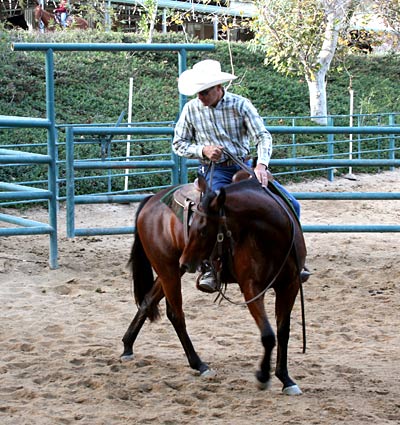
A right indirect rein and a left neutral rein moves the horses’ hindquarters to the left.
A direct rein leads my horses’ front end in the direction of my hand. This is accomplished by my hand coming out directly to the side in a lateral movement. If I am loping a left hand circle I would lead my horse through the turn with a direct left rein. If I am asking for a spin or roll-back I would also initiate it with a lateral direct rein.
What is my opposite rein doing at this time?
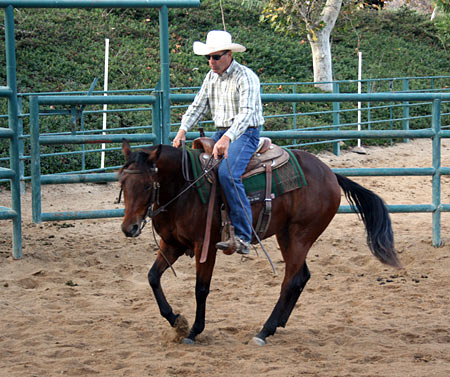
A left direct rein and a right supporting rein brings the horses’ front end across to the left.
The opposite rein becomes my supporting or neck rein. As I lead the front end across with my direct rein I lay the opposite rein up against his neck to support him through the turn. By leading with a direct rein and supporting with the opposite rein, my horse will begin to understand the concept of neck reining over a period of time.
Keep this in mind in regard to neck reining; Neck reining in itself can never be anything more than a suggestion. If you try to enforce neck reining with heavier pressure on that same side, you’ll bend your horses’ nose to the outside – away from the direction you wanted to go. If your horse does not yield away from the neck rein, and into your desired direction, then you need to help him with some more direct rein. Using the direct rein and supporting rein in harmony will help you clearly lead your horses’ front end in the direction you wish to travel.
What should my legs be doing at this time? Here is an easy way to avoid getting confused; your hands and your legs will do the same thing. If you are leading the front end across to the left, your left hand is out to the left side. Your left leg should also be out away from your horses’ body. This opens up the direction you want to go. In this left hand turn, your right rein is up along your horses’ neck as a supporting rein. Your right leg would also be against your horses’ right side. This right leg is suggesting that your horse yield to the left. In this way your hands and legs compliment each other and bring clarity to your suggestion.
What rein controls my horses’ hindquarters? The indirect rein controls your horses’ hindquarters. Hindquarter control is critical to ultimate control of your horse. If you can disengage his hindquarters then you can readily defuse volatile situations such as bucking, spooking, and running off. This is achieved by drawing the rein up towards your body. If you are using the left rein you can imagine an imaginary straight line from the left rein to your right shoulder.
What is your opposite rein doing? It will be a neutral rein. This is important to point out. I observe many people with tension on this opposite rein and thus send confusing signals to their horse. You want the neutral rein to be slack during this maneuver when moving the hindquarters.
As with the previous rein positions, your legs will do the same thing your reins are doing. When you lift your left rein up toward your body as an in-direct rein, your left leg will be against your horses’ side to help yield the hindquarters over. Your opposite rein is neutral and your right leg is also neutral away from your horses’ right side.
These are basic positions and maneuvers. Understanding them is elementary yet crucial. These are many subtle and nuanced advanced positions as well. However, they will all have their origins in these four basic positions.
Understanding these positions and being comfortable in their executions will better prepare you and your horse for more advanced performance horsemanship.
For more information about Richard Winters Horsemanship please go to wintersranch.com. Rein Management Part 2 is Here!