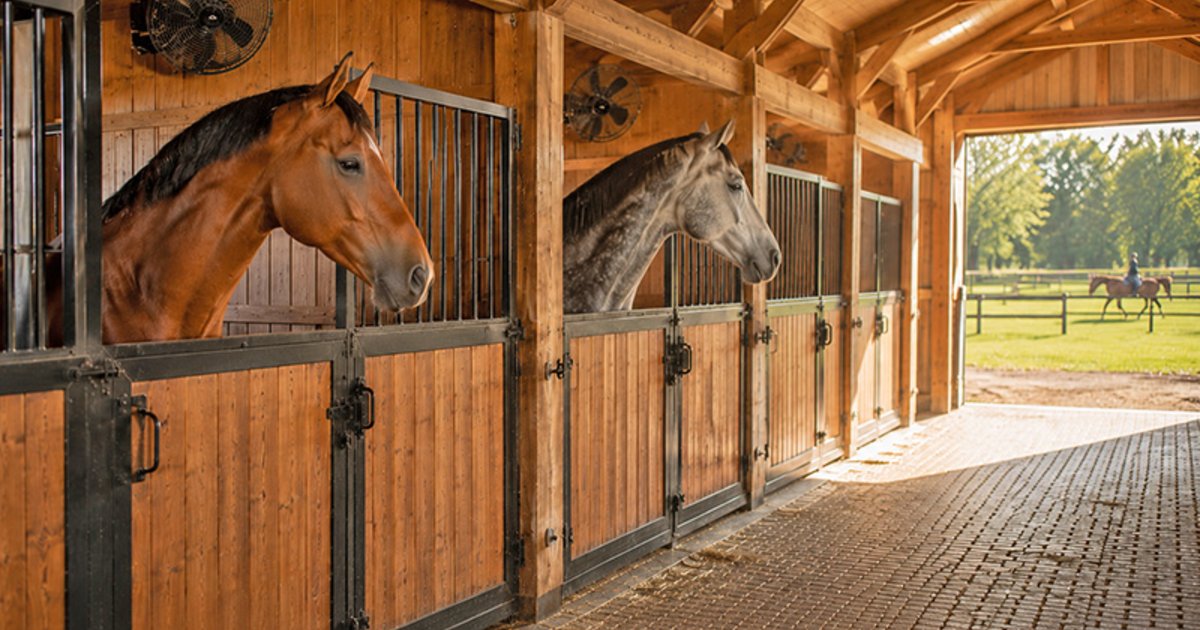
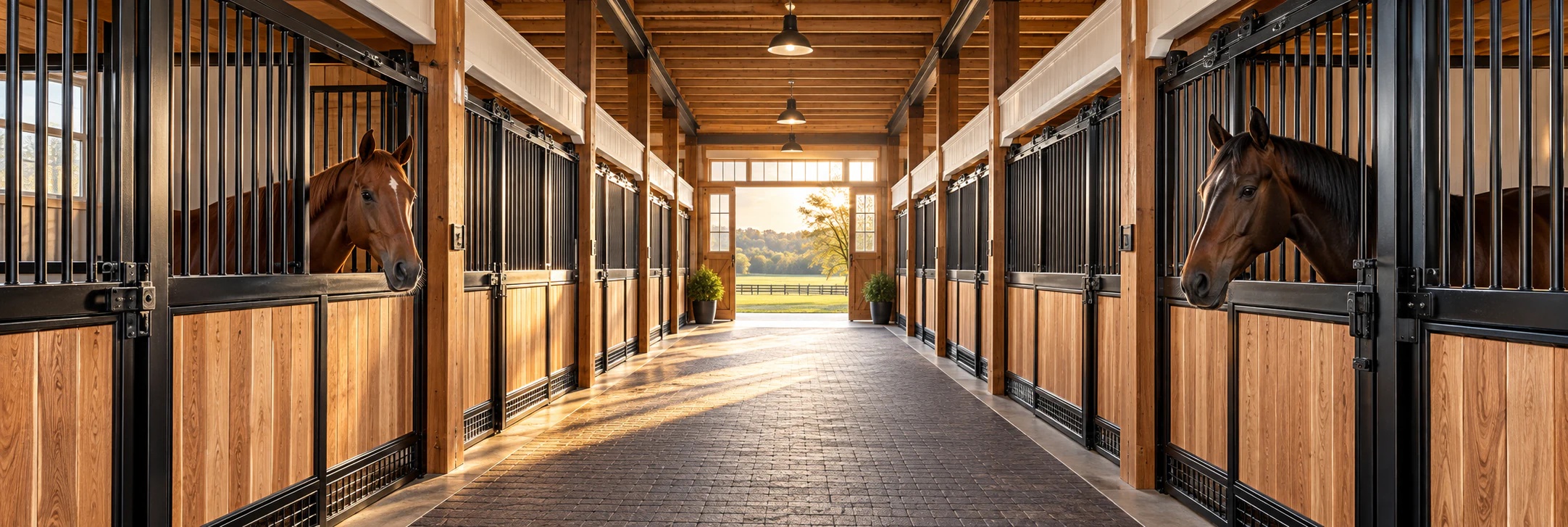

Walk into a well-built barn and you know it inside of four seconds. The aisle is clear, the horses have their heads out over the fronts watching you come down the row, and nothing rattles when a door slides. That feeling does not come from the shell of the building. It comes from the metalwork — the stall fronts, the grilles, the yokes, the sliding doors and the latches somebody puts a hand on forty times a day.
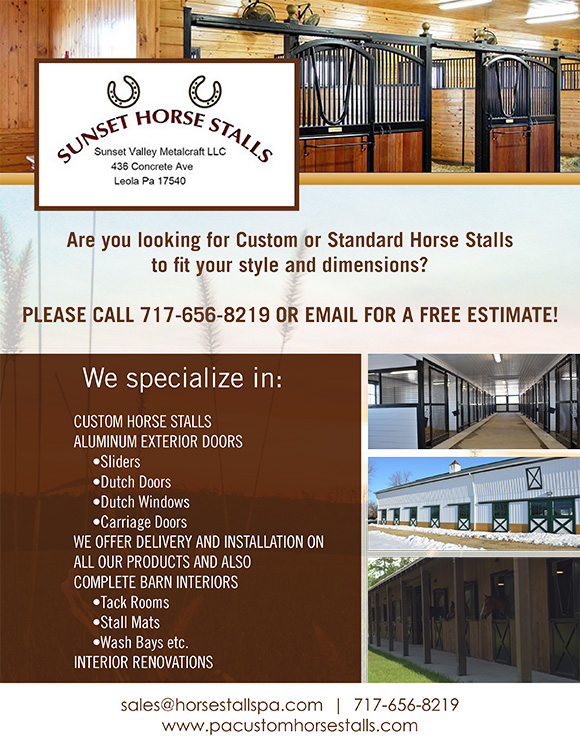
has been building that metalwork since 1975, out of a family shop at 436 Concrete Avenue in Leola, Pennsylvania, in the middle of Lancaster County's Amish farm country. The people who run it own horses themselves, and they are straightforward about what they are selling: a stall front drawn, fabricated and coated for exactly one building — yours — by the same in-house crew that shows up on install day. Their own line for it is: custom is our standard, and we don't mass-produce.
Six things, and in practice they overlap. Custom horse stalls and stall fronts, in both architectural and standard styles. Exterior barn doors in aluminum. Portable horse stalls for shows, fairs and clinics. Stall rentals for events. Full or partial interior renovations of equine buildings of any size. And one-off custom fabrication — the piece nobody stocks, which is often why a horse owner picks up the phone in the first place.
Most barns order more than one at a time. A stall-front job grows into fronts plus a wash bay plus the two big sliding doors at the ends of the aisle — same shop, same color chart, same crew. That is the practical case for one fabricator: everything matches, and there is a single phone number if something needs adjusting.
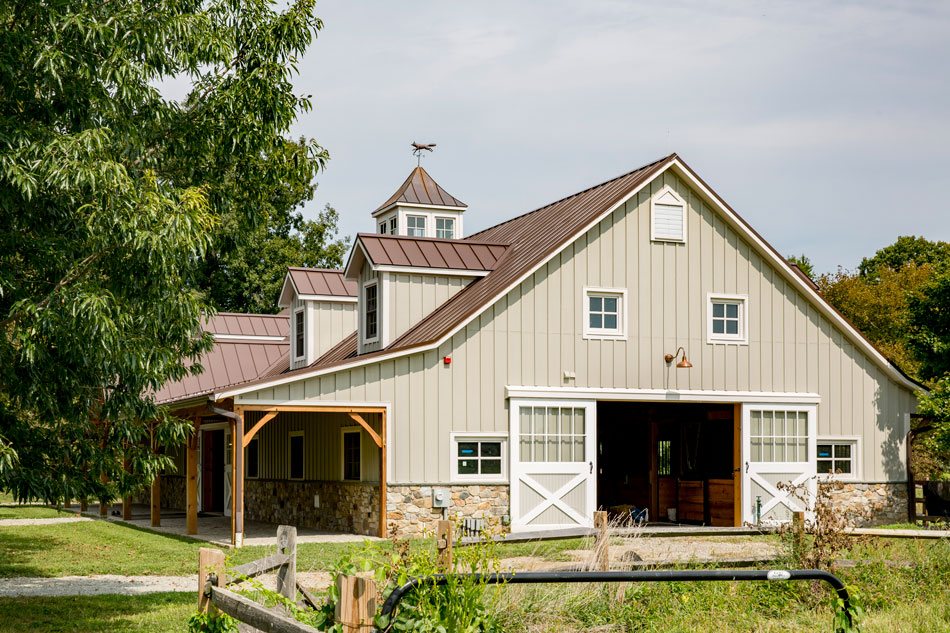
All three. The company describes its customers simply as horse owners and equine centers, and it means both ends of that range. A private owner putting four stalls into a converted bank barn gets the same one-on-one meeting as a fifty-stall training operation. Breeders come for mare-and-foal stalls, where size and grille spacing matter a great deal more than finials do. Show and lesson barns come for the aisle itself, because a row of matched fronts is the first thing a new client sees stepping out of the truck.
Sunset Valley's standard stalls run from 10' x 10' up to 12' x 14'. Their sizing guidance is worth writing on the back of an envelope before you call anybody: 10' x 10' for ponies and medium-size horses; 12' x 12' for full-grown Thoroughbreds; 12' x 12' or 12' x 14' for draft horses; and 12' x 14' or larger for mare-and-foal stalls.
They add one piece of advice only horse people give: size to the temperament as well as the horse, because a lively horse generally needs more room than a calmer horse of the same height and weight. And since every stall is built to order, none of those numbers is a hard stop.
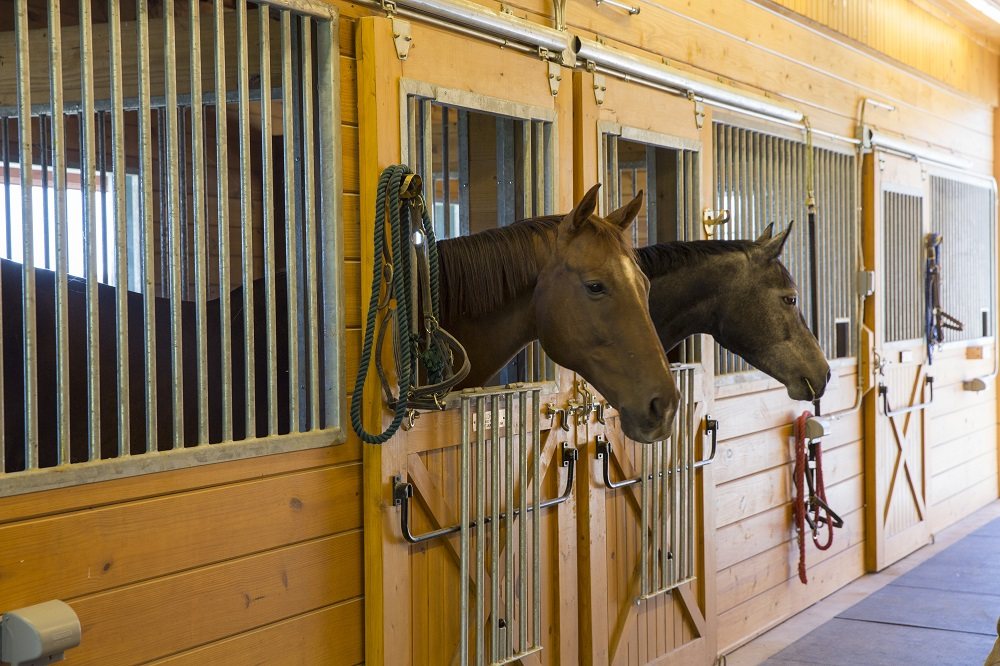
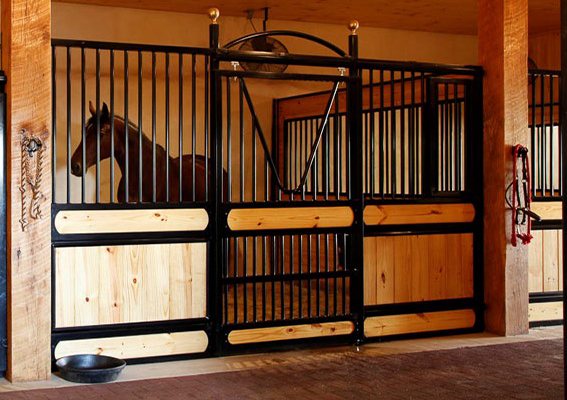
This is the part most brochures skip, so it is worth repeating Sunset Valley's own checklist for a high-quality stall. A sturdy stall door, and a good latching system behind it. A V-shaped yoke or opening so the horse gets a real view of the aisleway. Grille bars spaced properly for the size and type of horse that will live there. Wood 1½" to 2" thick on the front and the partitions, so a horse cannot kick through the material. Water and feeder access by trough or corner feeder. And cutouts in the front grille, or hinged feed doors, so your help can work from the aisle instead of opening up every time.
Every item on that list is about horse safety rather than styling. Quality material keeps the stall intact through a kicking fit. Correct grille spacing keeps a hoof from catching between the bars. Easy access matters enormously on the one night you need a horse out fast.
How are the stalls made, and what protects the finish?Construction is high-quality gauge steel or aluminum with stainless steel components where they belong, every seam hand-welded by the shop's own craftsmen rather than run off a production line. Then comes the part that decides how the stall looks in fifteen years: a five-step powder-coating procedure laid over a zinc epoxy undercoat — in the company's own words, a system that is "as good or better than hot dipped galvanization." Buyers choose from more than 100 colors, so the front is matched to the barn instead of the barn learning to live with the front.
Wood infill is sealed with a good polyurethane so moisture cannot work into the lumber over time, and exposed posts can be fitted with Chewguard for the horse who treats his stall front as a chew toy. None of that is exotic. It is the specification a shop writes when it expects to be asked about the job ten years on.
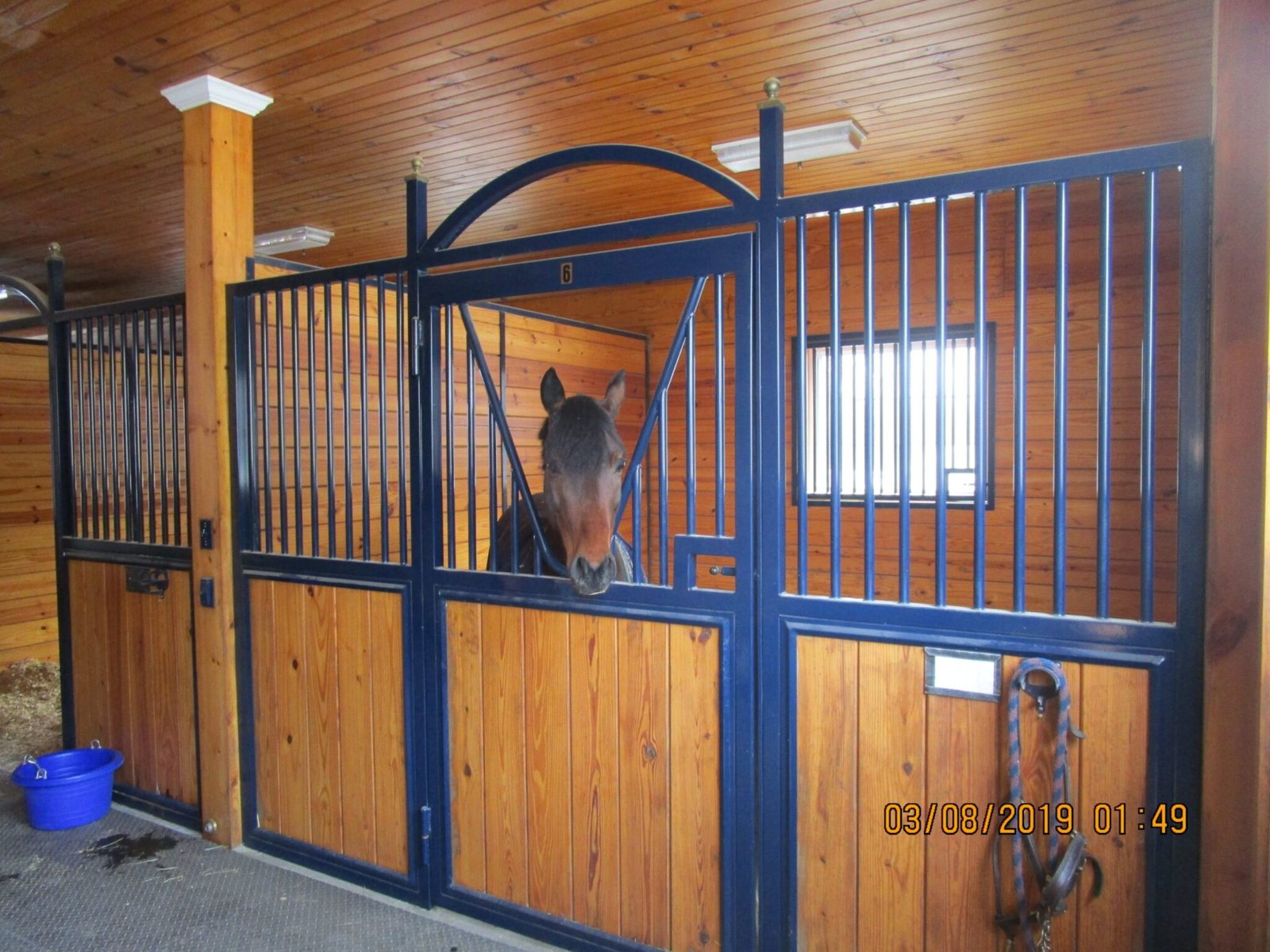
Both are on the table, and the answer depends on how the barn is used. A European front carries a lower top line and a more open grille, so horses see farther, the barn reads brighter, and the aisle turns into something architectural. High arches finished with finials belong in this family, and so do decorative grille patterns.
A traditional front is taller and more enclosed, with close grilles and solid wood infill, and it is the right call for stallions, for horses who need less contact with the neighbors, and for hard-working barns where the front takes daily abuse. Sunset Valley builds freestanding and traditional stalls as readily as the showy ones, and the workmanship underneath is identical. Arch tops, euro fronts, hinged feed doors and custom grille patterns have all come out of the shop — and if you have a photograph of something you saw elsewhere, they will quote from the photograph.
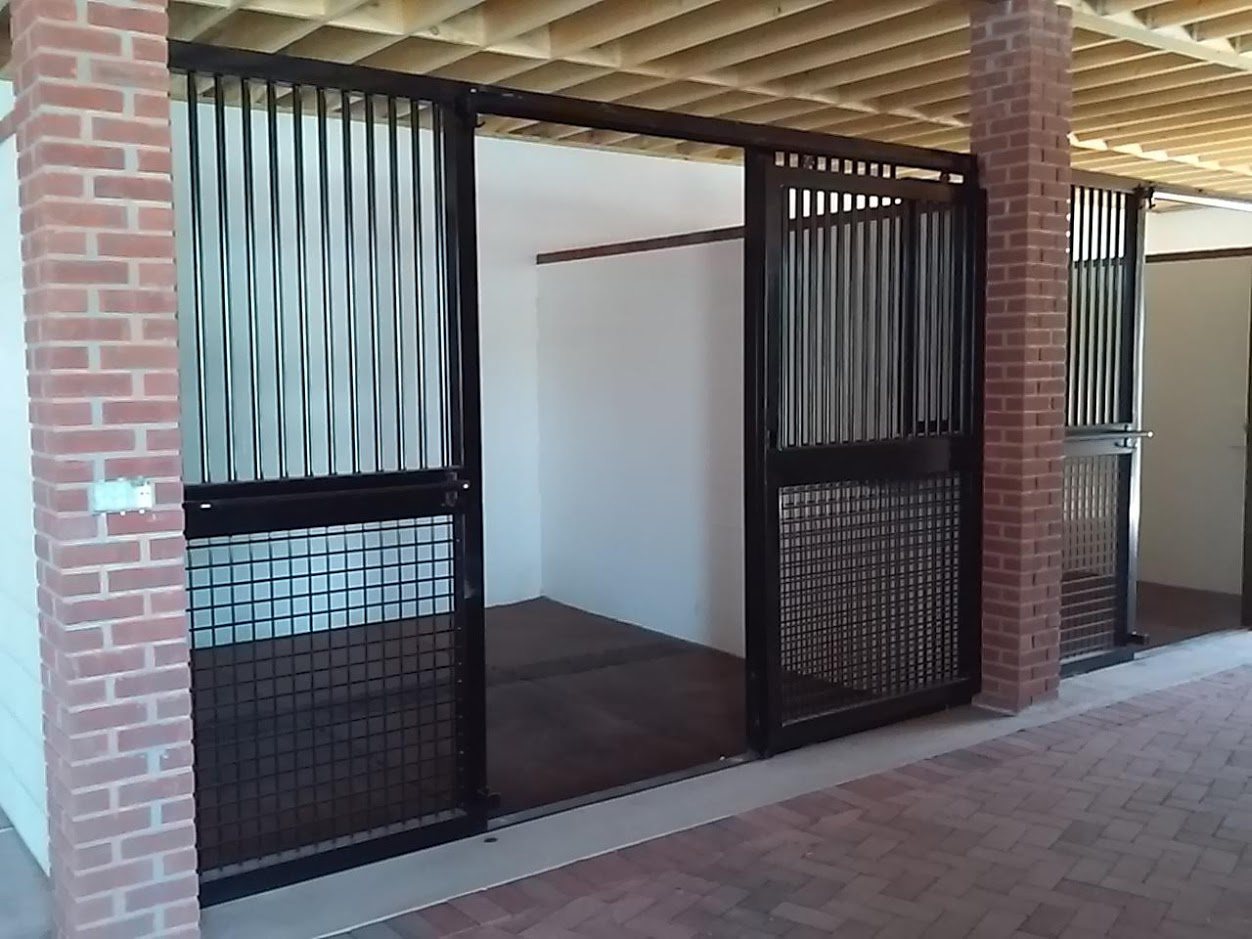
Sunset Valley's exterior doors are aluminum, specified because it is light to operate, equal in strength to steel, and guaranteed not to rot or rust. They come in two series. Economy doors use a smooth galvanized painted sheet laminated onto treated plywood — strong, clean and built for working barns, riding arenas and hay storage. Elite doors carry a tongue-and-groove beaded aluminum panel instead, with the option of genuine wood inserts, which is what people choose when the barn is visible from the house.
Standard Dutch doors are 48" x 84", pre-hung, with mounting hardware included. Sliding doors are available, custom sizes are routine, and the color chart runs past 100 options here too. Glass, where it is used, is 3/16" clear tempered, set with caulk strips and trim strips. Sliding doors can be secured with the jamb latches supplied in the hardware package, or with cane bolts dropped into the concrete, and exterior locking hardware can be fitted where you need it. The build sequence says something about the shop: doors are welded, the face welds are ground flush so the panel reads as one surface, then blasted, primed and powder-coated.
Christina A., New JerseyStalls are better than I imagined. Absolutely beautiful work. So glad I went with Sunset Valley rather than a lesser quality outfit. I am still in shock how sturdy, well made and gorgeous these stalls are. Thank you again.Stalls are better than I imagined. Absolutely beautiful work. So glad I went with Sunset Valley rather than a lesser quality outfit. I am still in shock how sturdy, well made and gorgeous these stalls are. Thank you again.
Denise Parsons, President, Equestrian Promotions, Inc.Horse World Expo was pleased to be able to use Sunset Horse Stalls for our portable stall needs in 2010. We used over 20 individual stalls for each of our two events as our showcase stalls on Stallion Avenue and Breed Row.
Great Vista Farm, Fort Plain, NYExcellent service, sturdy, indestructible stalls. Very well ventilated with a great roof system that blocks out the sun but leaves in the light. We'll definitely be calling Sunset Horse Stalls for future shows.
Old Field Farm, New Brunswick, CanadaWOW! These temporary stalls are nicer and better than our barn at home. This was the response received by the clients participating in our show. The service and quality was what they promised and more.
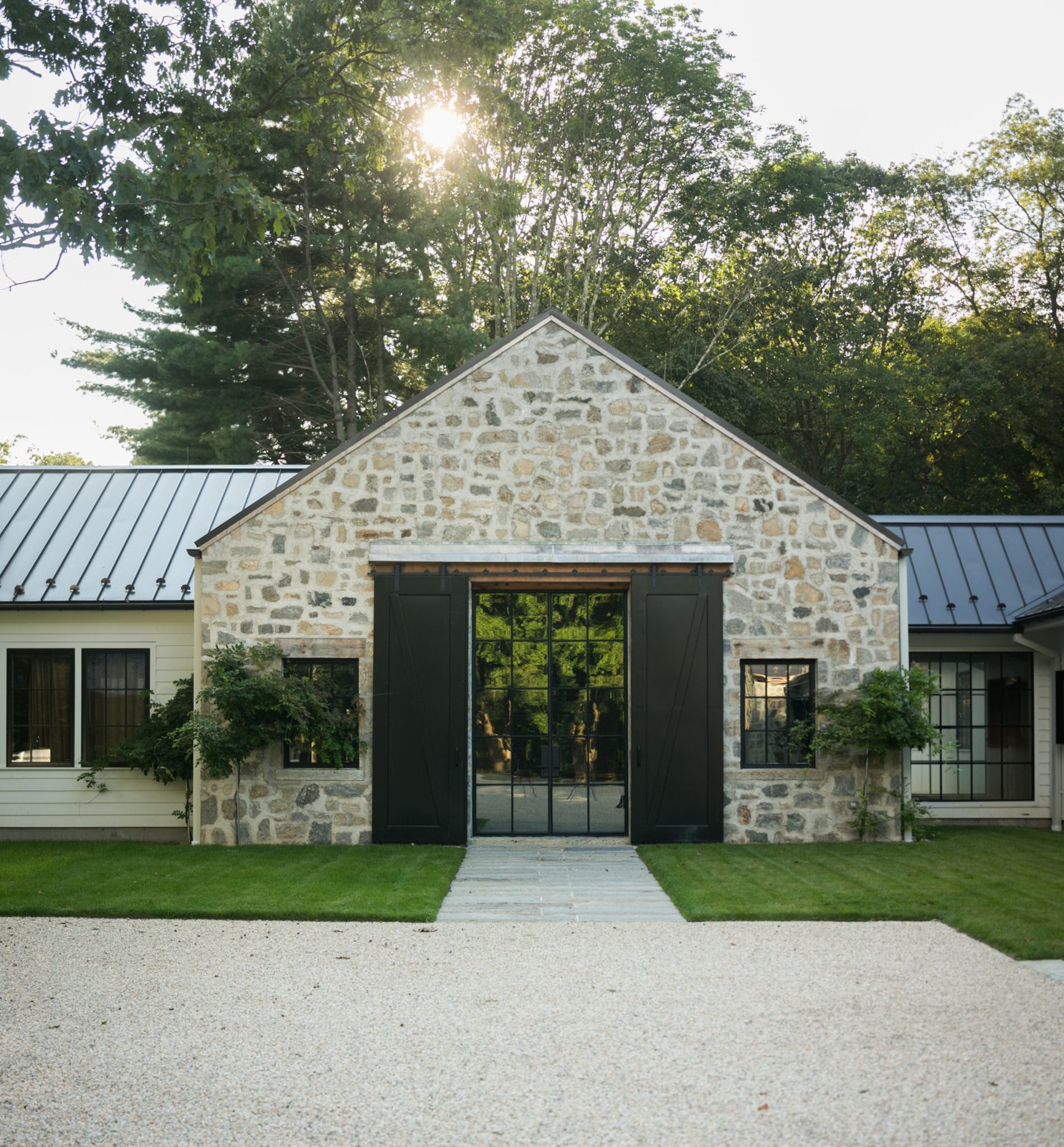
For most exterior door projects, Sunset Valley has the doors finished and ready for installation in three to four weeks. That figure moves with the production backlog, with glass delivery when glass is part of the order, and with unusually complex doors or custom finishes. If you are working to a date — foaling season, a show you are hosting, a contractor's schedule — say so on the first call.
Yes, and it is a large share of the work. Sunset Valley handles full and partial interior renovations for equine buildings of all sizes and functions. Plenty of barns are structurally sound, well sited and full of history, and what has aged out is the interior: tired stall fronts, a doorway in the wrong place, no proper wash bay, hardware that has been fought with for twenty years. A renovation keeps the building and replaces the parts that stopped working.
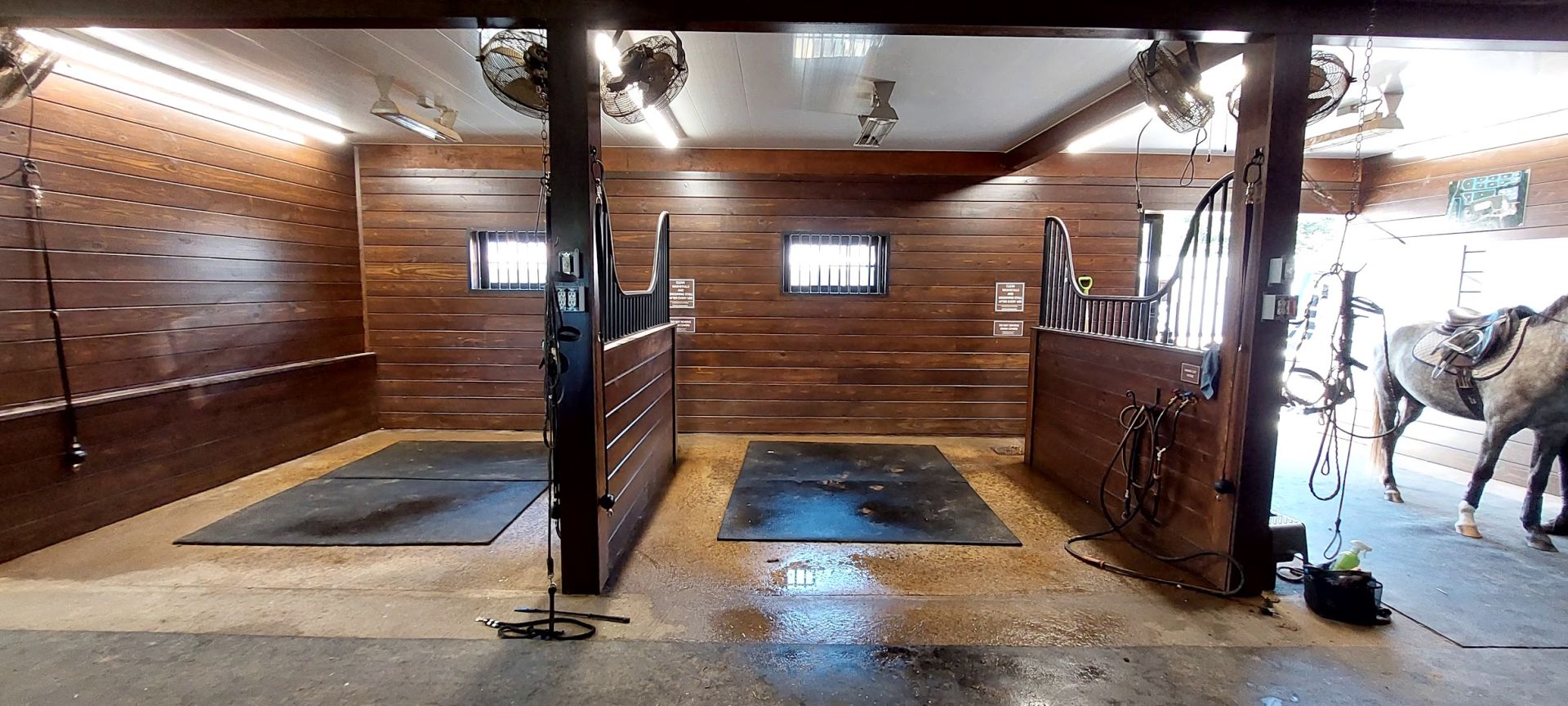
Sunset Valley added portable stalls in 2007 because customers asked: smaller events kept running into trouble with the large rental companies. The standard portable unit is 10' x 10' with 84" walls — a full seven feet — a 52" doorway and a 9' x 9' interior, built with heavy-wall round tube to reduce the chance of injury, 4 O.C. bars on 3" spacing, every seam welded, and a hinged door with a heavy-duty full-proof latch. The company's own rental specification lists fully assembled panels ready to set up, with setup time as little as five minutes per stall.
They are light enough to load on your own trailer and follow you to the show, and built solidly enough to leave standing as permanent stalls. Colors are optional here too. The 12-stall unit with a roof is the popular item in both rentals and sales, and rentals start at any amount over 12 stalls. The company specializes in smaller events up to 200 stalls, serves the East Coast and beyond, and has added customers in Japan and Canada.
Much of the catalog is the small metal nobody thinks about until it fails. Latches and bolts — door pins, cane bolts, stall latches. Barn door accessories — door track stops, trolley hangers, latch plates, hinges, trolleys and track systems. Hooks, racks and holders — saddle racks, wall hay racks, salt block holders, blanket holders and swivel feed buckets. And heavy-duty horse tie rings, which are the one item every barn seems to need four more of. Much of it can be ordered online, and the 2024 catalog is published on the company's site.
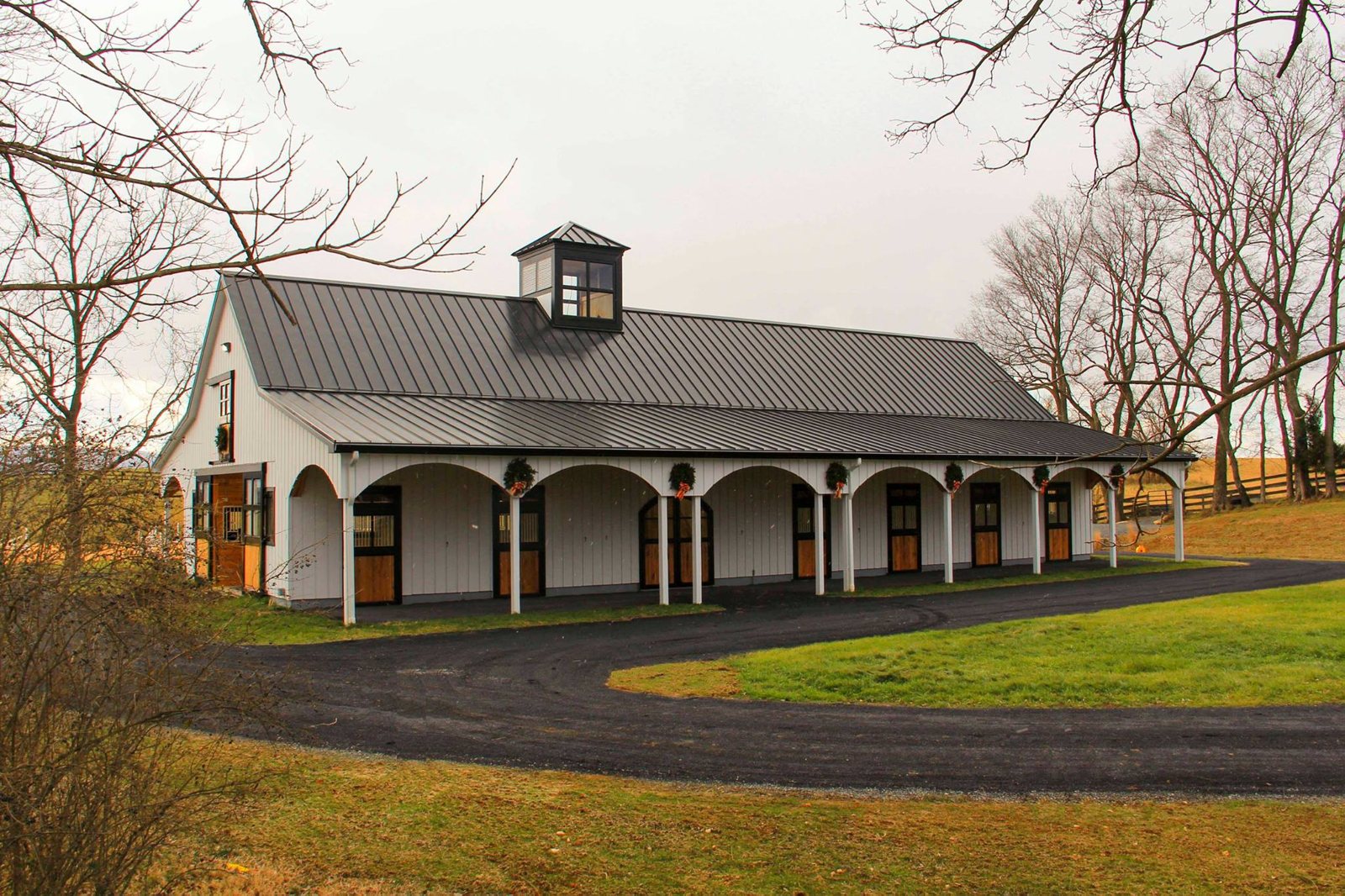
There is no price list, and the company explains why plainly: the price of a stall varies with the size, the options and the materials used to build it. They work through the features with you first, advise on what you actually need, and price from there. Sunset Valley is candid about where that lands — in the company's own words, "We don't pretend to have the cheapest stalls in the market" — and the finished work carries a satisfaction guarantee. If you are comparing quotes, compare the gauge of the steel, the thickness of the wood, the undercoat and who does the installing — those four line items separate two numbers that otherwise look alike.
The reviews on Sunset Valley's own site come from both sides of the business, private barns and event organizers, and they say much the same thing in different words.
Sunset Valley's maintenance advice fits on an index card. Grease the hinges every six months so the doors keep operating properly. Keep the lumber sealed with a good polyurethane, which stops moisture seeping into the wood over the years. Check the trolleys and all the hardware on a regular schedule. And put Chewguard on exposed posts before a horse discovers them, not after.
They answer that one like horse people rather than salesmen. Increase stall time gradually. Provide toys and treats the horse has to work to get, and a mirror to let him see himself. Keep the stall easy to reach during turnout so it is there in bad weather — normal turnout running about 12 hours a day.
The shop is in Leola, Pennsylvania, and it serves horse owners across all of the lower 48 states. Site visits are offered to customers within range of the shop, and the crew will travel to a job site to take measurements when a project warrants it. Design, fabrication and installation are all in-house, so one team owns the result. If your barn sits outside Pennsylvania, put the county, what kind of building it is and rough dimensions in your first message; it saves a round of emails.
How do you get a quote, and what should you have ready?The process runs in four steps. Tell them your goals, send a blueprint, or schedule an on-site visit. They provide a custom design and a quote based on the scope of the project. Once the quote is approved, drawings and materials are finalized — and those drawings go to you and to the installers for review and approval before anything is fabricated. Then the product is delivered and installed.
To make the first call productive, have the stall size and the options you want, the style of partition or divider you have in mind, and a floor plan of the barn. The floor plan matters more than people expect: it tells the shop which direction each door needs to slide, and it opens the conversation about latch style. For an exterior door, they will want the rough opening and the specifications — glass, color, wood inserts, any custom hardware. Where Sunset Valley handles the installation, the crew manager reviews the measurements and you approve the appearance before the doors go up.
To start, call (877) 389-0844, email , or request a free quote at sunsetvalleymetalcraft.com. The shop is at 436 Concrete Avenue, Leola, PA 17540.
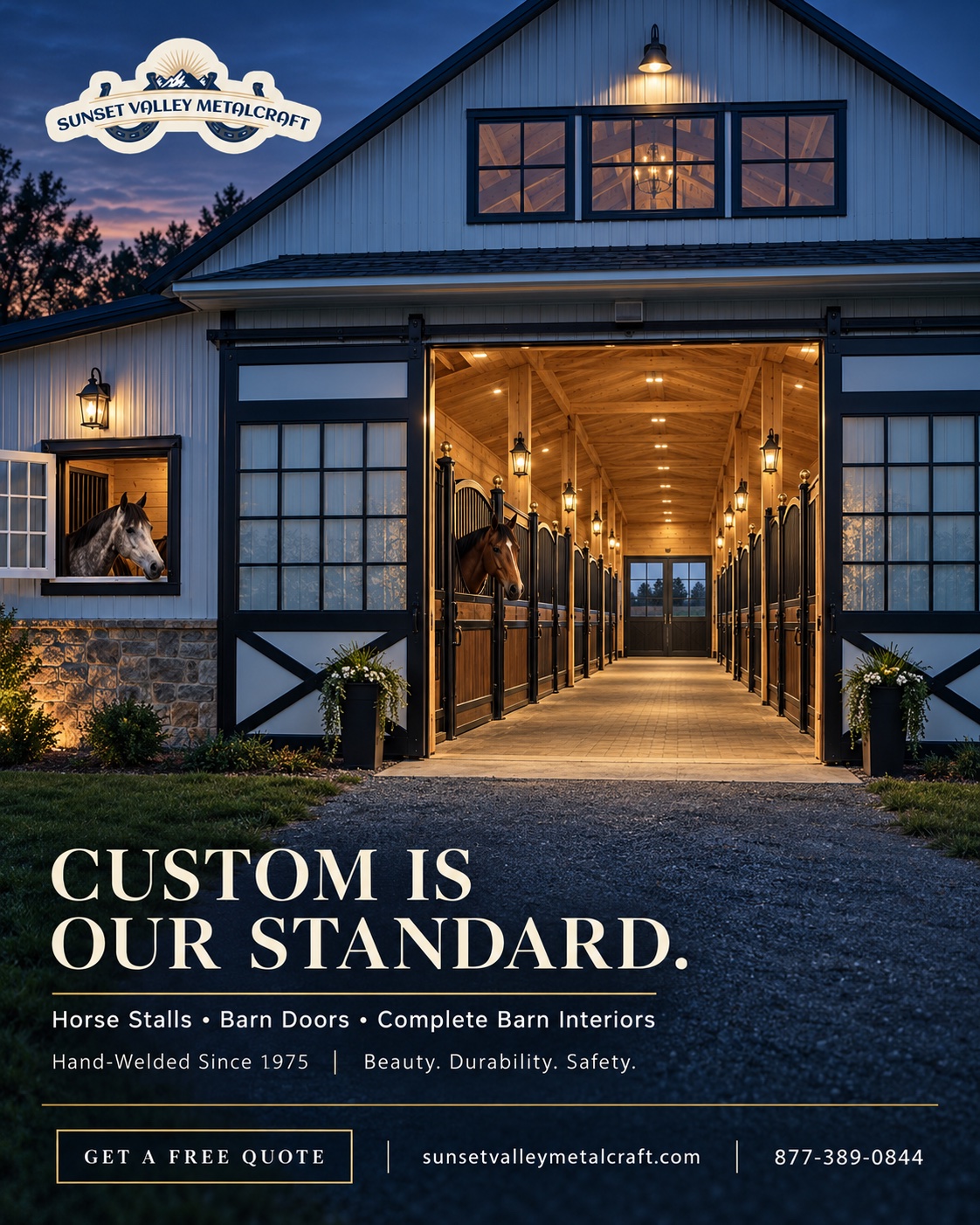
Sunset Valley Metalcraft is a family-owned Leola, Pennsylvania fabricator serving horse owners since 1975. It designs custom and standard horse stalls, aluminum barn doors, portable stalls, rental stalls, interior barn renovations and one-off metalwork such as latches, track systems, racks, holders and tie rings.
Custom is the company’s standard rather than an upgrade. The process begins with the owner’s goals, blueprint or an on-site visit when appropriate, followed by a project-specific design and quote. Options include custom sizing, arch tops, European-style fronts, V-yoke openings, decorative grille patterns, hinged feed doors, glass, wood inserts, colors and hardware.
Its published starting points are 10 by 10 feet for ponies and medium-size horses, 12 by 12 for full-grown Thoroughbreds, 12 by 12 or 12 by 14 for draft horses, and 12 by 14 or larger for mare-and-foal stalls. The company also recommends considering temperament, then confirming final dimensions during project design.
Sunset Valley says its stalls are hand-welded from quality steel or aluminum, with stainless-steel components where appropriate. Its horse-stall specifications include a powder-coated finish over a zinc-epoxy undercoat and more than 100 color choices. Wood infill should be sealed with polyurethane for moisture protection.
Yes. The company offers delivery and installation and can use its own installation crews for a turnkey project. Its published process moves from the initial request to a custom design and quote, approved drawings and materials, then delivery and installation.
Yes. Published specifications for its standard portable unit include a 10-by-10-foot footprint, 84-inch walls and a 52-inch doorway. Fully assembled panels are designed to set up in five minutes or less; rentals are offered for shows, expos and events. Ask Sunset Valley about current minimums, delivery and setup for your event.
The product range includes door-track stops, trolley hangers, latch plates, door pins, cane bolts, stall latches, saddle racks, blanket holders, wall hay racks, salt-block holders and heavy-duty horse tie rings.
Sunset Valley recommends greasing hinges approximately every six months, regularly checking trolleys and other hardware, keeping lumber sealed with polyurethane, and fitting Chewguard to exposed posts where needed.
Explore more from the InfoHorse.com directory


Explore expert guides on topics related to your business
By Bob Pruitt
By Ann Pruitt
By Bob Pruitt
By Bob Pruitt
By Bob Pruitt
By Ritchie Waterers