

DurableToys for HorsesCreate A Stimulating Environment For Both Horse and Rider
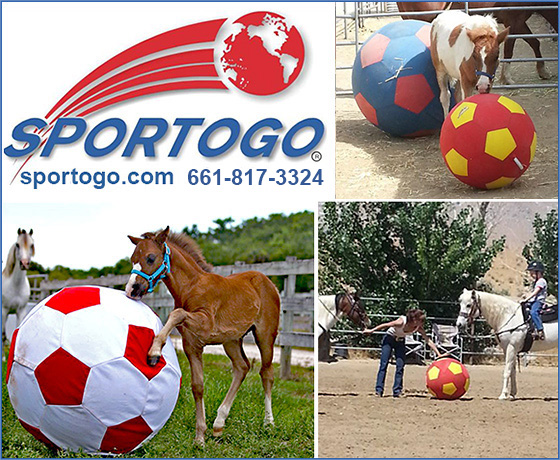
Durable horse toys—giant play balls, plastic cones and parachutes—keep a confined horse mentally stimulated and physically active, heading off boredom vices like cribbing, pawing and pacing before they become habitual. Horses are built to move, covering 10 to 15 miles a day in the wild, and games such as pushing a ball toward a goal, riding serpentines through cones or playing horse soccer give horse and rider a fun way to build that movement, balance and focus into everyday life.
There are many principles involved in supporting your horse in mind, body and spirit. One of these is creating a stimulating environment in your equine living area as well as exciting and fun activities for horse and rider.
For the Horse
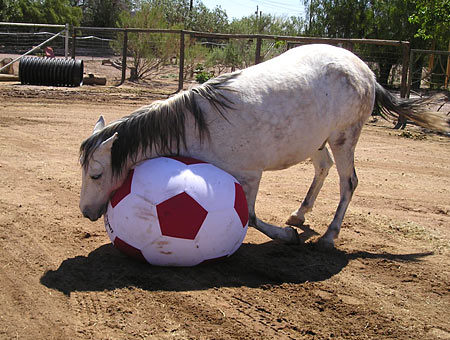
Ideally, we would all have at least a 100 acres for our horses to roam. This is rarely possible, but even a small property can offer a natural environment. A natural living area should provide your horse with enough room for continuous movement except during rest and sleep. Horses are built to move, and in the wild will cover a minimum of 10 to 15 miles a day.
When not able to exercise, body circulation is hindered, causing systemic problems in the legs and feet. When a horse moves, blood from the hoof and lower leg is pumped back through the body to the heart by the hoof and tendon action. In order to have strong, healthy feet and legs, a horse needs constant freedom of movement. This activity also exercises and strengthens the muscles and joints and promotes healthy gut function, helping to cut down on the risk of impaction colic and other digestive disorders.
Unfortunately, many horses are confined to small pens or even worse, box stalls. Not only does this hinder the horse physically, but it also affects his mental well-being. The horse is naturally very perceptive and curious, so standing in a stall day and night becomes boring and unsettling. Having nothing else to do, he turns to "vices" such as cribbing, pawing and pacing, and eventually these behaviors can become habitual.
Give your horse as much room as possible and don’t be afraid of uneven ground, hills and rocks, or fallen logs, shrubs and trees. It is human nature to assume that what we find comfortable is also good for the horse, so we think we should level their living area and remove rocks and other "dangers”. This means the horse has nothing left to do but mindlessly wander between his feed and water areas. How could this be physically or mentally stimulating?
A more challenging environment can easily be created. Obstacles often can be obtained for free including rocks or branches from trees and shrubs. You can pick up logs from specialized lumberyards often for free from their scrap pile –but don’t use wood that splinters or that has been treated with chemicals. Grow some native plants, many of which have excellent beneficial properties, and plant trees and shrubs of various heights and sizes for horses to scratch against.
Provide toys to stimulate your horse’s mind. A naturally challenging environment, with plenty of time to run and play in it, enables a horse to learn to use his body. This is paramount both for his sake and his rider', since finding his balance and knowing how to move his feet independently around obstacles is not necessarily inborn. Only through practice and by trial and error can he become handy with his body. And in order to learn, there must be a challenge.
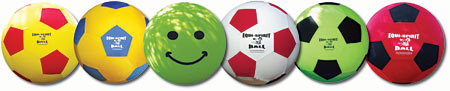
Ground and Mounted Games for Horse and Rider Has your imagination fizzled out? Are you looking for a fun horse activity you can do with your friends? Might your equine partner be getting bored with the normal routine? Having fun with durable horse toys and tools can be the answer. Here are some great ideas and tasks using Equi-Spirit giant balls, cones, and parachute.
Play Ball Groundwork * Using a halter and at least 12 foot lead rope, ask your horse to push the ball with his nose or feet toward a goal (2 cones spaced apart). Accomplish at first at a walk and then a trot.
* While lunging or doing the circle game, walk around and focus on the ball, asking your horse to touch it once while continuing on the circle.
* Focus on the ball and drive your horse toward it without pressure on the lead rope. Ask him to touch it with either his foot or nose.
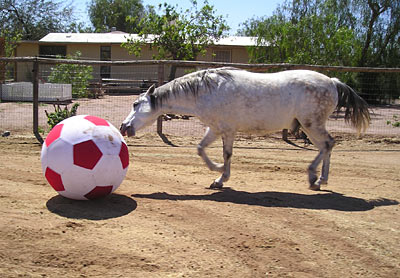
For a challenge, try doing these at liberty.
Mounted * While mounted, ask your horse to push the ball with his nose or feet toward a goal (2 cones spaced apart). Accomplish at first at a walk and then a trot.
* Focus on the ball and ask your horse toward it without using too much pressure on the reins.
* Ask for just one push with his foot or nose only.
Equi-Spirit Plastic Cones--Set the cones up in a line
Groundwork and Riding * Send or ride your horse through and around the cones in a serpentine pattern * Back your horse through two cones * Side-pass over a line of cones
For a challenge, try the groundwork at liberty. For riding, try this in a halter and just one rein and eventually at liberty.
Horse Soccer
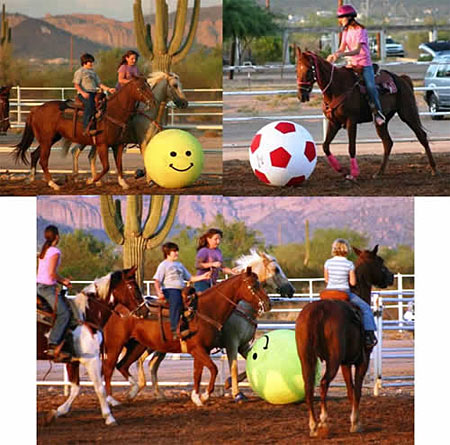
Horse Soccer is a great activity that promotes horse and rider working together using concentration and focus while having fun. Once a basic foundation and communication are in place, this game helps put principle to purpose, allowing horse and human to work as a team. Watch for our next article on Horse Soccer.