

Cooling Horses
Equine Facilities: Two Problems, One Solution Horse Cooling Companies on InfoHorse Beat the Heat, Eliminate Condensation
Large, slow-moving fans are one of the most effective ways to cool horses, because moving air speeds the evaporation of sweat—the horse’s natural cooling system—while also reducing moisture in the air so the barn feels cooler. That matters because heat stress can cause weight loss, high body temperatures, low performance, and dramatic water intake, and some heat-stressed horses stop sweating altogether, a life-threatening condition called anhidrosis. Big fans ranging from 6 to 24 feet in diameter push a column of air down to the floor and out toward the walls; a single one can eliminate 12 to 13 standard alley fans while running on just a one or one-and-a-half horsepower motor.
People feel the heat and so do horses. Heat can, in fact, affect a horse’s health and well-being a lot more than it does us humans. After all, we just move into a comfortably air-conditioned room when we get too hot. Most horses don’t have that luxury. It is impractical and expensive to air-condition most horse barns. Heat stress in horses can cause weight loss, high body temperatures, low performance expectations, and dramatic water intake. Also associated with heat stress is some horses’ inability to sweat, despite an elevated body temperature. This condition, called anhidrosis, can be life threatening.
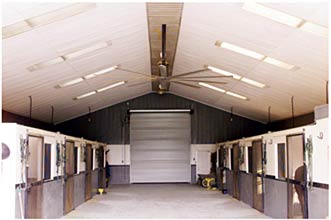
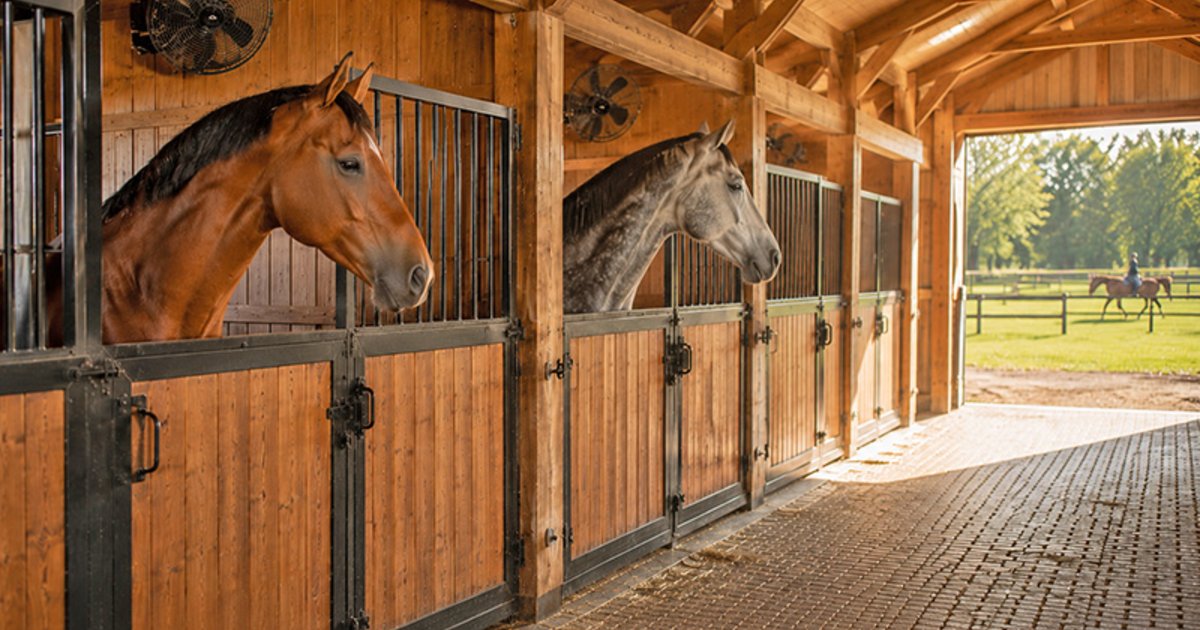
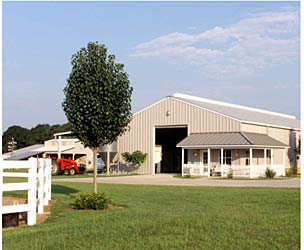
Ronnie Kent of Chipley, Florida understands this about horses, and understands the need to keep his mounts comfortable and healthy. That’s why he’d been looking for a solution to keeping his horses cool ever since he erected his metal horse barn five years ago. For four of those five years, Kent kept air moving with eight box fans and two floor fans. It wasn’t until a year ago that he discovered a better solution.
That solution was rotating slowly above his head at MetalCon, the convention of metal building professionals. The fan was, at 24 feet in diameter, one Big fan. Some Companies fans range in diameter from 6 feet to 24 feet and are used in a variety of applications – industrial, manufacturing, warehousing, commercial, and in dairy barns across the country. Many sizes are available from various cfan and cooling companies.
Kent was so impressed by the volume of air created by the slow-turning fan blades that he ordered one for his horse barn. “I thought it would be ideal for the horses,” says Kent. “It just made sense.”
Kent knew that fans are one of the most effective ways to cool the body. A cool body is key to reducing heat stress, which occurs when the core temperature rises beyond safe limits. Fans work on both the horse and human natural cooling system. When sweat evaporates, it feels cooler. Fans help speed up the evaporation process. Slow-moving fans also reduce the amount of moisture in the air.
This reduction in humidity makes the environment seem cooler. Dairy farm owners have found this approach useful in keeping their herds cool in summer. Dairy barns usually vent heat through the roof. For many dairy farmers, Big Ass fans also pull in air through the ridge vent, washing cattle with fresh air from outside the barn. Big fans can eliminate 12 – 13 standard alley fans.
I had to do something to control the ventilation. We didn’t want to put in spiral ductwork. We wanted a nice, clean refined look.” Riley worked with Industrial Ventilation, Inc. of Nampa ID, a Big Fan distributor, to achieve that look. “It just made sense to me,” he says. “If I was to use any other type of ceiling fans, we determined that we’d need at least twenty-seven of the commercial grade ceiling fans. We solved our problem with three of the Big Fans.
With the installation of just one Big Fan, Kent was able to eliminate the box and floor fans he'd been using. “That one fan is all we need, ” he says. “It's like having a cool breeze in here all summer long.”
A fan works on the principle of convection currents. Unlike high velocity fans, the big fan slowly rotates and generates a downward column of air equal to the fan's diameter. As the column hits the floor, it slides outward toward the walls. There, it moves up to the ceiling and then back down through the fan blades, gaining momentum as it goes. Since the fans are made of lightweight aluminum and move slowly, they operate on a one or one-and-a-half horsepower motor. This results in significant energy savings.
Kent was so impressed with the Big Fan Company, he placed another fourteen footer in his business – a 7500 sq. ft. sheet metal shop. “They're fine fans,” he says.
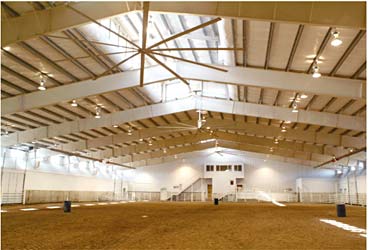
I knew we had to do something to control ventilation because that’s the best way to control condensation.” You want to keep the temperature differential down.” In wintertime, warm air rises and hits the metal roof where moisture is taken out of the air by the colder temperature of the ceiling. In some indoor environments, it can seem like it’s raining inside.