Dressage in Plain English: The Training Language Every Rider Should Understand
Dressage Terminology in Plain English for Beginners and Lesson Parents
By Bob Pruitt
The word dressage comes from the French word dresser, which means to train or prepare.
That is the whole secret.
This article is for you if:
You are new to dressage, taking lessons, watching your child ride, hearing unfamiliar words from a trainer, or simply wondering what dressage riders mean by terms like on the bit, half-halt, impulsion, and throughness.
Dressage is not just white breeches, braided manes, expensive horses, or formal tests in a show ring. Those may be the parts people notice first, but they are not the heart of it.
At its core, dressage is simply correct training.
The FEI describes the goal of dressage as developing a “happy athlete” a horse that is calm, supple, balanced, confident, attentive, and willing to work.
Read that again.
Dressage is the systematic training of the horse to become calm, balanced, supple, responsive, and willing. Although it is a competitive English riding discipline, the principles of dressage can improve almost any horse because they teach rhythm, connection, balance, communication, and correct use of the body.
Is there a horse owner alive who does not want that?
A trail horse that stays soft when something jumps out of the brush.
A young horse that learns to carry himself instead of falling on his front end.
A jumper that comes back to the rider between fences.
A ranch horse that responds instead of braces.
A lesson pony that is safe enough to trust and educated enough to teach.
That is the heart of dressage.
It is not only for riders chasing ribbons. It is not only for imported warmbloods, although there are certainly some beautiful ones out there. It is also for Thoroughbreds, Morgans, Quarter Horses, ponies, rescues, grade horses, and every honest horse trying to understand what we are asking.
So why does dressage feel so closed off to so many people?
A lot of it comes down to the language.
A rider takes a lesson and hears the trainer say:
“More forward.”
“Use a half-halt.”
“Get him through.”
“Don’t just make him round.”
“Take a better contact.”
“He’s not really on the bit.”
The rider nods, tries hard, and may even improve in the moment. Then later, driving home from the barn, the words start running through their mind.
What did she actually mean by through?
Was I pulling too much?
Is forward the same thing as faster?
How do I know if my horse is really round or just bending his neck?
A rider hears the instructor say, “Don’t let him get faster - make him more forward.”
At first that sounds impossible. But what the trainer means is: keep the same tempo, keep the same rhythm, and ask the horse to become more willing and energetic from behind.
Parents hear these words too. They stand by the arena watching their child ride, wanting to understand what the trainer is asking for, but the language can sound almost like a foreign code.
That is what this article is for.
Not to make dressage more complicated — but to make it less mysterious.
Let’s take some of the most common dressage terms and put them into plain English.
“On the Bit”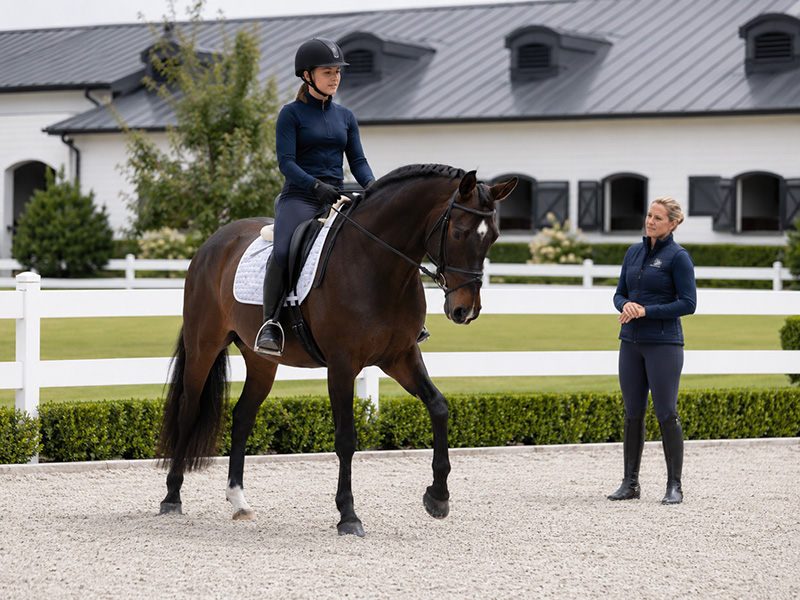
Here is what it sounds like: the horse is being held in place by the bit, forced into a frame, with his head pulled into position.
Here is what it actually means: the horse is accepting a soft, steady connection with the rider’s hand because the energy from his hindquarters is traveling forward through his body into the reins.
That part matters.
A horse is not truly “on the bit” because the rider pulls his head down. He is not on the bit because his nose is tucked in or his neck looks pretty from the ground.
A horse is on the bit when he is moving forward from behind, lifting through his back, and meeting the rider’s hand with a soft, elastic connection.
The rider is not creating the shape with the reins. The rider is receiving the energy.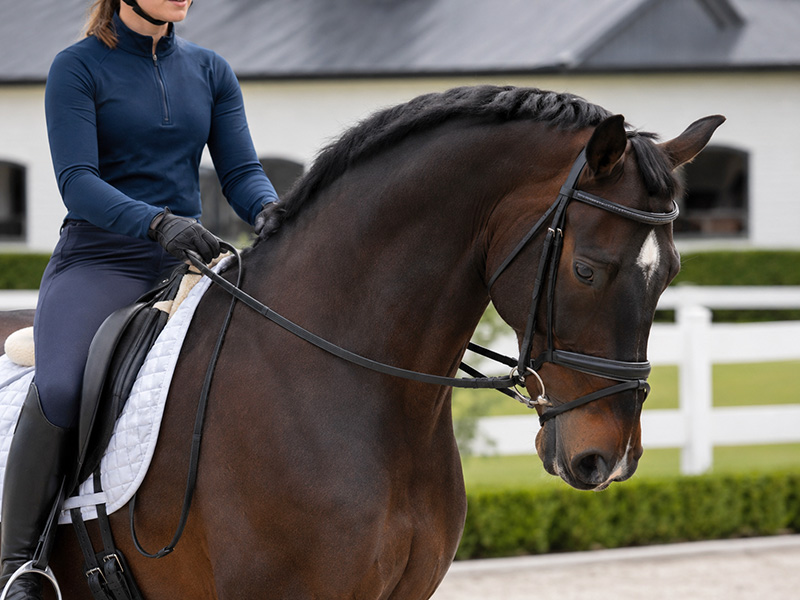
Think of it like this: a rope only stays gently taut if there is connection from both ends. If only one person is pulling, that is not connection. That is just pulling.
A horse that is truly on the bit is not being trapped. He is participating in the conversation.
“Round”
Here is what it sounds like: the horse’s neck is bent into a nice arch, the chin is tucked, and the picture looks pretty.
Here is what it actually means: the horse’s whole topline is working — from the hindquarters, over the back, through the neck, and into the contact.
That is a very different thing.
A horse can fake roundness with his neck. Many horses learn to curl behind the bit or tuck their nose without actually using their body correctly. From the rail, that may look attractive for a moment. Under saddle, it does not feel right.
A truly round horse feels different.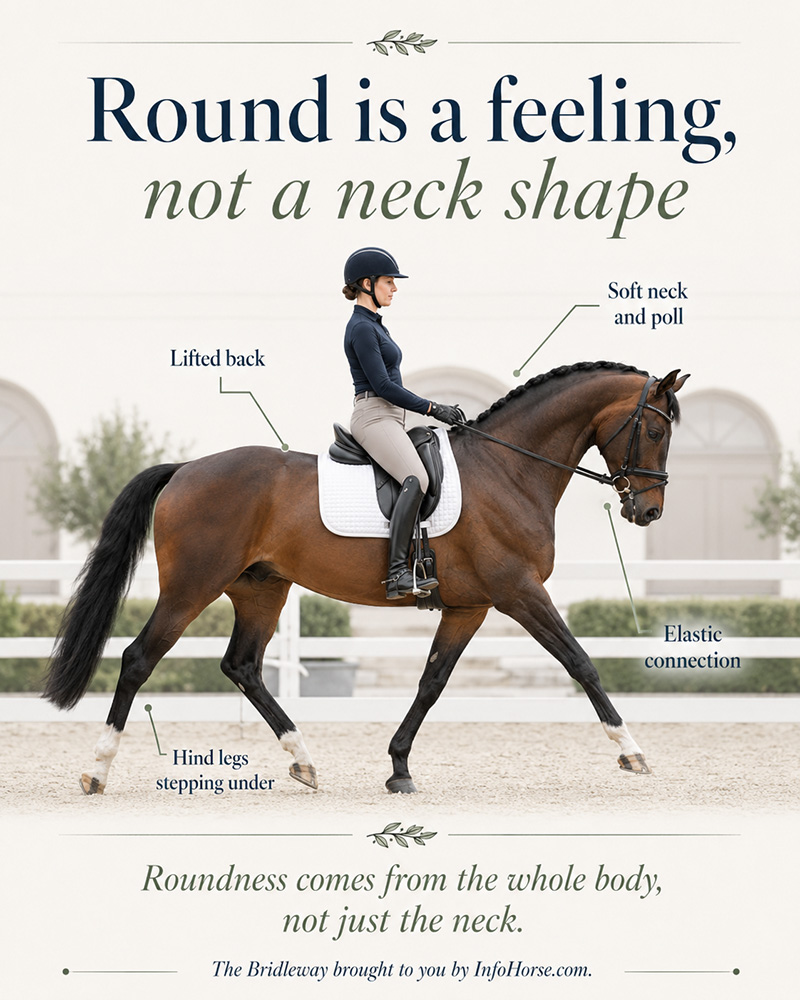
His back comes up under the saddle. His stride becomes more connected. He feels like a spring instead of a plank. The hindquarters are stepping underneath him, and the back is lifting instead of hollowing.
I have ridden horses that only looked round in the neck. I have also ridden Zoey, my Morgan mare, on days when she was honestly round through her body. There is no mistaking the difference once you feel it.
Round is not just a shape.
Round is a feeling.
“Contact”
Here is what it sounds like: how tight your reins are.
Here is what it actually means: the quality of the conversation between your hand and the horse’s mouth.
Good contact is steady, soft, elastic, and alive.
It is not loose, dangling reins where the horse is left on his own. It is not a death grip either. It is more like holding hands with someone you trust. There is connection, but not force.
That is why good contact is so important in dressage. It is the communication line between the rider and horse. If the contact is too heavy, the horse may brace. If it is too inconsistent, the horse may become unsure. If there is no contact at all, the rider has lost one of the main ways to communicate clearly.
Good contact says, “I am here with you.”
It does not say, “I am holding you prisoner.”
“Half-Halt”
This term intimidates a lot of riders, and it really should not.
A half-halt is not a half-stop.
It is a brief moment where the rider uses seat, leg, and hand together to say, “Pay attention. Rebalance. Get ready.”
That is all.
You are not trying to stop the horse. You are organizing him before the next thing happens.
A trail rider uses a version of a half-halt when she sits deeper and steadies her horse before a steep downhill stretch. A barrel racer uses a version of it before setting up a turn. A jumper uses it between fences to rebalance the horse instead of letting him run flat and fast.
Dressage gives it a name, but good riders in many disciplines already use the idea.
The half-halt is one of the most useful tools a rider can learn because it teaches the horse to listen before he reacts.
“Impulsion”
Here is what it sounds like: speed.
Here is what it actually means: controlled, purposeful energy from the hindquarters.
Impulsion is not a horse rushing around the arena. It is not legs flying faster and faster. In fact, a horse can go very fast and still have poor impulsion.
A horse with impulsion feels like there is energy stored underneath you, ready to be used when you ask. The hindquarters are active. The horse is not dragging himself along. He is pushing with purpose and carrying himself forward.
A horse can walk with excellent impulsion.
A horse can trot with no impulsion at all.
That is why “more impulsion” does not mean “go faster.” It means the horse needs more active, organized energy from behind.
“Engagement”
Engagement describes what happens when the horse’s hind legs step farther underneath his body and begin to carry more weight.
This is one of the big keys to correct training.
A disengaged horse may still be moving forward, but he is often pushing from behind while falling onto the front end. He may feel heavy in the rider’s hand or flat underneath the saddle.
An engaged horse begins to carry himself differently. His hindquarters do more of the work. His back lifts. His front end becomes lighter. He feels more balanced and powerful.
Think of engagement as the horse’s natural shock absorber and power source starting to work correctly.
It is not about forcing the horse into a shape. It is about helping the horse use his body in a stronger, healthier way.
“Through” or “Throughness”
This may be one of the most confusing words in dressage because it does not sound like much by itself.
When a trainer says a horse is “through,” they mean the energy is traveling freely from the hindquarters, over the back, through the body, into a soft contact, without getting blocked by tension or resistance.
A horse that is not through may feel stuck somewhere.
Maybe the hind end is not really stepping under.
Maybe the back is hollow.
Maybe the neck is tight.
Maybe the jaw is braced.
Maybe the rider’s leg asks for something, but the response never makes it all the way through the horse’s body.
A horse that is through feels connected from back to front.
It is the difference between flipping a light switch that works and flipping one where the wire has been cut somewhere inside the wall.
When a horse is through, the body works as one piece.
“Forward”
Forward does not mean fast.
This is one of the most important things for beginners to understand.
A forward horse is willing to go. He is thinking ahead. He responds to the rider’s leg without nagging every stride. There is energy available.
A horse can be forward at a walk.
A horse can be sluggish at a canter.
A horse can run fast and still not be truly forward.
Forward is not a speed.
Forward is an attitude.
A good forward horse says, “I am with you. I am ready.”
That is very different from a horse that says, “Make me.”
Now Put the Words in Order: The Training Scale
Here is the part that helps dressage terminology make more sense.
These words are not just random vocabulary. They are connected to a training system.
It is called the Training Scale, sometimes called the German Training Scale. In German, it is known as the Ausbildungsskala. You do not have to remember that word, but you should understand the idea.
The Training Scale gives riders a roadmap. It explains what must come first and what has to be built later.
There are six basic steps:
- Rhythm
- Suppleness
- Connection
- Impulsion
- Straightness
- Collection
Each one builds on the one before it.
1. Rhythm
Rhythm means the horse’s footfalls are regular, clean, and consistent in each gait.
The walk has a four-beat rhythm.
The trot has a two-beat rhythm.
The canter has a three-beat rhythm.
Rhythm comes first because nothing else works correctly if the gait itself is irregular.
Before a horse can be round, through, collected, or beautifully balanced, he must first move in a steady, correct rhythm.
2. Suppleness
Suppleness is also often called relaxation or looseness.
It means the horse is working without unnecessary tension, both mentally and physically.
This does not mean the horse is sleepy or dull. A supple horse can be alert and energetic. But he is not tight, braced, anxious, or locked up in his body.
A tense horse cannot use himself correctly for long. You may be able to force a shape for a moment, but it will not be true training.
Suppleness allows the horse to learn.
3. Connection
Once the horse has rhythm and is relaxed enough to use his body, he can begin to develop true connection.
Connection means the horse and rider are no longer working as two separate pieces. The horse is listening to the rider’s seat, leg, and hand. The rider is feeling what is happening underneath the saddle and responding with timing instead of force.
This is where contact becomes part of a bigger whole.
Good connection includes the reins, but it is not only about the reins. It includes the horse’s back, hindquarters, balance, rhythm, relaxation, and attention to the rider.
A connected horse feels as if the aids travel through the whole body. The rider’s leg does not stop at the horse’s rib cage. The hand does not only affect the mouth. The seat is not just sitting there. Everything begins to speak together.
Connection should not be forced from the front.
It develops when the horse is moving in rhythm, relaxed enough to use his body, and willing to accept the rider’s aids without fear or resistance.
4. Impulsion
Impulsion is the horse’s controlled energy from behind.
But here is the important part: real impulsion cannot be created correctly in a tense or irregular horse.
If the rider asks for more energy before rhythm and relaxation are in place, the horse may simply rush. That is not impulsion.
Good impulsion feels powerful but organized. The energy is available, but not spilling out everywhere.
5. Straightness
Every horse is naturally a little crooked, just like people are naturally right- or left-handed.
Straightness means the horse is learning to travel evenly through his body, with both sides becoming more equally supple and strong.
This matters because crookedness causes energy to leak out sideways. A crooked horse may bulge through one shoulder, lean on one rein, drift off the line, or struggle more in one direction than the other.
Straightness helps the power from behind travel forward correctly.
6. Collection
Collection is the top of the scale.
A collected horse carries more weight on the hindquarters, lightens the front end, and becomes capable of more advanced work.
This is where many people get into trouble, because collection is beautiful and everyone wants to get there. But collection cannot be skipped to. It has to be earned.
A horse cannot be correctly collected if he has lost rhythm.
He cannot be correctly collected if he is tense.
He cannot be correctly collected if the connection is forced or broken.
He cannot be correctly collected if there is no impulsion or straightness underneath it.
Collection is not just a horse shortening his frame.
Collection is the result of all the earlier pieces working together.
The Training Scale Is Not a One-Time Checklist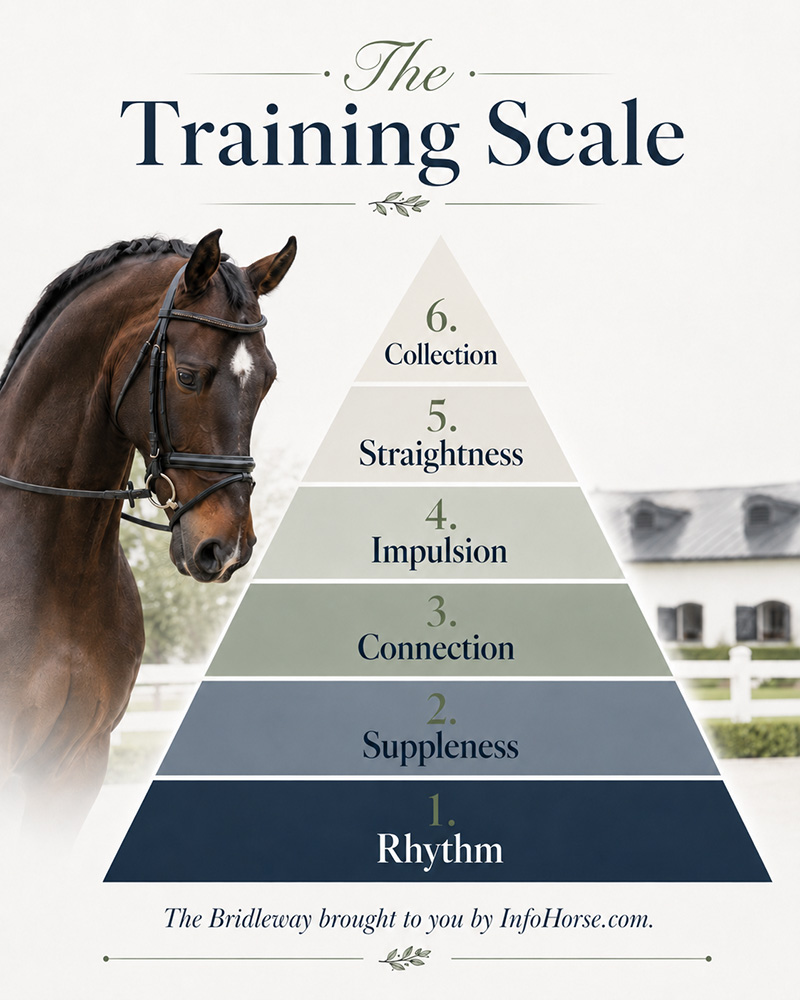
This is important.
The Training Scale is not something a rider completes once and then leaves behind.
Even Grand Prix horses doing the most advanced dressage work in the world still depend on rhythm, relaxation, connection, impulsion, straightness, and collection. Every ride. Every day.
If a good rider feels the horse lose rhythm or become tense, that rider does not just keep pushing for bigger movements. The rider goes back down the scale and fixes the foundation.
That is why you cannot cheat your way to “round,” “on the bit,” or “through.”
Those are signs of correct work. They are not tricks.
If you chase the look without the steps underneath, you may get a horse that appears right for a moment but falls apart the second he is tested.
Once you understand the Training Scale, the terminology becomes less intimidating. It stops being a pile of fancy words and starts becoming a roadmap.
Rhythm first.
Then suppleness.
Then connection.
Then impulsion.
Then straightness.
Then collection.
In that order.
Every time.
One Common Mix-Up: Rhythm vs. Tempo
These two words are often confused, but they do not mean the same thing.
Rhythm
is the pattern of the footfalls.
A walk has four beats.
A trot has two beats.
A canter has three beats.
Rhythm is about whether those beats stay regular and correct.
Tempo
is the speed of those footfalls.
A horse can trot with a quicker tempo or a slower tempo while still keeping the same clean two-beat rhythm.
Think of a drummer. The drummer can play the same beat faster or slower without changing the pattern. That is tempo changing while rhythm stays the same.
Here is a simple test.
If you ask the horse to slow down and the footfalls stay even, the rhythm stayed intact.
If you ask the horse to slow down and he starts jigging, dragging, rushing, or stepping unevenly, the tempo change cost you the rhythm.
That matters.
Good training allows a horse to adjust tempo without losing rhythm.
That is something dressage judges watch for, but it is also something every rider can learn to feel.
Why This Matters, Even If You Are Just Starting
Dressage terminology can feel intimidating, but the ideas behind the words are practical.
A horse that understands a half-halt is a horse that learns to rebalance before the next request.
A horse with good contact understands a clearer conversation with the rider.
A horse that is forward without rushing is more pleasant to ride.
A horse that is supple, through, and engaged is using his body in a healthier way.
A horse with rhythm and relaxation is easier to teach and easier to trust.
That matters whether you are riding Intro Level dressage, taking your first English lesson, watching your child ride, retraining a Thoroughbred, riding a Morgan, or simply trying to understand what the trainer is saying from the middle of the arena.
The words are not meant to exclude you.
They are meant to help describe what good training feels like.
That is why we are starting here.
The Bridleway exists to make English riding easier to understand, more welcoming, and more connected to the horse underneath it all. We want riders and horse owners to feel at home in this world, not locked outside of it by unfamiliar language.
Dressage is not supposed to be mysterious.
It is training.
It is balance.
It is communication.
It is helping the horse become stronger, softer, more confident, and more willing.
And once you begin to understand the language, you may find that dressage is not nearly as distant as it once seemed.
Welcome to The Bridleway.
Welcome to dressage in plain English.
Dressage Terms in Plain English
On the bit: The horse accepts a soft connection because energy is coming from behind.
Round: The horse lifts through the back and topline, not just the neck.
Contact: The feel of the conversation through the reins.
Connection: The horse and rider working together through the whole body.
Half-halt: A brief rebalancing signal.
Impulsion: Controlled energy from the hindquarters.
Forward: Willing energy, not speed.
Throughness: Energy traveling freely through the horse’s body.