

How to Develop Our Horses Speed with Control Performance Horsemanship with Richard Winters
To build controlled speed, start in a safe arena with good footing: lope relaxed circles until your horse is warmed up, then push your hands forward and let him extend his stride on a loose rein for one to four full circles. To slow down, shift your weight back in the saddle, say the word “easy” in a low, drawn-out tone, and pick up slightly on the reins—and if the horse struggles to decelerate, make the circle slightly smaller so he learns to regulate his own momentum without being pulled on. A horse that never practices speed can get excited and overwhelmed the first time you ask for it, so conditioning him to accelerate and willingly slow back down is what keeps a fast ride safe.
Whether it’s an extreme cowboy race, a reining, a cow horse event, or a barrel race – speed and control must travel on parallel lines.
I recently judged an Extreme Cowboy Race where riders had to navigate an obstacle course, as fast as possible, and exhibit control and refinement in every maneuver. I addressed the contestants and audience, and told them, “It will probably not be the fastest horse that wins this event. Nor will it be the pair that exhibits the most control. The winner will no doubt be the horse and rider combination that exhibits both speed and control throughout the entire course.
” Whether it’s an extreme cowboy race, a reining, a cow horse event, or a barrel race – speed and control must travel on parallel lines. When these two elements travel at an equally high level, it makes for an outstanding performance. When speed intersects control and begins to exceed the amount of control you are able to maintain, it makes for a dismal and sometimes dangerous situation.
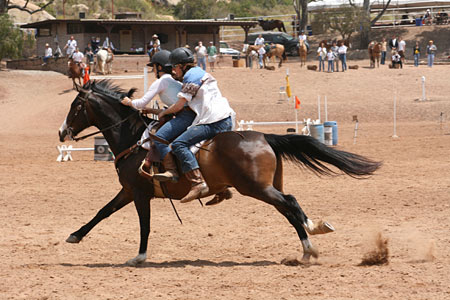
“Rescue race” at our home at The Thacher School. - Photo credit: Cheryl L. Winters
Much of our training and conditioning of horses is done to help them relax, soften, and slow down. We lope a thousand circles to teach our horses that they don’t need to speed up and get excited, but rather that they can relax and lope around in a soft three beat cadence . All of this is very important, and I do a lot of it, however, somewhere along the way, we need to get them comfortable with speed as well.
I need to condition my horses so that I can ask for speed without them emotionally falling apart. I need them comfortable with speed and build in a willingness to then decelerate and slow back down, without resistance. If my horse is far enough along in his training, and can willingly walk, trot, and lope on a loose rein, then it’s time for me to periodically accustom him to controlled speed.
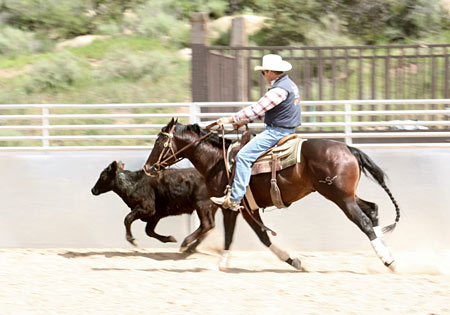
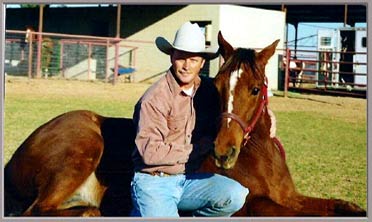
This colt is learning to handle speed while rating a cow. Photo Credit: Primo
If you never ask your horse for speed and then on a random Saturday morning, at a local team penning, attempt to run after a wayward steer, the horse might get excited and overwhelmed and buck you off! If you are out on trail ride and all of your friends lope off, at a pretty good clip, and you attempt to keep up on a horse that is not used to moving out fast, it could get dangerous very quick as you realize how little control you have once the speed factor is added to the equation.
Here is a simple exercise that I recommend: In a safe arena, with good footing, without others in your way, begin to lope some circles with your horse. After your horse begins to feel very relaxed and warmed up, begin to urge him forward and travel faster. Maintain a big, wide, circle and push your hands forward and allow your horse to extend his stride, on a loose rein. The sluggish horse might need more encouragement with clucking, our legs, or spurs, or even a spanking.
The high-strung horse would require that we be much more subtle in our suggestion for acceleration. Ask your horse to lope fast, one to four full circles and then shift your weight back, in your saddle, and ask him to slow down. As I sit back, I say the word “easy” in a low drawn out tone and pick up slightly on my reins.
If your horse has difficulty understanding how to slow down, you can make your circles slightly smaller as you suggest with your body, hands, and voice to slow down and relax. A slightly smaller circle can help your horse learn how to regulate his forward momentum without you having to pull back on the reins. You can also vary this exercise by loping around the entire arena, periodically speeding up along the rail and then asking them to slow back down.
If they don’t follow your suggestion of slowing down, you can go right into a loping circle until you can begin to feel them relax and soften. One horseman said, “The only way to gain experience is to experience it !” Yes, you need to be smart about it and you need to stay safe. However, not teaching your horse to handle speed, with control, is limiting your horse’s potential and setting yourself up for a possible dangerous situation.
By presenting these ideas, in a controlled environment, when it’s your idea, will better prepare you and your horse reach your goals confidently and safely.
For more information about Richard Winters Horsemanship please go to wintersranch.com.