

Keeping Your Horse Balanced with Richard Winters
A horse has to be trained on both sides individually—his brain is divided into left and right sections, so a maneuver taught on one side must be taught again on the other. Because we halter, lead, saddle, and mount from the left, many horses become predominantly left-sided; you can rebalance yours by spending time on his right side, occasionally leading from the right, and working the weaker lead—for a left-leaded horse, that means doing about 75% of your loping on the right lead for the next month. A balanced horse is a more athletic horse, and an athletic horse is a better performer.
Whether you are working on ground work with your horse, or riding exercises, it’s very important to keep him working equally well on both his left and right side.
The first thing necessary to developing a balanced horse is to be aware that a horse’s brain is divided into two sections; left and right. You can teach a horse a maneuver on one side, but it is necessary to teach the same concept on the other side as well. Each side has to be taught individually.
Are horses like people?
Are some left handed (or sided) and others right handed? Possibly so. Some theorize that the way a foal rests in his mothers womb has bearing on which side they will favor after they are born. I’ve know some horses to be right-sided and others left -sided. However predisposed they may be to one side or the other, much of this has to do with how we handle them. We halter and lead them from the left. We saddle, mount and dismount on the left hand side. I’ve been in a thousand warm-up pens at horse shows over the years. More often than not, riders will all be trotting and loping to the left. I believe these things contribute to many horses becoming predominately left-sided.
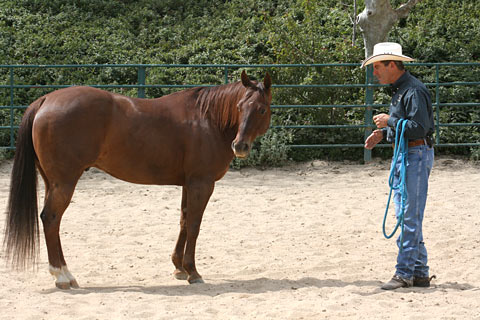
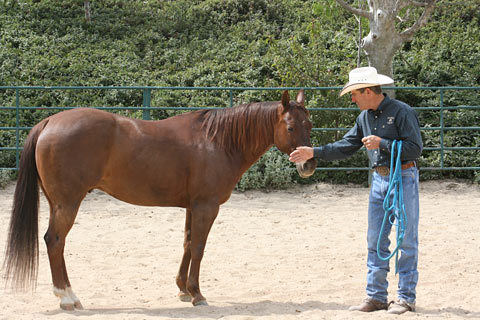
Try this revealing exercise next time you go out to catch your horse. Approaching in front of your horse’s nose; step to your horse’s right side. Horses will often tip their nose to the right and force you to their left side. They have what I call, a soft left eye and a hard right eye. If your horse is resistant to your approach, slow down and use your right hand as a wedge along his right cheek to keep him from rotating his head to the right. Once you are on the right side, take a moment to rub your horse and help him enjoy this time with you on his “off-side.” If it’s not an issue, great! Yet I know from experience that many horses could benefit from this balancing exercise.
Leading your horse occasionally from the right side is also a good idea. By doing so, you are softening the right eye. When is the last time you saddled your horse and mounted from the right hand side? Can you even do it? You’ll be surprised how awkward you’ll be if you haven’t developed these ambidextrous skills.
It’s also very common for a horse to be predominantly right-leaded or left-leaded (the latter being more common). This means that when asked to lope or canter, your horse will pick up the dominant lead time and time again. Of course, the longer this imbalance is ignored, the more deep-seated the problem becomes. Muscle memory becomes more engrained as they form this habit of picking up only one lead. That side of the horse’s body also becomes stronger than the other and thus loping on the dominant lead becomes easiest.
I’m left handed. My left hand is probably 25% stronger than my right. If I were to arm wrestle you I’d want to use my left arm. I write with my left hand. Writing with my right hand is awkward and crude. If I were serious about becoming ambidextrous, I would need to make a conscientious effort to write with my right hand for the next month. It would be difficult at first, but no doubt a huge improvement would be seen in thirty days.
Our horses are exactly the same way. If I have a horse that is predominantly left-leaded, about 75% of all my loping will be done on the right lead for the next month. Some horses never get perfectly balanced. Yet the vast majority will make huge progress once we are aware and become proactive in our training regiment. Attention All Team Ropers! You are especially vulnerable to this left-sided/lead phenomenon.
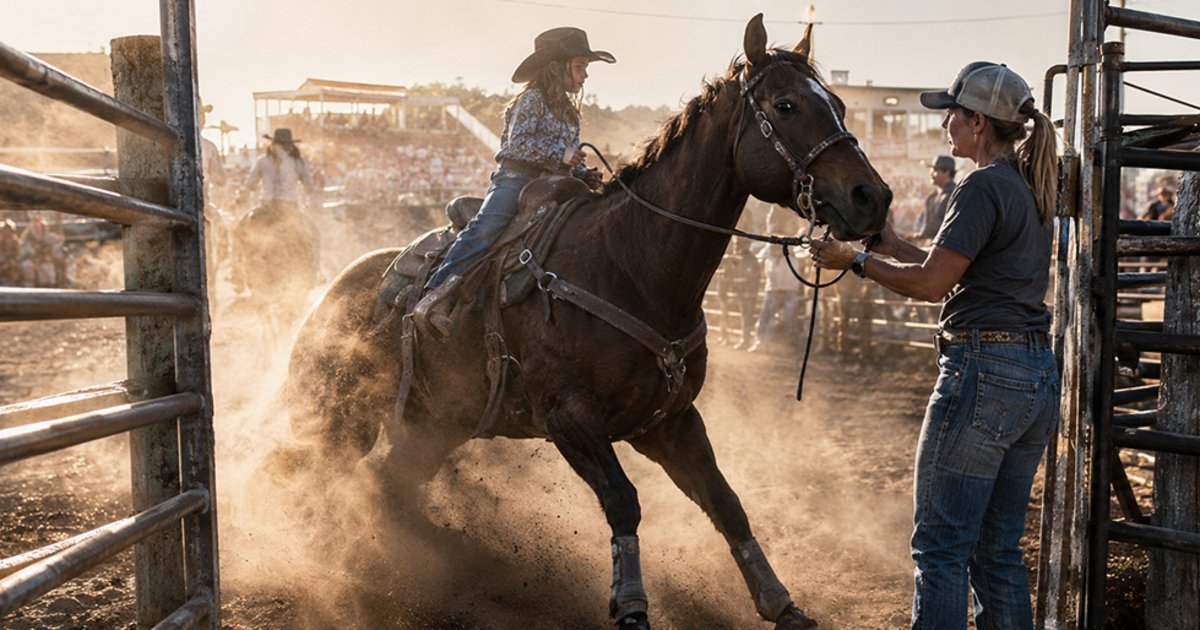
Your sport dictates that the header ropes the steer and turns left. Then the healer follows to the left to rope two hind legs. It’s true that you want your horse on the left lead to make these moves. However, I don’t believe it will take away from your horse’s performance if you get them equally comfortable loping on the right lead as well when you’re not roping. A balanced horse is a more athletic horse. An athletic horse is going to be a better performer.
You won’t be sorry you took the time to get your rope horse loping comfortably on both leads.
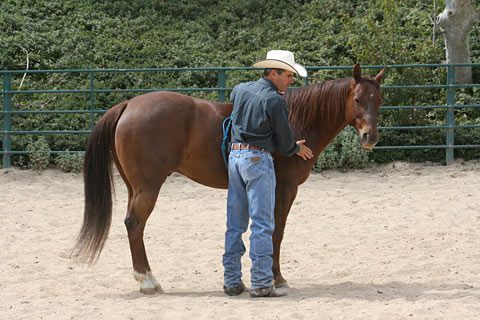
I’ve actually had horses that came to me one-sided and with consistent work on the weak side, I have caused them to switch and favor the opposite side. Of course, that’s not what we’re looking for either. I am constantly envisioning my horse on a balance scale. If he’s a little heavy on one side, I’ll spend some time working the opposite until I feel him become balanced and working equally well on both sides.
What’s your homework? Go out tomorrow and put your horse on the scale. Which side needs improvement? Does he have a soft and hard eye? Does he favor one lead over the other? What about lateral flexion to the left and right, along with leg yielding each way? The first step in creating a balanced athletic performer is for the coach (You!) to become aware of what’s going on in your horse’s development. Left is not right and right is not wrong! Keeping both sides equal is challenging but well worth the effort!
For more information about Richard Winters Horsemanship please go to wintersranch.com.