

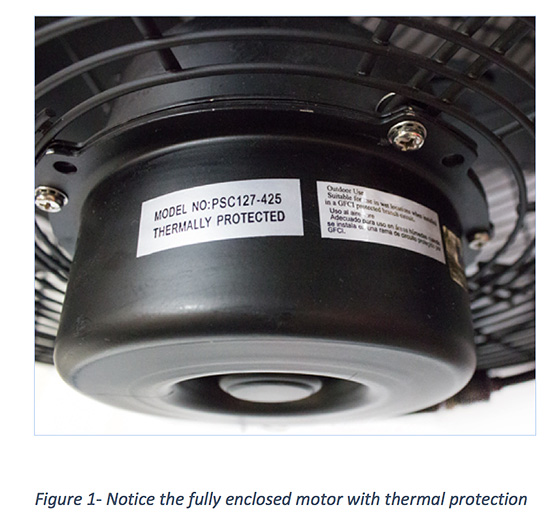
A stall fan should be agricultural-rated, with three non-negotiable safety features: a fully enclosed motor with sealed ball bearings, a thermostatic overload switch that shuts the fan off before it overheats, and a UL507 certification rating it for outdoor, wet-location use. Residential box fans are vented, so barn dust reaches the motor and builds up in the electrical housing—in 2007, 44 horses were killed in a single barn fire caused by new box fans. Look for airflow of roughly 1,000–2,250 CFM; moving more air than that mainly blasts dust into a horse’s eyes and airways.
The best fan for a horse stall is a barn-rated (agricultural) fan — one with a fully enclosed motor, sealed ball bearings, and a thermal shut-off — not a hardware-store box fan. Box fans are the single most common fire hazard in American barns, and the difference that keeps your horses safe is inside the motor, where you can't see it. Here is exactly what separates a fan built for a barn from one that only looks the part.
Article by Christy Schulthess.
The air is still, making the sounds of the cicadas more prominent. It is hot, muggy. Yep — it's summer. By this point we have already broken out the fans in the barn; they have been running quite a bit for the past couple of months. They are probably a little dusty by now, but they will be fine — they always have been… right? Don't make the mistake that so many barn owners have. Unless those fans are specifically rated for agricultural use, they are NOT safe.
We've all seen it — plastic box fans strapped to the front of a stall, or suspended above the stall with a mounting device sold through any online equestrian retailer. It would appear, based on the fact that fellow horse enthusiasts are selling them for barn use, that they must be safe. They are not.
The problem is that these box fans (and many other "industrial" fans) are not designed to be in our barns. I've heard many people proclaim, "I dust my fans, so they are safe!" The blades and guards are not the problem — if the motor is not enclosed and the bearings are not sealed, all that barn gunk Will get inside of it. That causes friction. Friction causes heat, and possibly fire. In 2007, 44 horses were killed in a single barn fire caused by new box fans.
On this point we do a disservice to each other. Whether it is at a major farm-retail store or through the many online stores, fans are sold to unsuspecting horse owners that are not designed to be in a barn. Catchy words and phrases such as "industrial," "high velocity," and "weatherproof" are designed to lure us in. In actuality, however, these fans are most often not suited for any agricultural use — indeed, there are sometimes explicit disclaimers in the operating manual stating just that.
3 Safety Features a Barn Fan Needs
- A fully enclosed motor with sealed ball bearings. Residential fans are vented, so the motor parts are exposed to dust and dirt. That grime builds up in the electrical housing and can start a fire.
- A thermostatic overload shut-off switch. If the fan overheats, it automatically shuts off — preventing the heat build-up that can cause a fire.
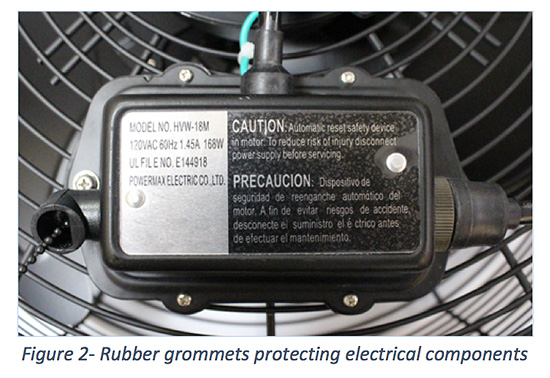
- A UL507-certified motor. This means the electrical device is rated for outdoor, wet-location use. In wash bays these fans can be safely used and even sprayed down to clean them off.
Beyond those three safety points, remember that bigger is not always better. CFM is the rating for how much air a fan moves. Many industrial or high-velocity fans — even ones that cover points 1 and 2 above — are not well suited for barn use because they move TOO much air. Think about how much dust gets kicked up if there is basically a jet engine pointed into a stall. Fans up to roughly 2,250 CFM are the sweet spot in a barn.
You should also consider what happens if you did have a fire caused by a box fan (or any other non-agriculturally rated appliance). Will your insurance cover a claim if the item that caused the fire was not rated for use in the barn? It's worth asking your agent to be sure.
Many of you are thinking by now, "I've used my box fans for years. I've seen them in use at hundreds of facilities. I'm safe." So did one barn owner who wrote to us — luckily she caught it in time and nothing was too badly damaged. In her words, it was "all because of a stupid box fan."
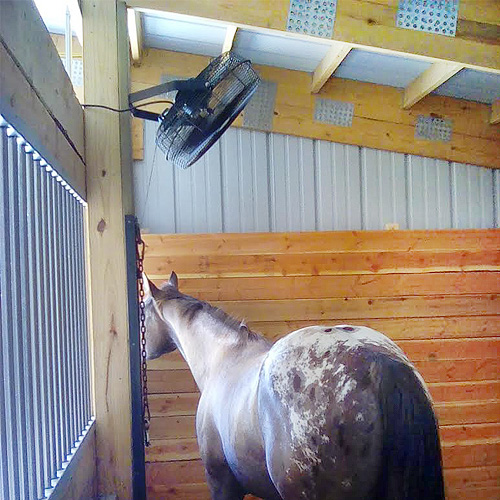
So where are these "unicorn" fans to be found? Look for a fan up to about 2,210 CFM with an enclosed motor, sealed ball bearings, thermal regulation, and a wash-down-safe rating. A 24-inch wall-mount oscillating fan built to those same specs is a barn favorite, and some models add a misting option for extra cooling on the hottest days. (Use common sense when washing any fan off — please don't hit the seals with a pressure washer on "high.")
Yes, agricultural fans cost more than a $20 box fan. But as one reader put it on our Facebook page: "I understand the concern about cost, but I bit the bullet and bought the sealed-motor fans years ago. I was tired of constantly having to replace box fans because they didn't last. They last 10–15 times longer, even in the deep south under constant use. Given the time and cost savings of always shopping for and replacing them — plus the safety factor — they are well worth the cost."
Quick Checklist: Is This Fan Safe for a Horse Stall?
Before you mount any fan in front of a stall, run it against this list. If it misses even one, it does not belong in your barn:
- Enclosed motor + sealed bearings — no open vents where dust can reach the windings.
- Thermal overload shut-off — it powers itself down before it can overheat.
- UL507 / wet-location rating — safe to run (and rinse) in a humid, dusty barn.
- Roughly 1,000–2,250 CFM — enough air to cool without blasting dust into eyes and airways.
- Secure, dedicated mount — never balanced on a stall rail or run off a daisy-chained extension cord.
Barn-Safe Fans and Cooling on InfoHorse
InfoHorse lists equine suppliers whose fans and cooling systems are built for agricultural use rather than the living room:
- Humongous Fan — high-volume agricultural fans designed to move barn-appropriate air over stalls, aisles, and arenas.
- The Aqua Breeze™ Cooling System — a misting-and-fan cooling approach for the hottest days, the same evaporative principle noted above.
Always confirm the enclosed-motor, sealed-bearing, and thermal-shut-off specs with any supplier before you buy — those are the features that actually keep a barn fan safe.
Cooling a whole barn, not just a stall? See our companion guide, Best Fans for Horse Barns & Stalls, for airflow, CFM, placement, and when a large Hvls fan makes sense.