

Why Should You Consider Rubber Stall Mats for Your Horse’s Stall?
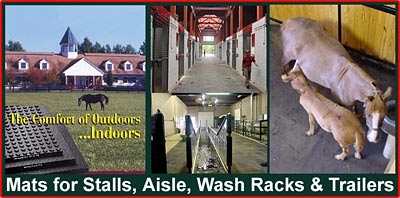
By Donna Wilkinson Horse Stall Mats can be placed over concrete, asphalt, wood, or any level well-compacted surface. Guaranteed to never roll, buckle, or curl or grow bacteria! Rubber mats have been the number one choice for many years.
Rubber stall mats can be installed over concrete, asphalt, wood, or any level, well-compacted surface, and a quality mat saves time, money, and bedding while keeping horses safe. Solid re-vulcanized rubber mats are the standout choice—they are totally non-porous, carry a natural anti-fungal and anti-bacterial agent, and will not roll, buckle, or curl. For traction, look for a durometer reading between 59 and 63 on the shore A scale, and consider an interlocking floor system that acts as a single solid piece a pawing horse cannot shift.
Whether you have a two, or a sixty, horse facility your main concern should be to provide a comfortable and safe environment for your animals. Another factor should be how much bedding you use and how much time you spend mucking your stalls. The simple truth is that by using a quality stall mat you will save time, money and know your animals are safe.
There are numerous varieties of products on the market today for stall floors; everything from rubber filled mattresses to rubber grids. Each has their place depending upon the consumer’s choice after investigating what his needs are. Rubber mats have been the number one choice for many years.
The stall sub-surface is important. Most rubber mats can be placed over concrete, wood, or any level compacted surface that is not affected by freeze/thaw conditions. They can be placed on any type surface except soft sand, which will drift to the side as the horse moves in the stall causing a low spot. An alternative to a concrete or asphalt sub-surface are crushed fines, or screenings.
Depending upon the geographical location, commonly found materials are limestone or granite fines, which should not exceed 1/8 inch in size. The fines are easy to work with, compact well, provide good drainage, and stand up well to freeze/thaw conditions. Fines should be installed to a dept of four to five inches, which may require excavating some of the existing material to maintain current stall elevations. It is important that the fines are well compacted.
Use water to soak the material aiding in the compaction process. Once the material has been stabilized and leveled you are ready to install your mats.
After preparing the sub-surface it is now time to consider the different products available. Using a solid rubber mat will ensure that the urine is removed with the bedding. It is very important that the urine is either removed or drained away from a horse stall. High concentrations of urine either in the stall or soaked into the ground under a stall can cause toxic ammonia fumes which can result in serious health problems for your animals.
The use of a re-vulcanized mat will also aid in the removal of any urine odor. Re-vulcanized mats are totally non-porous. They have a natural anti-fungal and anti-bacterial agent through out the mat. Because they are non-porous they will not roll, buckle, or curl up when the mat dries. Many of the mats on the market today are not re-vulcanized, they are manufactured by using ground rubber material bound with polymers under low heat and pressure.
The top pattern on the mat does not indicate the traction the animal will have. The durometer reading of the mat (how deep the PSI of the hoof sinks into the surface) should be between 59 and 63 shore a scale. Urethane bound mats can reach a durometer of 65 to 80. Mats with large amounts of natural rubber can also range from 65 to 80. The higher the reading the less traction the animal will have. Grid type stall floors which have no durometer reading will provide some traction, but urine flows into the sub-surface.
Straight edged rubber mats may work fine on concrete or asphalt sub-surfaces if the mats are installed correctly. However, if you have a horse that likes to paw (and most horses do) there is the possibility the mat will shift and bedding may become lodged under the edge. This will lift the mat and make the cleaning process much more difficult, and could cause a trip hazard for you or your animal.
Using straight edged mats on a lime stone based sub-surface the animal may start digging a hole which will cause the owner to eventually have to fill in the hole and reposition the mats. Purchasing an interlocked floor system may be more expense, but once placed in the stall it will act as a solid piece. The horse will not be able to shift the mats, which means that on concrete or asphalt no bedding will become lodged underneath.
Also, with an interlocked system the urine will remain on the top to be soaked up by the bedding and removed from the stall, which provides a much cleaner environment for the animal.
Humane Manufacturing, LLC, writer of the above article has made quality products since 1907, and has over 30 years of mat making experience. Creators of Loktuff® interlocking flooring, we provide matting solutions for Stalls, Aisle Ways, Wash Bays, Walker Floors, Trailer Floors, Foaling Stalls and more!! Our line of Equine mats are environmentally friendly, we use post-consumer tire-derived rubber material.
The rubber material is re-vulcanized (not glued or held together by fillers) to produce a durable, long-lasting mat. Humane mats are absolutely non-absorbent and will not harbor or promote bacteria growth. They can be placed over concrete, asphalt, wood, or any level well-compacted surface. They are guaranteed never to roll, buckle, or curl. An excellent thermal barrier against cold and damp. Humane mats are covered by a 12 year Limited Warranty.
We are recommended by Michael Plumb’s Horse Journal and have a long list of satisfied customers.