

True Horsemanship – A Life Long Journey
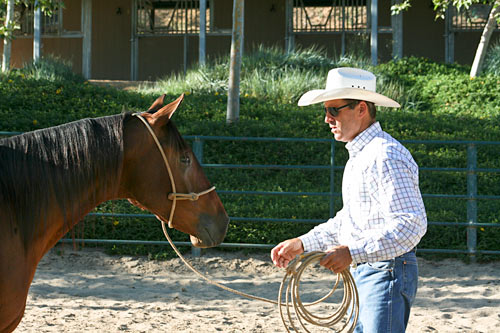
After thirty years of full time horsemanship, I believe I am the product of many great horsemen and women I’ve had the privilege of learning from.
Performance Horsemanship with Richard Winters
True horsemanship isn’t something you finish learning—after thirty years of full-time horsemanship, trainer Richard Winters still considers himself the product of the many great horsemen and women he has learned from. Rather than being self-taught or shaped by one mentor, he gleaned training nuggets from figures like Tom Dorrance, Ray Hunt, Pat Parelli, Joe Wolter, and Les Vogt, some in person and others through training videos, DVDs, and articles. The lesson for every rider is that the list of teachers is never all-inclusive, and the learning is unending.
Some trainers proclaim they are “self-taught.” Others credit one particular mentor who shaped their horsemanship philosophy and techniques. After thirty years of full time horsemanship, I believe I am the product of many great horsemen and women I’ve had the privilege of learning from. I have had the opportunity to work extensively with numerous amazing individuals. Some trainers only once or twice, while others it was through their training videos, DVD’s, or articles in which I gleaned training nuggets. The following is a glimpse of many who have been so generous with their horsemanship knowledge.
When I was just a boy, every Saturday morning I would help Clay, the resident wrangler, saddle twenty-five dude horses at the local rental stable. He taught me to do up my latigo when unsaddling so that it would hang straight, and pull smooth, when I saddled my next horse. I’ve been pleased to continue the routine for over thirty-five years.
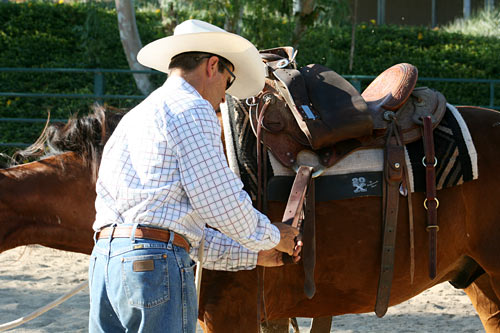
While still in High School, Troy Henry taught me how to use a lariat rope as a nerve line. (What others might call a war bridle), I still recall how he would step up and loosen the rope to release the pressure when a horse attempted to yield rather than resist against the pressure.
Pat Parelli showed me how a round pen should be so much more than the place where you first stepped on broncs or just run horses around to get them tired. He demonstrated how the round pen could be a place to have a conversation with a horse and establish a relationship built on trust and respect.
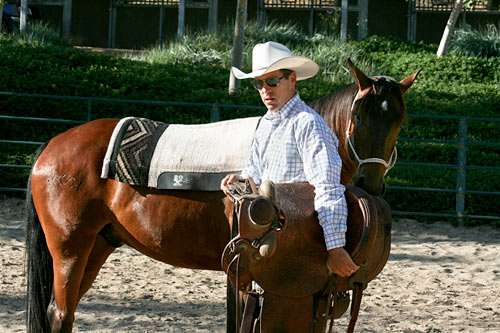
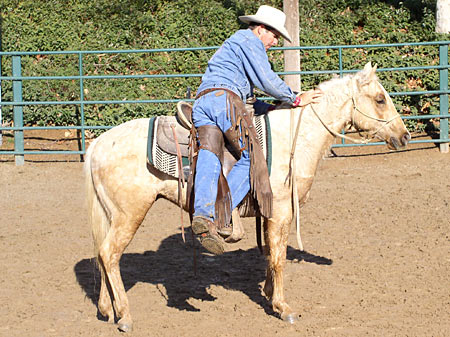
Twenty-five years ago, I observed Joe Wolter at a clinic with a young horse to be saddled for the first time. Joe held the saddle with his left hand and had it propped on his left hip. When he put it up on the colt’s back, it was the smoothest technique I had ever observed. I vowed to go home and master that same method. I’m glad I was there that day!
Many years ago Tom Dorrance showed many of us how we could help a horse execute a flying lead change, using a pole on the ground. This is a great exercise for horses and riders, who have a pretty good foundation, yet lack the refinement of ultimate body control. I use this same exercise with students at many of my clinics today.
Observing Ray Hunt, in numerous Colt Starting clinics, convinced me that getting out of a colt’s way, and not pulling on them, would be the best policy for getting along and staying out of trouble. The objective is not “how I would get them stopped,” but rather, “how can I help them move out.”
Buck Branaman came to the Thacher School to conduct a clinic a few years ago. He demonstrated a simple yet meaningful technique for softening a horse on the ground, while backing. With his left hand at the base of the halter, thumb down, he firmly worked the halter laterally back and forth. As the horse softened his face and backed up, he softened his hold on the halter. This exercise removes a lot of braciness in a horse and helps the handler develop a lot of feel. I do this with all of my colts before I step on them for the first time.
I attended a Les Vogt clinic in Klamath Falls, Oregon, about ten years ago. That was a turning point in my own personal horsemanship journey. He showed us exercises and a plan to obtain control of each of our horses’ body parts. This body control opened doors for me to advance my own performance horsemanship. What I learned that weekend was invaluable.
Doug Williamson has shown me the advantage of shortening my stirrups when riding performance horses. If I want to be comfortable, on a long trail ride, I can let them down. Yet, if I want to help my horse do something athletic, I need to raise them up.
Ted Robinson suggested I might like the feel and results of a Billy Allen curb bit, versus a Tom Thumb or Argentine Snaffle. He was right! It was also Ted who helped me understand a horse’s proper body position when counter cantering. Without that guidance, I would just be loping around on the wrong lead!
Of course, this is by no means an exhaustive list. These are just a few instances and individuals who have added value to my training program. As I’ve recounted a few of my “learning moments,” I hope it has reminded you of the teachers and mentors who have given you so much as well. Remember, the list is not all-inclusive and the learning is unending.
For more information about Richard Winters Horsemanship please go to wintersranch.com.