

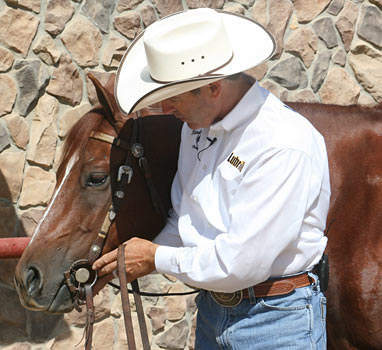
There is probably no bit that is more widely used, regardless of the riding discipline, than the snaffle bit. From Richard Winters Horsemanship
A snaffle bit has a broken mouthpiece connected to rings on either side, and it is a lateral mechanism—designed to work side to side rather than through hard, direct pressure on both reins. It excels at teaching a horse to give and yield his head, and thus his feet, to the left and right, which is why most horses are started in a snaffle and why it remains the most widely used bit across riding disciplines. A chin strap is still worthwhile on most snaffles because it keeps the bit from pulling through the horse’s mouth when one rein is used.
Hanging in your tack room is probably some form or style of snaffle bit. Perhaps you use it everyday. Or maybe it’s unused and gathering dust. There is probably no bit that is more widely used, regardless of the riding discipline, than the snaffle bit. Even though it is a commonly used piece of equipment, there are still many misunderstandings regarding its use. Here are some of my thoughts regarding the snaffle bit.
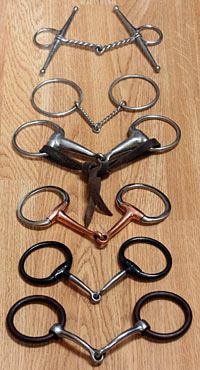
Generally speaking a snaffle bit has a broken mouth piece connected to rings on either side. There are different mouth pieces such as plain smooth, extra thick, extra thin, twisted wire, and a handful of other variations. The cheek pieces can be a simple ring, egg butt, o-ring, or full cheek. Most snaffles will be 5” to 5'” wide. This size will fit the vast majority of horses. In the last few years some performance horse trainers have been using 6” to 6'” snaffles with extra heavy rings.
They believe there is more “pre-signal” and “feel” with those larger bits.
Snaffle bits are lateral mechanisms and are made to be used laterally - side to side. Pulling back hard on both reins in a snaffle becomes increasingly less effective in controlling a horse’s movement. However, the snaffle is very effective in teaching a horse to give and yield his head (and thus his feet) laterally to the left and right. Most horses are started in snaffle bits and can learn to bend and turn as the rider uses each rein independent of the other.
The Snaffle Is A Safe Place To Start
If I am going to ride a horse that I know little about, a snaffle bit will allow me to evaluate where this particular horse is in his training and understanding. If I use a leverage (or curb) bit initially and the horse has never had one on, I’m probably going to create confusion and have trouble.
The Value Of A Chin Strap
“Why would I need a chin or curb strap? That’s only for curb bits where leverage is applied.” This is the perception of many. On a snaffle, a chin strap will be very effective in keeping the bit from pulling all the way through the horse’s mouth when using one rein. It need not be adjusted tight and is normally placed between the reins and bit. The one exception to the need for a chin strap is with the full cheek snaffle. Its design has two bars on each side of the ring that keeps it from running through the horse’s mouth.
Adjustments
There are different theories in regard to how tight or loose to adjust the snaffle in a horse’s mouth. I like my snaffle to hang a little lower than some riders are accustomed to. I adjust it just below where it would cause a wrinkle in the corner or my horse’s mouth. I don’t want constant pressure against my horse’s mouth that he can’t get away from. You might think that a lower hanging bit will allow the horse to get his tongue over the bit.
I’ve found that adjusting it higher does not prevent a horse from getting his tongue over the bit; however, it does make it harder for him to get it back under. Most horses decide that the most comfortable place for them is to have their tongue resting under the bit.
Material
Snaffle bit mouth pieces are generally made of sweet iron, stainless steel, copper, or a combination of these. You’ll often see an iron or stainless steel mouth piece with copper inlaid in the bars. This is believed to promote salivation. A moist mouth is important to creating softness and suppleness.
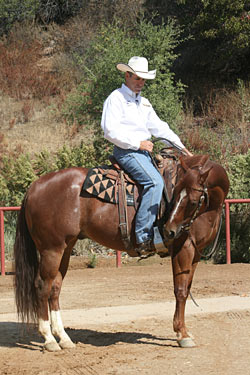
Some people may characterize a snaffle as a mild bit and perhaps a spade bit as severe. I don’t think these generalizations are necessarily true. Mildness and severity are in our hands and the feel we apply to the mechanism. The tools we use are important to understand, yet any bit can be abused by those who lack understanding and horsemanship skills. The snaffle bit is a great tool. As your horsemanship improves, you’ll find this simple piece of equipment an invaluable part of your training program.
For more information about Richard Winters Horsemanship please go to wintersranch.com.