

 Hay Bonnet™ Hay CoverHay Bonnet™ Hay Cover is Strong enough for high winds, Cool enough to stay cool in the Heat, light enough to be able to maneuver as needed and effective enough to help you Save on hay!Are You Tired Of Wasted Hay In The Pasture?The people at Hay Bonnet™ are horse people and understand all the frustrations and expense of trying to feed horses responsibly and reliably! We’ve all seen it. Hay scattered and strewn all around the feeder— tramped in mud, urine, or worse! With the cost of hay this is an unhappy sight to say the least. If you live in a wet or damp climate, now the fear of “mold” becomes an issue- and that can mean colic, illness, or vet bills.What If I Want To Turn My Hay Bonnet™ Into A Slow Feeder?
While the Hay Bonnet™ IS available without the slow feeder net, we want you to understand that our Slow Feeder NETis worth every dime and most of our clients opt to turn their Hay Bonnet™ into a Slow Feeder! Not only does it keep your hay from being dragged out and stomped into the ground, but it helps horses to eat, swallow and digest smaller, more uniform mouthfuls. This is Huge savings on hay— and vet bills— and it keeps horses happily eating for hours at a time! So What Makes Hay Bonnet™ Superior To Competitors?* More Durable- Hay Bonnets are made of 100% virgin Lldpe. A specialized polyethylene with UV inhibitor - Lldpe was chosen to ensure many years of flexibility without cracking. * Cooler Inside During Hot Temperatures-Basic thermodynamics supports our findings: darker colors absorb more heat than lighter colors. * Virgin Materials (not weaker ‘recycled’ materials!) The Hay Bonnet™ is made from 100% virgin material to ensure integrity of material, to maintain high quality and flexibility, and to allow for the light color of the Tumbleweed Tan. Recycled material has to be darker to cover the variations in the recycled products and also has to be thicker to allow for variations due to impurities in recycled material. * Wider Stance- Creates more stability in High Wind Areas. No need for anchors. Easily fits over Any Large Round, Large Square or Multiple small bales. Base remains wide open. No sagging when tipping. * Solid One Piece Construction- Eliminates the twisting and cracking problems as well as the loose and missing bolts common with other 2 piece models. * Tapered Sides- Hamper physical contact from stock, eliminating damage to windows and roofs.
* 100% Made IN THE USA! How Long Can I Expect My Hay Bonnet™ To Last ? The original Hay Bonnet™ prototype built in 2000 is still in daily use. Hay Bonnet™ has evolved over the past 16 years to address issues such as easier shipping and the integrated slow feed net. A customer should expect your Hay Bonnet™ to provide at least ten years of daily use. What Is Hay Bonnet™ Made Of ?Hay Bonnet™ is made of 100% virgin Lldpe. A specialized polyethylene with UV inhibitor Lldpe was chosen to ensure many years of flexibility -without cracking!Why Do We Use Virgin Lldpe Instead Of Recycled Plastic Like a Competitor?We do it to ensure integrity of material, to maintain high quality and flexibility, and to allow for the light color of the Tumbleweed Tan. Recycled material has to be darker to cover the variations in the recycled products and also has to be thicker to allow for variations due to impurities in recycled material… darker materials hold more heat which make it really uncomfortable for horses in hotter months!Are We Much Cooler Than Our Darker Competitor? YES! Basic thermodynamics supports our findings: darker colors absorb more heat than lighter colors. Our research on temperature difference demonstrated that the green covers were on average 30 to 50 degrees hotter than our Tumbleweed Tan Hay Bonnet™. A cooler temperature provides a more pleasant equine experience and extends the life of the hay. (Hotter temperatures coupled with humidity increase the chances of mold.) Another advantage of a light color like Tumbleweed Tan is the extended longevity of the Hay Bonnet™. Does The Hay Bonnet™ Collapse When It Is On Its Side? NO! Hay Bonnet™ is designed with 2 reinforcement bands to help it maintain its shape. The double band reinforcement ensures the Hay Bonnet™ does not collapse when on its side during the hay loading process. Since the Hay Bonnet™ does not collapse when on its side, it makes flipping it over any size bale of hay very easy. Can The Hay Bonnet™ Hold Up To High Winds? YES! While nothing can hold up to a 'tornado"— The Hay Bonnet™ hold their ground in high winds, protecting your hay from debris and being scattered across the field! What If I Don’t Have A Tractor To Use?NO Tractor, NO Problem, Just bring those big bales home as needed!
Can Women Easily Use The Hay Bonnet™?Yes-- they can and do! The Hay Bonnet™ is 8' x 8' square by 69" tall and only weighs 160 pounds making it very easy to handle.Some folks say that is short. Equine are grazers- they eat off the ground not over their heads.The larger base and lower profile makes it more stable in high winds without the need of anchoring. It has 8 large windows to allow plenty of room for your herd. The tapered sides eliminates the stock from leaning and pushing on the unit.Note:The extra supports at the bottom help it hold its shape to stay wide open for lowering over those large bales without hanging up on them. What Do Horse People Say About Their Hay Bonnet™? Our clients Love their Hay Bonnet™! Mike and Jonine JaycoxWe absolutely love our Hay Bonnet. We've owned one since 2001 and it has been the greatest asset to our farm. We went from getting 50% out of our hay to getting at least 85% of the hay (good quality) when feeding from the Hay Bonnet. This past year we invested in a round bale hay net to put inside the Hay Bonnet and now are saving 95% of the hay. We are always telling people what a great investment they are. We highly recommend the Hay Bonnet!
Diamond MC Performance HorsesWe have used this product for several years on our family-based horse ranch! The Hay Bonnet has exclusively protected horse manes as it prevents rubbing. Another important benefit of this product is the prevention of hay loss. We are able to make valuable use of the entire bale. Our horses have hay in front of them year round and this factor benefits their digestive needs. We highly recommend this product, and will continue to utilize this Hay Bonnet.
Janice from Shorter, Alabama I just can't say how much I love my Hay Bonnets! I originally purchased Hay Huts and I like to use nets to keep them from wasting hay. The fight to get the large hay nets on then putting the bale under the Hay Hut was just so time consuming. Then I discovered Hay Bonnets and their integrated net! Made my life so much easier! Also as a breeder I love that they are very sturdy and help me keep hay in front of my mares 24/7. I highly recommend Hay Bonnets! I now own 4 Netted Hay Bonnets.
Order Your The Hay Bonnet™ Today! The H ay Bonnet™ pays for itself in savings of hay— and health— for your horses in just a few short months— and it lasts for decades! With the rising costs of hay, you honestly can’t live without it! Hay Bonnet™ is only $825 without the slow feeder net and $1025 for net and Hay Bonnet™ combined. Call and talk to Anita today! |
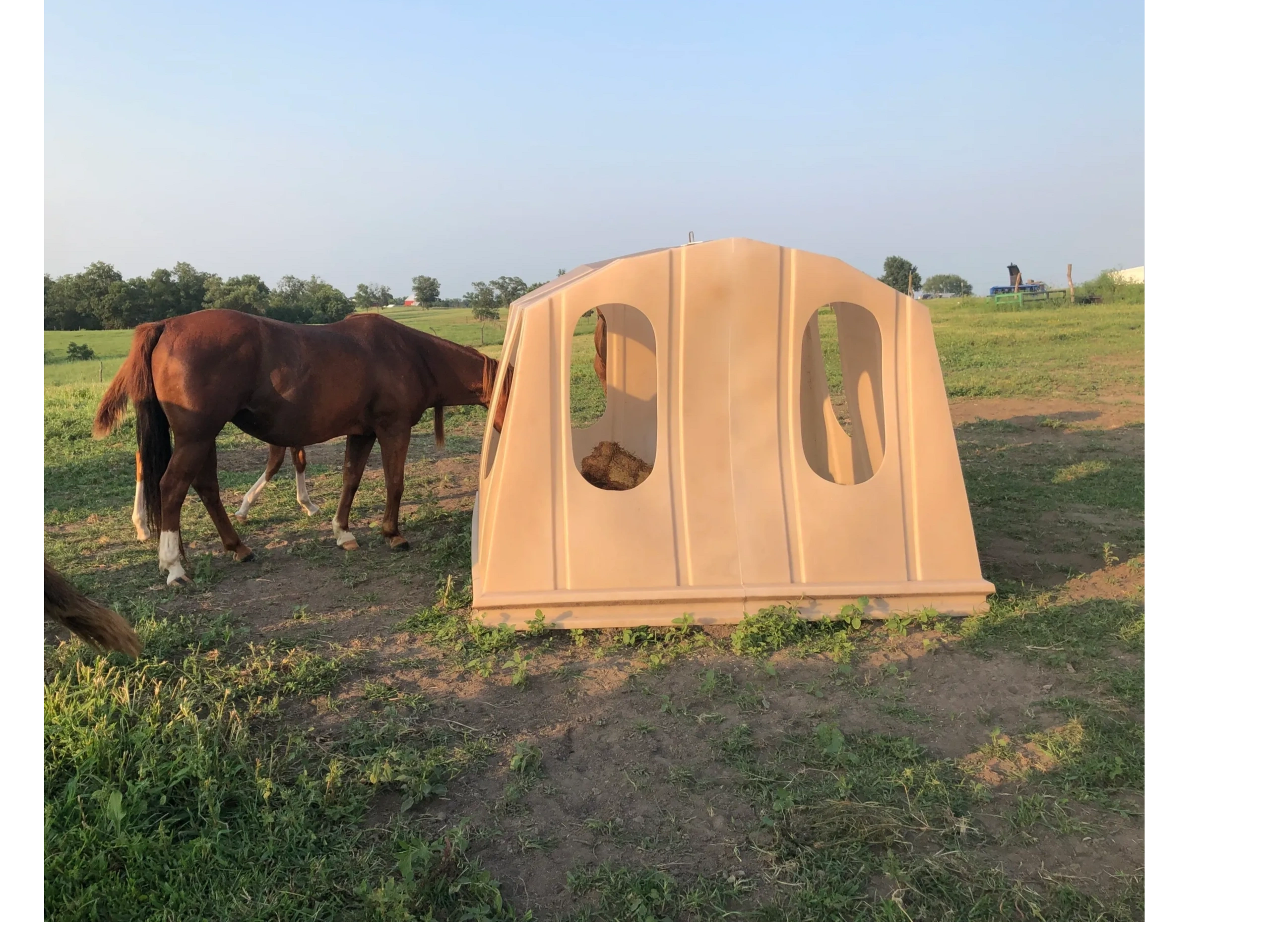
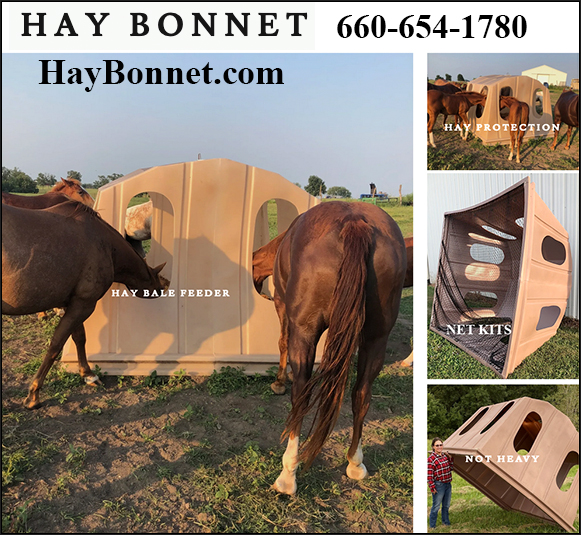
The Hay Bonnet™ is a one-piece plastic hay-bale feeder that drops right over your bale to shield it from rain, snow, sun, and mud. The unit measures 96" x 96" x 69" high and weighs roughly 160 pounds, so a single person can reposition it around the pasture without machinery. It holds an entire round bale or several square bales at once, and the hay stays protected for as long as it remains covered.
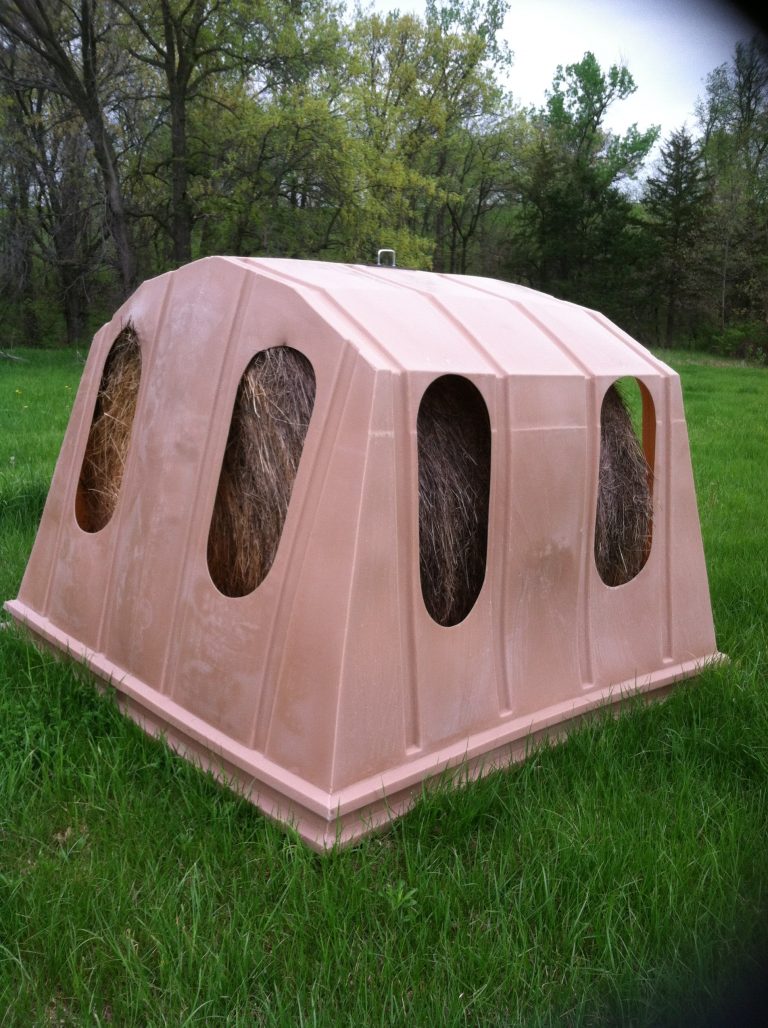
The people behind Hay Bonnet™ are horse people who first put the design to work on their own farm back in the early 2000s, then had it tested by horse lovers across the United States. The covers are rotationally molded by Coon Manufacturing of Spickard, Missouri (78 NE 115 Street, PO Box 108, Spickard, MO 64679), a maker that specializes in heavy-duty roto-molded livestock equipment. For pricing and orders the company asks buyers to Call directly.
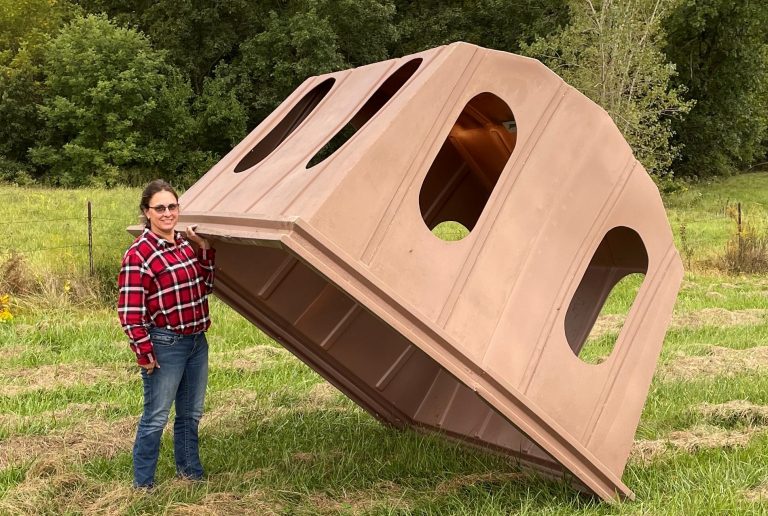
What is it made of, and why does the material matter?
Each Hay Bonnet™ is a single piece of durable Lldpe (linear low-density polyethylene) plastic, so there is nothing to assemble and no hardware to rust or fail. The plastic is intentionally a lighter color, which keeps the bale from overheating or sweating the way a dark cover would. Because the whole shell is light-weight molded poly, it transports easily and stands up to season after season of weather.
How does the design beat wind, heat, and waste?
The Hay Bonnet™ sits short to the ground with a wide, low base, giving it an aerodynamic profile and a low center of gravity that makes it hard for high winds to tip or roll. Setting the unit on a pallet creates air circulation underneath, which keeps hay dry, prevents the fermentation and mold that moisture causes, and further cuts waste. The company says the cover is proven to pay for itself during the first year of use, and growers report hay utilization climbing from around 50% to 85-95% once a bale is kept dry and clean.
Eight large openings let horses of every size reach the hay comfortably, and the smooth molded edges are designed so manes do not rub or break — DiamondMC Performance Horses notes the Hay Bonnet™ has exclusively protected horse manes by preventing rubbing. The same unit feeds cows, llamas, alpacas, and other large animals, and it works just as well for younger, shorter horses that cannot reach a tall rack. One bale serves multiple animals at the same time, with feeding stations on all four sides.
The Orange Slow Feeder is made from Factory New Marine Grade netting — the same high-quality material used in the fishing industry. Nothing is used or reclaimed; it is all new material. The twine is thick, finely braided Polyethylene, which lasts considerably longer than the lighter-weight non-braided twine many competitors use.
Marine Grade netting is abrasion resistant, UV inhibited, and built to be over-stuffed, which gives it a much longer life than typical feed-net materials. The Orange Slow Feeder uses netting with a 1200 lb breaking point. Brian Leary and his clients have used the same nets with their horses for nearly 4 years.
Slow feeders reduce hay waste and support a more natural, healthy way to feed, which can lower costs tied to hay, colic, and ulcer prevention. The bigger savings come from durability: if you replace cheaper nets every 30 to 90 days, those costs add up fast. Orange Slow Feeder nets are built to last years, reducing your long-term replacement cost.
The current square size is 1-3/4 inch. Additional sizes are planned, with 1-3/8", 1-1/2", and 2" squares listed as up-and-coming options.
The lineup includes the Small Trailer Feeder at $42.50, the Large Trailer Feeder at $57.50, the Pumpkin Net at $72.50, and the West Coast Net at $92.50. Larger options include the Round Bale Net at $215 to $345 depending on size, the Small Square Bale Net at $330, and the Large Square Bale Net at $390.
Yes. The nets are designed to be compact for easy storage and transport, while still offering a wide opening that makes filling simple — they can even be over-stuffed. That suits busy horse owners who often work jobs off the farm or ranch.
That is exactly the problem it was built to solve. Founder Brian Leary started the company after his own horses destroyed every net he tried, and customers report the nets are virtually indestructible. One client kept the same net in front of a known net-eater for 18 months.
You can call or click to order. Reach Brian Leary by phone at 253-363-7801, or visit the Orange Slow Feeder online at https://www.orangeslowfeeders.com to choose the net that fits your hay and your horses.
The standard mesh is a 1-3/4" square opening. Select nets like the Pumpkin Net also offer 1-1/4" and 2-1/2" square mesh, and the company can produce custom mesh sizes on request to match your slow-feed goals.
Orange Slow Feeder is a woman- and veteran-owned small business in the Pacific Northwest, founded in 2014 by Brian Leary. The netting and ropes are manufactured in Washington State, and the rings are manufactured for the company in Rhode Island, making it an all-USA build.
It started with horses. Owner Brian Leary was looking for a way to help his own horses, and as the company says, "The Original Orange Slow Feeders were built for our use with our horses." That personal need in 2014 turned into a product line of heavy-duty slow-feed nets.
On orangeslowfeeder.com, the Pumpkin Net is $75.00, Round Bale Nets start at $215.00, Square Bale Nets start at $82.50, and stall/trailer nets start around $42.50. Bulk netting and accessories begin near $17.00.
The company states the nets "Reduce Waste by 98%." Because the horse must nibble hay through the mesh instead of pulling it onto the ground, far less hay is trampled, soiled, or blown away, which is where most feed money is normally lost.
With everyday use, the nets are rated for roughly 1 to 6 years. Stationary nets that aren't moved around tend to last 1 to 3 years; rotating a stationary net to a fresh section of mesh about once a month helps extend its life.
Rarely. According to the company, "maybe a handful of horses chew through these nets," and that's typically only extremely aggressive chewers. The heavy 4mm marine-grade twine is built specifically to withstand the abuse of a determined or playful horse.
The netting has a 1,200-lb breaking strength, so as the company puts it, "The netting is NOT going to break. The shoes will get ripped off." Proper hanging is essential for shod horses, and for ground feeding with round bales, shod animals need the net protected or elevated.
Yes — they are ideal soaking nets. The netting does not hold water because, in the company's words, "The netting material is designed to drag along the bottom of the ocean," so it sheds moisture and drains rather than staying waterlogged.
The polyethylene material "does NOT hold moisture so it will NOT freeze" on its own, and stays pliable in cold weather even if it stiffens slightly. The one caution: if animals pack a ground net into wet ground, mud can freeze the net into the soil, so keep it off saturated dirt.
Pressure wash it, or soak or spray it with a vinegar-and-water solution. Cleaning out the dirt and grime that collects between the fibers also keeps the net from getting stiff, which is the usual cause of stiffness rather than the material itself.
For a single horse, the Pumpkin Net is the most versatile choice — it hangs in a stall, on a high line, or on the side of a trailer. For pasture or herd feeding, choose a Round Bale Net (4'x4' up to 6'x6') or a square-bale net like the West Coast or Colorado Bale Net to match your bale size.
The Pumpkin Net's open end is "large enough for one person to easily fill the net with 3 flakes of a 3-tie hay bale or 1/2 of a full compressed bale." Its top rope is strong enough to hang from a beam or eye-bolt for stall, high-line, or trailer-side feeding.
Yes. The company says, "Absolutely! Our usual mesh size 1-3/4" is a good size but you can always ask us for a larger size if needed." Custom larger mesh is available for livestock that need bigger openings.
Slowing intake keeps the horse chewing and producing saliva over a longer period, which buffers the stomach, and it spreads feeding across more of the day. As the company notes, "Horses are designed to graze 18 hours a day," so a slow feeder more closely matches a horse's natural grazing pattern than meal-style feeding.
Wet, moldy, and trampled hay is wasted money, and that loss adds up quickly over a feeding season. The Hay Bonnet keeps hay dry, cool, and clean so far more of every bale gets eaten, which is why the company says it pays for itself in the first year and longtime owners credit it as one of the best investments on their farm.
Explore more from the InfoHorse.com directory
Explore expert guides on topics related to your business
By Ann Pruitt
By Bob Pruitt
By Bob Pruitt
By Bob Pruitt
By Ritchie Waterers
By Bob Pruitt