

The Value of Using Elastic Kinesiology Tape in Equine Training Programs Horse Health Products Here
Elastic kinesiology tape helps horses by using its unique stretch-and-recoil properties to support joints and muscles while still allowing full range of motion—unlike traditional athletic tape, it does not restrict movement or compress tissue. Applied through the Equi-Taping™ method, the medication-free tape adheres with a medical-grade non-latex adhesive and can decrease pain and inflammation, speed recovery, increase circulating blood and lymph flow, and relax tight, hypertonic muscles in equine athletes.
by Dr. Bev Gordon Elastic kinesiology taping has been popular in human athletics for many years, but its popularity has been markedly on the rise since the 2012 Summer Olympics, where many Olympians were seen wearing it during their competitions. Its proven success has led forward -thinking equine professionals to consider its use in equine health care and training programs, where they are witnessing firsthand its clinical benefits.
What is it?
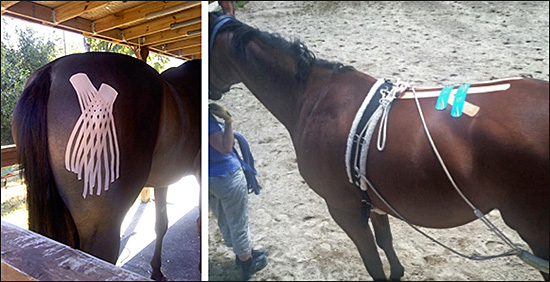
Equi-Taping™, the modality named for using elastic kinesiology tape on horses, employs the tape to enhance training outcomes, and, therefore, positively influence the potential performance of equine athletes. Equi-Taping method uses the tape’s unique properties of stretch and recoil to effect function of the musculoskeletal and vascular systems of the body. The tape has no medication on it, and adheres by a medical grade non-latex adhesive. Its clinical success is based upon how the tape is applied, specifically, the technique used for the application. The amount of stretch, the pattern and direction for laying down the tape determine the physiological effects achieved.
Why use it?
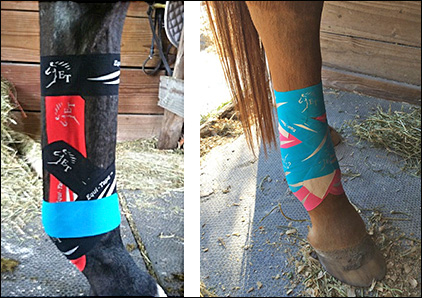
Some of the benefits derived from Equi-Taping include decreasing pain and inflammation, decrease recovery time, support joints and assist muscles during activity, as well as increase circulation, and relax tight hypertonic muscles. The tape is unique and differs from traditional athletic tape in that it does not restrict movement and does not compress tissue.
The tape supports joints and muscles while allowing full range of motion, and actually acts to decompress tissue which decreases pressure on pain receptors and allows for an increase in circulating blood and lymph flow. The application and theory of elastic kinesiology taping for use on horses is based upon our current knowledge and clinical success in the human field.
How does it work?
It is noteworthy to mention that when used as part of an athletic training program, elastic kinesiology tape applied to healthy tissue can be used to support joints, ligaments, and tendons, as well as assist muscles in training. This type of application works preventatively to help horses train harder, recover more quickly, and prevent injury. Effects of the tape are based upon its interaction with the skin, its ability to stretch and recoil, and particularly its decompressive nature which increases circulation to working muscles.
This is a key factor regarding its use in training programs. Simply stated, muscles in training need oxygen (along with other components made available in the circulating blood) to produce the energy necessary for work.
In the absence of oxygen, the working capacity of the muscles decreases, and the body builds up by-products which are toxic to muscles. These end products of anaerobic muscle activity are responsible for muscle fatigue, as well as soreness after exertion. Increasing blood flow to working muscles increases the available oxygen necessary for work, thereby increasing muscle work capacity. Increased circulation also plays a major role in removal of these toxins and speeding recovery time.
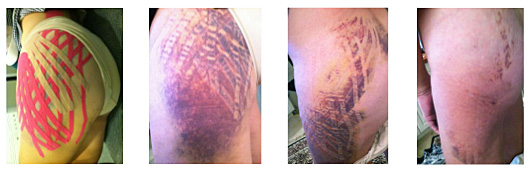
Use in training programs- The tape’s unique property of stretch and recoil aids muscles in contraction during work and helps decrease early fatigue. Additionally, the tape can support joints and assist them in returning to neutral position. One of the major benefits of using the tape during training is its ability to support a joint while allowing for full range of motion, thereby assisting joint movement rather than restricting it.
Examples of common athletic training applications include assisting gluteal, back or neck muscles in horses who are training for competition, use in warm-up in preparation for competition, and use as support on ankle joint and lower leg tendons/ligaments to prevent unsoundness. Taping can be beneficial to horses of all disciplines.
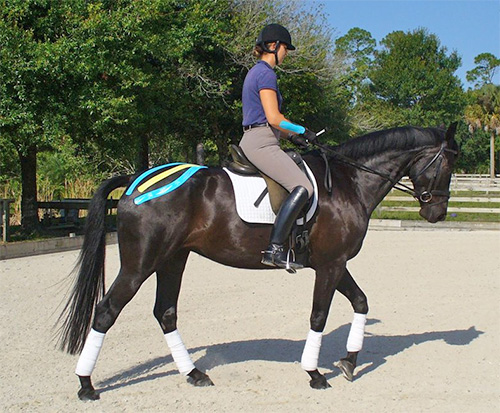
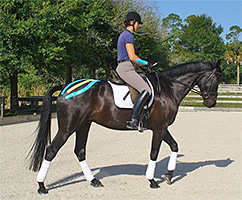
Including the use of Equi-Taping in equine athletic training programs can encourage greater working capacity of the muscles, and offer support, which in turn can improve the effects of training. Pictured in this photo is an example of an Equi-Taping application for Gluteal Medius/Hind End Muscle Assist.
Common uses by trainers and professionals, which are often included in training programs, would be: 'Assist hard working, over-used or weaker muscles in training 'Use for horses moving up a level in training, or returning to training after rest to decrease soreness and speed recovery times (i.e., hind end or back muscles) 'Support joints/ligaments/and tendons through their full range of motion (i.e., ankle joint) 'Prevent future injury, especially on tissue previously injured (i.e., suspensory ligament or DDF) Equi-Taping is growing in popularity as it is proving to be an effective modality when included in equine training programs. As with most modalities, the success of its use is directly related to proper assessment, application and technique.
While trainers and horse owners can easily learn to use the tape in their training programs, it is highly recommended that lay people consult certified Equi-Taping practitioners to determine the best taping application for their horse.