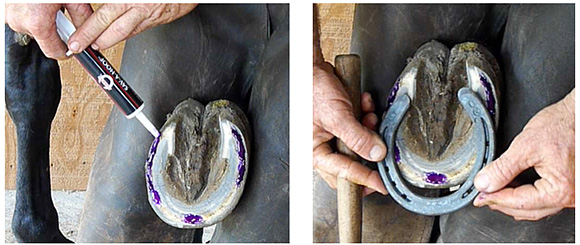


Equine Thrush – What It Is and How to Deal With It For our horses’ sake, keep the stalls clean, keep the floors cleared of feces, keep them clear of mud, keep that pick and wire brush close at hand and use them daily. Catch it early!
Thrush is a hoof infection caused not by a single organism but by a mix of yeasts, bacteria, and fungi—most commonly the yeast Candida albicans, along with the bacterium fusobacterium necrophorum. Surface-dwelling aerobic microbes respond to topical sprays and wipes, but the anaerobes buried deep in the tissues require soaking: a thirty-minute soak in apple cider vinegar or dilute chlorine dioxide kills the microbes themselves, while a product such as CleanTrax also kills the spores that cause re-infection. Daily hoof picking and wire-brushing, clean stalls, and mud-free footing remain the best prevention—the real trick is to catch it early.
Thrush is an infection most often found in the hoof. Massive efforts have been expended over the years to develop The Absolute Thrush-Buster, with limited success. It has resulted in a broad spectrum of products becoming available on the tack shop shelf, all of which claim to eliminate thrush from your horse's feet. While many of them do reduce and control the infection in some hooves, there are several problems that remain to be dealt with; a given product may clear things up for some horses, but seems ineffective for others. And secondly, many of those hooves whose thrush does get controlled end up with a re-infection a couple months later.
It's certainly not a simple problem.
And this is the season, springtime, when thrush tends to rear its ugly head. Although we've covered this subject a while back, a reminder may prove of value. So read it; if it's new to you, it may prove of immediate help to your horse, and if it's old news, a timely reminder may be of equal value.
Just what is this elusive infection, anyway?
Well, that’s part of the problem. The term “thrush” gets hung on just about every hoof ache or pain that comes along, but it is not necessarily just one type of microbe that’s responsible. There are enough bad guys to fill a Post Office bulletin board, including yeasts, bacteria, and fungi! The most common of the “usual suspects” is a yeast named Candida albicans, a nasty little creature, and very difficult to eliminate.
In addition to albicans, there are a number of other species within the genus Candida that are known to cause human and equine infections. And to add some complication, a bacterium called fusobacterium necrophorum is also commonly held responsible for many “thrush” infections, Plus numerous fungi in the line-up as well. The invading army that causes “thrush” can have many mercenaries, and it is asking a great deal of any one treatment to go out there and kill ‘em all.
As if that’s not complex enough, yeasts and fungi exist in both “live” and spore form. Consider the spore to be a bulletproof “egg” that contains the microbe, which “hatches” when environmental conditions are favorable – dark, warm and moist, with maybe Mantovani playing in the background. Killing an army of microscopic fungi may be doable, but the spores they leave behind are virtually invinceable; they patiently wait for those favorable conditions to return, at which time they “hatch” and re-form a brand-new army!
Tackling the problem…then back to the drawing board
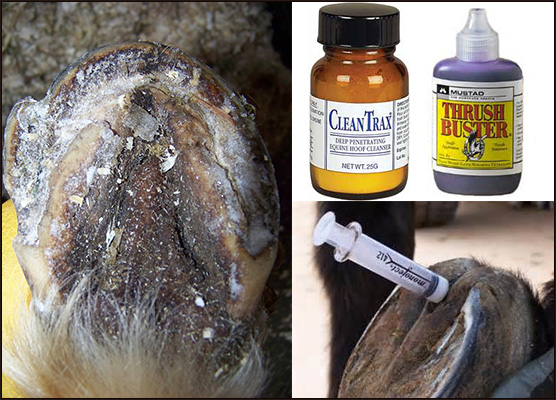
So here are we, one day, observing our horse three-legged lame, perhaps, with a gooey, stinky mess exuding from a frog. “Aha,” we think, “this is thrush and I’m gonna get rid of it.” Of course, we don’t know what organism or organisms are responsible, so we ask the guy in the tack shop for the best of the thrush killers, we buy it, then take it home and have at it. Sure enough, after a few applications, things appear to be getting better, the frog is healing, the goo and the smell are gone, and our horse is happy – until a few weeks later, when we see a rerun of the problem developing.
Spores have hatched and have started to party again, plus some new neighbors from the stall floor have joined them, and we’re ready to return to the tack shop to look for a newer and better anti-thrush miracle cure.
More about these nasty little critters
A real curve-ball that nature has thrown at us is that we can be actually dealing with two entirely different entities, here – aerobes and anaerobes. Aerobes live and breathe even as do you and I, which means they need air to survive, which makes them vulnerable to our attacks. That opens the field to most of the on-the-shelf products that we wipe on or spray on. These are the easiest to apply, and when they work, our job is easier and the thrush is gone.
The anaerobes are quite another story. They cannot live in air. Consequently, when without a host, they exist in spore form, sort-of in a state of suspended animation. But those spores, along with their aerobic cousins, cover the stall floor and walls, even the very dirt we walk on, even our own shoes! It takes two things for an infection to hit a hoof: the hoof needs to be standing amid the microbes (that’s a “gimme” – if he’s in the stall, he’s standing amid them, and standing anywhere in mud or feces, is like he’s put out the welcome mat for infection), and the hoof needs to have some “doors” open – any tiny lesion on the bottom of a foot will do. Both microbes and spores get jammed into the lesion, where they get sealed in when the horse stands or walks in mud.
The living microbes are already at work, and when the spores realize that there’s air, it’s warm, it’s moist, they burst forth and join the party.
Now we start to see the complexity of fighting “thrush”. Topical treatments work on aerobes because we can get at them. But not so for the anaerobes. Living in an airless environment means they are buried deep in the tissues, hard for us to reach. A new approach is called for; soaking those feet in the appropriate microbe-killer long enough for the medication to soak in and do its job.
A 30-minute soak in apple cider vinegar or dilute chlorine dioxide (Oxine or White Lightning, for example) will do the job on the microbes, but not their spores. For that, soaking in a product designed to kill spores is needed. There are several on the market, but the most effective may be CleanTrax, available on-line – it will kill aerobes, anaerobes, and spores.
So when you can see deterioration of the frog, and/or smell a real stink on those hooves, the “enemy” is obviously present and you can deal with it. But the real trick in dealing with it is to catch it early, before much damage has been done, and for that, some preventive measures are called for. Thoroughly scrub the entire bottom of the hoof – noplace for undesirable microbes to hide. Form the habit of picking and wire-brushing the hoof bottom clean, a quick scrub with Dawn detergent, every day, then spraying the entire surface with a microbe-killer; keep the foot off-ground for fifteen or twenty seconds to allow some penetration of the spray.
Two very useful sprays are colloidal silver (silver ions destroy key enzyme systems in the cell membranes of these pathogens), and Usnea (a symbiosis [one organism living on another] of a fungus and an alga, used for its antibiotic and antifungal properties). Both are available on-line: consider the colloidal silver brand, “Silvetrasol”, about $20 for a spray bottle, and Usnea Tincture, about $10 for four oz., available from Essential Wholesale & Labs, among others. Mix Usnea 50-50 with water and spray daily, but Silvestrasol once a week.
Spraying is a quick and easy preventive procedure – but take it a step further and disinfect any crevices you see. For example, a healthy hoof has no crevices or clefts, but a potential problem will show up as a cleft developing in the center of the heel of the frog. It will usually be just a slit, but if you can insert the metal tip of your hoof pick into it to any depth at all, it’s a problem in development.
Left untreated, that cleft will develop into a crevice that’s as deep as your pick’s tip is long – or deeper. That means trouble is coming, and you should take countermeasures right away. Such clefts are well-protected hidey-holes for thrush-causing microbes to start their damaging work. The trick is to deposit some microbe-killer directly into the bottom of that cleft, and to do that you need a special, inexpensive, syringe (no needle).
Your vet can probably provide you with one; it has a long, flexible tip that allows you to get it into tight quarters. An alternative is to buy the product, “ToMorrow”, from your local Agway, Tractor Supply, or equivalent. ToMorrow contains medication useful in treating mastitis in cow udders, hence its long, flexible tip. You can use it to deposit a pea-sized glob of medication at the very bottom of a frog cleft.
You can use the mastitis treatment cream itself in frog clefts, but a better alternative is to empty the syringe, and then refill it with a 50-50 mixture of Triple Antibiotic Cream and Clotrimazole, both available on your druggist’s shelves. TA Cream is effective in combating Athlete’s Foot – a fungus infection – and Clotrimazole is a powerful general treatment, especially useful in combating thrush. Added bonus is the cost for one ToMorrow syringe is only about two bucks.
The outlook is positive
And so, with all this, we’ve not yet crossed home plate – but we’re on third, waiting for the base hit that lets us score. We know what causes the infection; we have not yet found the silver bullet – but we’re getting closer. The thrush condition in horses is actually quite similar to the human version, and when we are able to nail it completely in humans, we should have it licked in horses, too.
Meantime, we do have means to control it and make our equine partners more comfortable while we’re at it. It’s so insidious that it can slide in under the radar and our problem becomes repair rather than prevention; but to prevent takes vigilance and some effort on our part. So for our horses’ sake, keep the stalls clean, keep the floors cleared of feces, keep them clear of mud, keep that pick and wire brush close at hand and use them daily. Catch it early!