


How to Select A Sound System for Horse Clinics

by Barb Paulsen for Equine Audio
Start by deciding between a permanent installation—recommended for facilities that host events or do training—and a portable solution, which suits traveling clinicians but won’t render the sonic quality of a permanent install. Clarity, meaning the lack of distortion, is the most important factor in any sound system: instructors must be heard loud and clear, especially in training scenarios with mounted riders, where missed instructions become a safety issue. Plan the coverage zones you need, allow ample time for installation and troubleshooting, and always test the system no less than a week before an event.
Imagine if you will, your guests arrive at your event and are welcomed by warm, inspiring music. Magic is in the air, and you have effortlessly set the tone for an engaging and enjoyable experience. But how did you did do it? In our world at Equine Audio, your first step is to select the appropriate sound system for your space. The primary objective for the sound system in horse clinics is to educate, and in order to effectively educate your audience you – the Ringleader – must be heard. To entertain is secondary.
A good to great sound system provides the necessary clarity required to project your message across your space. A clean sound elevates your performance while enhancing the element of safety.

Clarity is the most important factor in any sound system. Clarity is the lack of distortion in the sound emanating from the system. Your instructors must be heard loud and clear! You may have prepared a brilliant presentation, but without the appropriate clarity, your instructions and/or insights will be lost on your audience if they are unable to decipher your message. In training scenarios, particularly those that include mounted riders (students and/or instructors, it is critical that all instructions are heard and followed. This way we can avoid injury, breaches of safety protocol, and the occasional blooper! With that said, every well-defined project begins with the planning.
Planning – Set Expectations: Know what you want/need from your sound system. Are you looking for a permanent install or a portable solution? Safety is always the priority in any installation. Permanent Installations are recommended for facilities that host events or do training. In this scenario, all equipment remains in place and simply requires turning it on. Safety Note - all cables and wires are always properly concealed, eliminating any trip factor for our equines and the instructors.
Portable solutions are secondary to a permanent solution for facilities and are mostly used by travelling clinicians. Portable solutions will not render the sonic quality of a permanent installation, but they are compact and can be a fantastic solution for the frequent traveler.
Limitless System Options: Will a basic/simple install that covers an indoor or outdoor arena (or both) address all your needs? Or are you looking for a system that will provide coverage for various areas or zones within your facility? Coverage areas are defined as “zones” within the audio industry. For example, sound systems can be configured to cover an individual zone, or multiple zones, as follows:
Zone 1: Indoor Arena; Zone 2: Outdoor Arena; Zone 3: Conference Room; Zone 4: Barn; Zone 5: Gift Shop; Zone 6: Viewing Area; Zone 7: Fire Pit Additionally, a system can work simultaneously across all zones (projecting the same message into all zones), or you can select the zones to be used. When budget constraints limit coverage across multiple zones, it is possible to complete a comprehensive (dream) installation in phases. This can be addressed with your service provider.
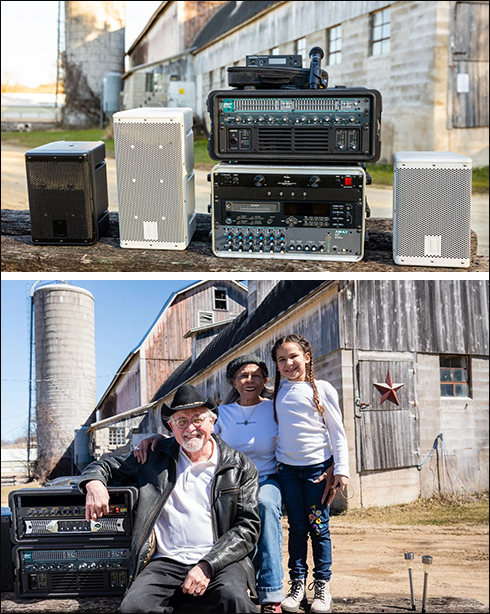
Sound Systems may consist of – Loudspeakers, power amplifiers, microphones (handheld, headset, lapel, wired/wireless), AC surge protector/power conditioner, mixer, feedback eliminator, multimedia playback devices – CD, AM/FM tuner, Bluetooth connectivity. Assistive listening and communication solutions (ADA compliance), protective equipment rack (lockable). Various cables. Some of the aforementioned products are optional based on your need, while others are not. For example, Bluetooth features allow clinicians to play music from online applications; CD, MP3, AM/FM tuners are also optional. The remaining components are required.
A reliable internet connection is key for those considering Bluetooth enabled features. Remote and/or rural locations with spotty service will require additional steps to strengthen your signal service or connectivity.

Regardless of your individual configuration, your system should accommodate both the spoken word as well as music. System costs will fluctuate based on the desired result. Set a budget, and a time-line for completion. Be sure to allow adequate time for the installation. Keep in mind, when technicians begin laying wires, things can go awry – always plan ample time for troubleshooting and system checks in your time-line.
No install should be completed the night before a clinic/training event! Always, always, always test your system prior to an event. No less than a week before the event to ensure the system is operating as intended. Testing may uncover a critical problem that could sideline an event. A disconnected cable? Mouse nibbles? Rehearsing or walking through your agenda prior to an event is the norm.
It is extremely important that you to become completely familiar with your system; and always have a reliable back-up operator.
A great sound system is additive to your business model, as it can provide additional revenue generating opportunities as you host events. Word of mouth marketing is powerful in our community, and as word spreads of your facility, sound system, delivery, and professionalism - especially in small communities – your reputation will grow (or shrink!) accordingly. Your system will be remembered.
An important reminder that your system costs are tax deductible! Section 162 of the Internal Revenue Code (IRC) details the guidelines for business expenses. The IRC allows businesses to report any expense that may be ordinary and necessary. Business expenses need not be required to be considered ordinary or necessary. Generally, ordinary means that the expense is common in the industry and most business owners in the same line of business or trade would normally expense these things.
Necessary means that the expenses are appropriate and a business owner might not be able to manage without making the expenditure. An expense that meets the definition of ordinary and necessary for business purposes can be expensed and, therefore, is tax-deductible. Finally, your selection of music should match the profile of your attendees and align with your image/brand as a host.
There may be a rather diverse age range/group, so be sure your selection will accommodate all. You control the volume. Happy Tales & Happy Tails!