


Equine Recurrent Uveitis (Moon Blindness) Not Just in Horses! Article by Douglas Kiburz, M.D. for HA-Top Shelf, LLC HA-Top Shelf is the highest potency, freshest, most potent form of Hyaluronic Acid available for your horses, dogs, cats and family today! Effective for joints, bones, eyes and so much more!
Moon blindness—known formally as equine recurrent uveitis—is the most common cause of vision loss in horses, affecting up to 25% of horses worldwide and eventually leading to blindness in more than half of those that develop it. It’s thought to be a complex autoimmune disease with both genetic and environmental factors, linked to bacterial infections such as Leptospirosis, parasites, viruses, and eye trauma, and it occurs about eight times more often in Appaloosas. There is no cure, so early diagnosis by a trained veterinarian and treatment aimed at reducing pain and controlling inflammation offer the best prognosis.
ERV or Moon Blindness (Nothing to do with the phases of the Moon) is the most common cause of vison loss in horses, can lead to blindness and affects up to 25% of horses world wide. Uveitis can occur in any critter (two legged or four) and affects 38 out of every 100,000 humans. It is thought to be a complex autoimmune disease with both genetic and environmental factors and is more common in Appaloosa ( 8 times higher) and Warmblood breeds.
ERV has been associated with bacterial infection (Leptospirosis), parasites, viruses, equine influenza, fungi and trauma- especially corneal abrasions. The horse’s eye, being large and prominent and located on the side of the head (nonpredatory position) makes it prone to injury and exposure with rolling, tree limbs, sun and wind, riding through brush and in the process of eating grass and hay. Eye Anatomy.-A complex organ for vision.
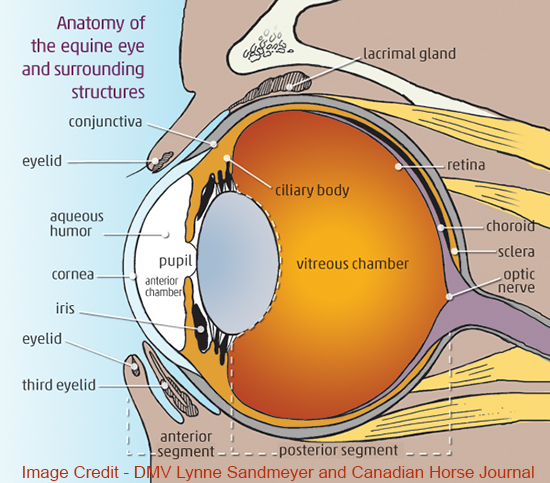
Cornea: The outer surface which is the round and transparent protective layer. It is sensitive to pain and refracts light toward the lens. Sclera: the tough protective white envelope of the orb. Pupil: The small, circular opening controlled by and centered in the iris. Uvea: The pigmented portion of the eyeball consisting of iris, choroid and ciliary body. Iris: The colored part of the eye just in front of the lens that acts like the shutter in the camera.
Choroid: The middle of the eye between the retina and the sclera that contains blood vessels and supplies oxygen and nutrients to the retina. Ciliary Body: It connects the iris and choroid and plays a role in accommodation and nutrition. Lens: A transparent structure enclosed in a thin capsule that allows for focusing at different distances. Macula: The central most sensitive part of the retina.
Fovea: A concentration of cone cells necessary for sharp vision. Aqueous Humor: The clear liquid filling the orb and giving it shape and providing nutrition having a high concentration of hyaluronic acid (HA).
Vitreous Body: The gel like connective tissue between the lens and the retina consisting of collagen and hyaluronic acid (HA) Both oral and topical HA supplements have been shown to be important in eye and overall health and to help heal corneal abrasions.
The ”recurrent” name in ERV implies that the inflammation may appear acutely and have episodic flare ups over time as the process invades the retina causing incremental vision loss. The eye is considered a “privileged organ system” separated and insulated from the immune system. Inflammation can be a positive healing process in the body’s response to injury or exposure. However in the eye , if the inflammatory process invades the “blood retinal barrier” by injury or infection, the inflammatory T Cells become destructive.
ERV is closely related to autoimmune diseases in all species as the immune system attacks native tissues. Symptoms may include a haze to the eye, green-yellow appearance, redness, light sensitivity (photophobia) and pain. On exam, clinical findings may demonstrate lowered ocular intraocular pressure, adhesions, corneal haze, a constricted pupil, depigmentation and abrasions. Over a period of time, complications can produce cataracts, retinal detachment, keratitis, glaucoma, corneal opacity and blindness.
There is no “cure” for ERV, making early diagnosis by a trained veterinarian and having regular eye exams an important part of equine health. Reducing pain and controlling inflammation are the goals of treatment which may include topical medications, anti -inflammatories, immunosuppressive treatments, antibacterials, bright light avoidance, rest, eye protection, nutritional factors and surgical procedures.
Newer procedures such as cyclosporine implants and mesenchymal stem cell injections are evolving and a vaccine for leptospiraemia (the most common bacterial infection causing ERV) is available. Though not curable, the best prognosis, though guarded, comes with early detection and treatment. More than 60% of horses are not able to return to their prior level of activity and blindness can eventually occur in over 50% of horses that have ERV.
What can we do to protect our faithful companions? Horses seem to have a knack of finding ways to get injured in even the safest and best designed spaces. In choosing a horse breed, knowing that ERV is more common in certain breeds, genetic testing may be an option. Horses are exposed to more pathogens in marshy environments so being aware of that may be an opportunity for prevention.
Proper health, wellness evaluation and optimum nutrition are always opportunities to avoid problems. That includes vaccinations, parasite control, fly and mosquito control and timely dental work. Preventing eye trauma is not always controllable but checking out stalls (look for nails and wire) paddocks and pastures for safety is advisable. Other areas for prevention are limiting exposure to sun, wind, bugs and dirt and sand with fly masks and curtains or protective barriers.
The bottom line: being aware of “moon blindness” helps us to think ahead for environmental and health factors we can influence and to make the “eye exam” a daily part of the equine “once over” just as we look for lameness, cuts, bruises, swelling, punctures and the assortment of body language signals that our horses communicate with. All animals, including humans, are prone to eye problems including uveitis, which is a general term pertaining to eye redness, pain and inflammation.
It can develop in one eye or both and may involve the front, middle or posterior layers or all of them. Those humans more susceptible to uveitis may have arthritis, autoimmune disease, inflammatory bowel disease, prior viral infections and those who smoke. ERV is not considered contagious, but Leptospirosis, one of the many potential causes, can infect humans. Zoonotic diseases are those that can spread from animals to humans by close contact, exposure to contaminated soil, bedding or body fluids, mosquito bites, tick bites, cuts or scrapes or environmental hazards. Those with compromised immune systems are most at risk. A long and healthy life is an ongoing process and obligation for us and our companion animals. Douglas Kiburz, M.D.