

Hobble Training Your Horse, with Richard Winters
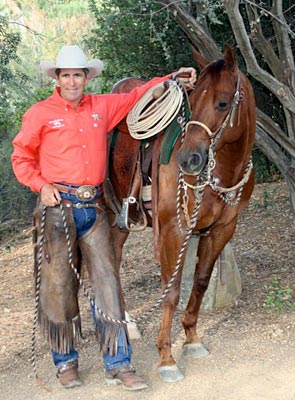
To hobble train a horse, start in a confined area like a round pen with soft ground, put support wraps on the front legs, and prepare him first by placing a rope around each front foot and asking him to yield to pressure. Once the hobbles are on, rock the horse gently at the withers so he feels the confines of the restraint, then step away with a raised hand and the cue “whoa,” rewarding every quiet stand with reassuring rubbing. After two or three days of these short lessons a horse is well on his way to being hobble broke—and a horse that has learned to yield to restraint rather than fight it may one day survive getting a foot caught in wire.
The practice of hobbling has been around since humans began riding horses. For some horsemen hobbling is as common and comfortable as putting on a halter. For others, hobbling a horse seems intimidating and maybe even dangerous.
In this article I’ll discuss the value of hobble breaking a horse and the procedures I use to teach this form of restraint.
Some may say, “I don’t need to hobble break my horse. If I want my horse to stay put, I’ll tie him up.” That might be true. However, there are other benefits of hobbling you might not have considered. The number one reason is that it might one day save your horse’s life. A horse’s basic instinct of survival is to run away. If they feel caught by something such as a mountain lion or a barb wire fence, their instinct tells them to pull, jerk, and fight until they are free.
If he’s caught by a lion, that’s O.K. If he has his foot stuck in a barb wire fence, it could be disastrous. If your horse understands the concept of restraint and yielding to pressure rather than resisting and pulling against it, he just might survive the experience.
Horses that incessantly paw, while tied, can also benefit from hobbling. A hobbled horse can learn patience at the hitching rail and not paw a hole clear to China in the process. I’ve also observed busy, nervous horses anxiously pawing at the ground while tied to trailers. They have torn off hub caps, dented trailers, and at times even hurt themselves. Putting on a set of hobbles often quiets everything down and defuses the situation. But remember - Never put hobbles on a horse until you know that your horse is adequately prepared and hobble broke beforehand.
This is how I do it: I recommend that hobbling be introduced in a confined area such as a round pen, with soft ground. Good ground helps prevent burns and scrapes should the horse fall down on his knees during this training session. I also put support wraps on the horse’s front legs to help prevent the hobbles from being abrasive should the horse struggle during the process.
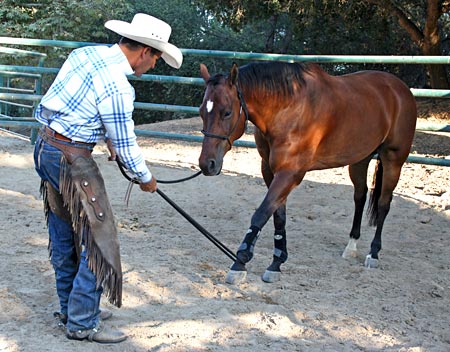
Preparing your horse for hobbling beforehand can allow this experience to be less traumatic. Placing a rope around each front foot and asking the horse to yield to pressure can be a great preparation exercise prior to introducing the hobbles. This is often a good indicator of how the horse will respond and or react to being restrained when hobbled. You can take a few minutes or even a few days preparing your horse with these preliminary exercises.
When putting hobbles on your horse, it is important to be aware that you do not put yourself in danger. Begin this process in the center of the arena (away from the perimeter panels) and stand alongside your horse in such a way as to not get hit or knocked over should your horse react negatively and struggle. Being hobbled for the first time can be scary for your horse. They could rear up and strike out. It’s important that you stay in a safe position alongside and not in front of your horse.
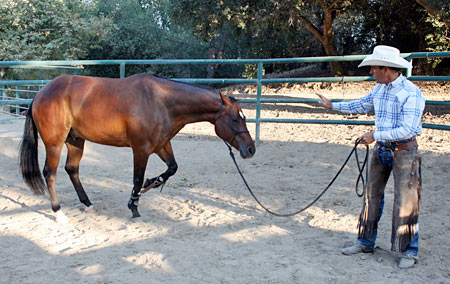
Once the hobbles are on, I want my horse to feel the perimeters of his restraint. Keeping hold of the lead rope, I’ll place my hands on his withers and rock my horse back and forth until he moves his feet feeling the confines of the hobbles. Once that is accomplished, I’ll step away while still holding onto the lead rope. His natural inclination might be to follow. I’ll raise my free hand (like a policeman stopping traffic) and say “whoa.” This will be the cue to let my horse know that he should stand still rather than follow me.
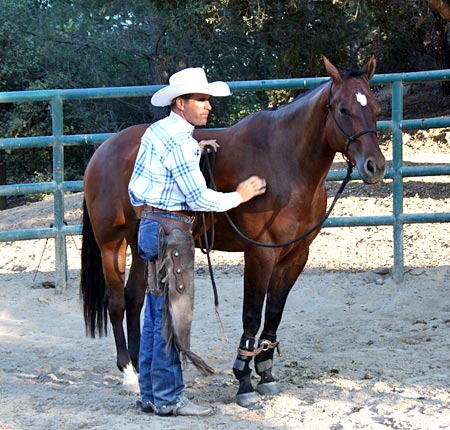
When first hobbled, horses react differently and with varying degrees. They might lunge forward, hop around, or fall down on their front knees. I’ll continue to say “whoa” and wait for them to stop. When my horse gets quiet and stands still for a moment I’ll walk up to him and begin rubbing him reassuringly. I will then step away again and repeat this process many times on both sides of my horse. At this point I might remove the hobbles and walk my horse around for a couple minutes and then hobble them again. I’ll then repeat the same process. After two or three days of these hobbling lessons, a horse is well on his way to being hobble broke.
It’s important to understand that hobbling a horse is not to be used as a method to keep your horse in one place in your absence. Horses can travel great distances while hobbled if they’re so inclined. More than one back country rider has been left stranded only to realize that their hobbled horse was nowhere to be seen the following morning.
Hobbling is a great exercise and every horse can benefit from learning this training technique. If you or a trusted professional adds hobbling to your horse’s repertoire; it just might save his life someday!
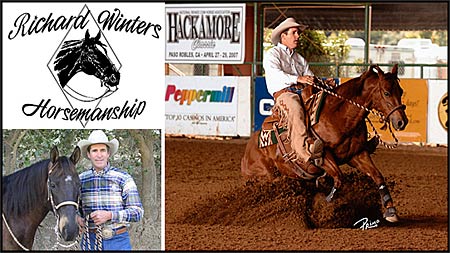
For more information about Richard Winters Horsemanship please go to wintersranch.com.