

Jumping Tips for Western Riders
A western rider can safely jump low obstacles in a western saddle—provided the horn is not too long—by learning correct seat and leg position. Adjust the stirrups so the stirrup bar sits at your ankle bone when your leg hangs free, hold the stirrup on the ball of your foot, and carry a half seat about a hand’s width out of the saddle, riding with a rein in each hand rather than the usual one-handed western grip. Start over small jumps, give the horse his head once he commits to the leap, and always wear head gear when schooling.
Are you a western rider who might want to play around with jumping? Maybe you are an avid back country trail rider, or a mountain trail competitive rider, both of whom need to be able to hop over a log, narrow creek or bale of straw safely. Article by Desiree Johnson for Smooth Stride Riding Jeans
But you are concerned because you don’t have an English saddle. If the western saddle horn is not too long, you can jump low obstacles if you learn how to position your seat and leg correctly.
Stirrups need to be adjusted so that when you hang your leg out of the stirrup, the stirrup bar is right at your ankle bone. The stirrup needs to be held on the ball of the foot so the rider keeps a gentle bend in the ankle and knee, to help absorb shock.
The shorter length allows a rider easily carry his seat out of the saddle. “Jumping Position” or “Half Seat” is a position approximately a hands’ width between the saddle and the rump, which is also the amount of lift your seat produces at the height of a normal upbeat while posting.
The rider must be able to hold Jumping Position or Half Seat in and out of trot and canter before you try to present to a jump. Incorporating a strap around the horses neck can help with your balance in the beginning, helping keep the rider from falling back in the saddle as the horse takes off. The rider should gently sit back down in the saddle only after the horse has completed the jump.
I find it very helpful to stay in this position, especially if the horse lands cantering. Often, the horse’s head is up as they land, so its back is hollow and sitting at the canter will not be comfortable for horse or rider. After the horse returns to a trot, the rider can gently sit in the saddle. The rider should eventually be able to feel the horses back rounding more after the jump as they relax into the exercise and sitting will be much more comfortable for horse and rider.
Contact with the bit is also very important. The rider should be able to feel the horses mouth lightly with both hands through the reins. Normally western riders hold the reins in one hand. But when jumping, it is best to have a rein in each hand. This gives the rider more control if the horse veers to avoid an obstacle. An athletic, kind, intelligent feeling contact is needed and this should sound familiar since it is needed in every aspect of horsemanship, not just jumping.
Once you know that the horse has committed to the jump or begins to leap, the rider should give the horse his head. There are so many reasons why this is important. The horse needs to have the freedom to look at what they are jumping and the freedom to jump. If the rider has too tight a grip on the reins and doesn’t give enough slack, the horse won’t be able to successfully accomplish either.
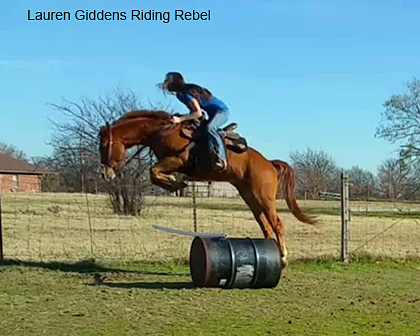
Remember to start small. Keep the schooling jumps low, as green horses have a tendency to ‘jump with spook.’ In the photo (very kindly shared with me), the horse looks happy and is using his back well. The rider is up, out of the tack correctly and has a nice straight line from elbow to bit, which I also like. Her heels are down and chin is up. The horse is over jumping a bit, but that is not a problem. It just means he is trying hard and with more time and experience jumping, the horse will gage the height better.
The jump height can be in increased as the horse and rider gain experience and confidence, when the horse is no longer over -jumping and the team has a smooth transition over the jump and back into the saddle. Safety is of the upmost importance so it is always wise to wear head gear while schooling over jumps!
Safe and happy riding, Desiree Johnson Event Rider and Owner of Smooth Stride Riding Jeans