

Lead Change Honesty Horse Training
Experienced performance horse riders are always thinking outside the box and being creative in how they set up and ask for lead changes.
With Richard Winters
The way to keep a horse honest in flying lead changes is to break the link between changing direction and changing leads—a horse that connects the two starts anticipating, dropping a shoulder, rushing the change, or not changing behind. Richard Winters rarely changes leads in the middle of the figure 8; instead he counter-canters the new circle, leg-yields the horse into the direction of the lead it’s already on for numerous strides, and asks for changes toward the arena fence so the wall discourages the horse from falling into the new lead. These exercises teach the horse that an outside leg means move the body over—not that a lead change is coming.
By any measure, a flying lead change is considered an advanced maneuver and can be tricky to execute correctly. Horses dropping their shoulder, not changing behind, rushing through the lead change and anticipating the change are all common problems that riders encounter. In this article I want to share with you some exercises that I do with my horses to keep them more correct and honest in the lead change. These tips are intended for horses that are advanced enough to perform flying lead changes.
To begin, let me say that I rarely change leads in the middle of the figure 8, like we are asked to do at the horse show. Changing leads in the middle of the arena is a sure way to get your horse anticipating the lead change. That anticipation often causes anxiety and acceleration in the change or not changing at all. When I do change directions in the middle of a figure 8, I will often begin to counter canter around the new circle and possibly change leads halfway around that new circle.
When setting up a lead change most riders will press with their outside leg on the horse. (Example: Pressing with your right leg when your horse is on the left lead.) The rider will then switch to the opposite leg when they ask for a lead change. However, many horses, when they feel our outside leg, will begin to anticipate and never really move off of the Rider's outside leg. They never picked up their shoulders, moved their rib cage over or changed the arc in their body to get set up for the new lead.
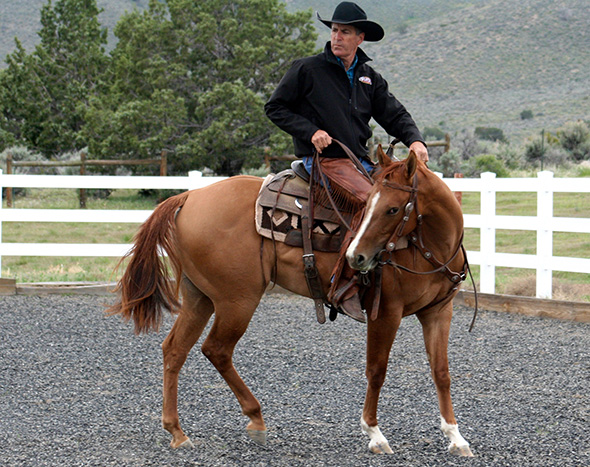
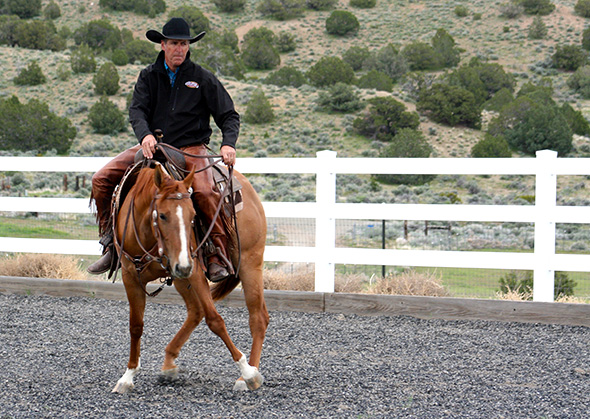
You can improve this by leg yielding your horse over into the direction of the lead that they are on, for numerous strides, and then continuing on in the same direction. You can set this up like you are going to do a figure 8. As you come through the middle begin to press your horse over into the pre-existing circle with your outside leg. Get definite lateral movement for numerous strides. You would then continue on in the same circle and direction. Now your horse will begin to realize that he really does need to move his body over when he feels that outside leg. Just because he feels your outside leg doesn't necessarily mean it has anything to do with a flying lead change.
You can also practice this leg yield at the lope by traveling from one corner of the arena all the way down to the diagonal corner at the other end while loping. Keep your horse pointed toward the end of the arena and push them over sideways. As you approach the end of the arena you can allow your horse to straighten out and continue in the direction of the lead that you are on or you can counter canter around the end. This leg yield down through the arena could be considered an "oblique" maneuver.
Here is another great exercise to keep your horse honest in the lead change. This is especially beneficial for those horses that drop their shoulder and want to fall into the new lead. This exercise will necessitate the fence or wall of the arena to help you. As you are traveling around the arena, a few feet off of the long wall, ask your horse to change leads towards the wall. This means that if you are loping around to the right, on the right lead, you would change leads to the left while loping along that fence line.
The arena fence will now become a visual barrier for your horse and discourage them from fading and falling into the new lead. Then you can continue counter cantering to the end of the arena and on around.
Always keep in mind that you never want your horse to think that a change of lead has anything to do with the change of direction. If they do, they will begin exhibiting the negative behaviors we mentioned previously and your lead changes are going to suffer.
Experienced performance horse riders are always thinking outside the box and being creative in how they set up and ask for lead changes. There are many other things that a rider can do as well. I certainly have not given you an exhaustive list. These are just a few ideas to help keep your horse accurate and honest with their flying lead changes. - For more information about Richard Winters Horsemanship please go to wintersranch.com.
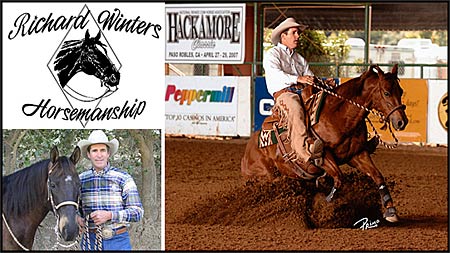
Richard Winters Biography For over 35 years Richard has dedicated himself to honing his horsemanship skills and to passing this knowledge on to others. Richard's credentials extend from the rodeo arena and high desert ranches of the west to being a highly sought after horse trainer and horsemanship clinician.
Richard Winters horsemanship journey has earned him Colt Starting and Horse Showing Championship titles. Obtaining his goal of a World Championship in the National Reined Cow Horse Association became a reality in 2005. He is an AA rated judge. Another of Richard's horsemanship goals was realized with his 2009 Road to the Horse Colt Starting Championship. Winters’ was also a Top Five Finalist at the Cowboy Dressage World Finals.
International travels include: Australia, Brazil, Canada, England, Mexico, Scotland, Sweden and Poland where he earned the European International Colt Starting Championship Title. Richard is a "Masterful Communicator" with horses and humans alike.
We are happy to announce the 2016 release of Richard’s brand new book, “From Rider to Horseman” that was published by Western Horseman Magazine.
Richard and his wife Cheryl currently reside in Reno, Nevada, and invite you to "Connect" with Richard Winters Horsemanship on Facebook and YouTube. You can also read Winters’ horse training articles, published monthly, in many horse magazines.
For more information about Richard Winters Horsemanship please go to wintersranch.com.