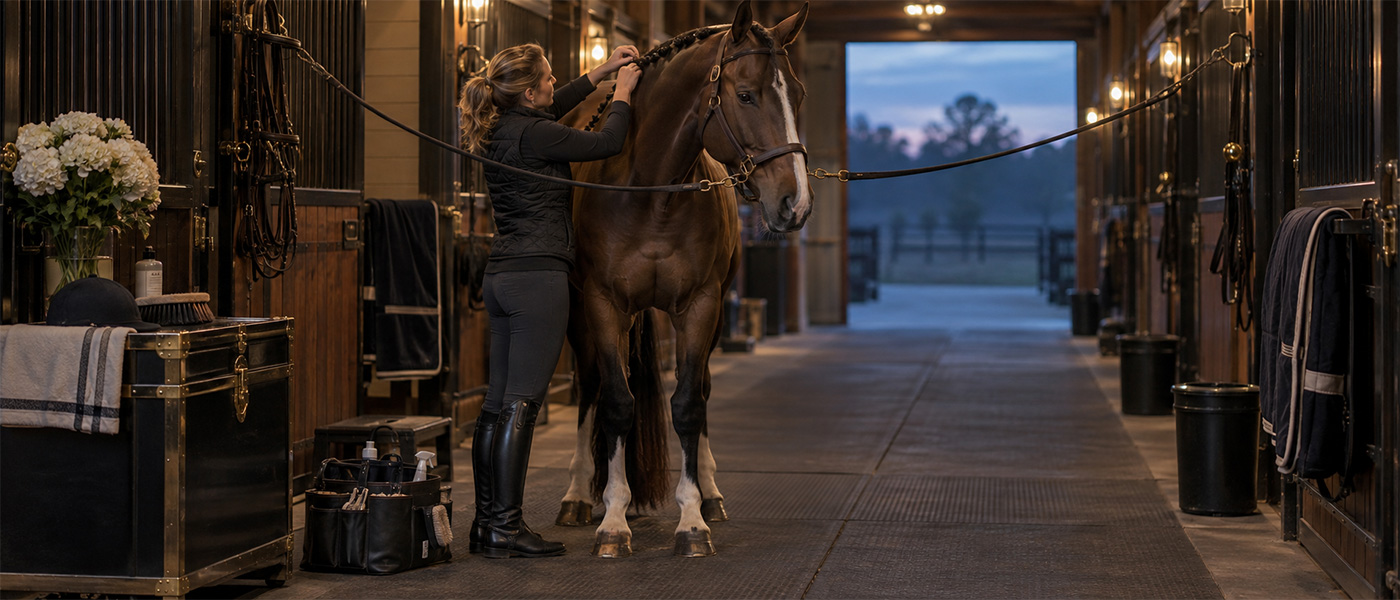


The Equine Groom Knows First
What does a professional horse groom actually do, and why are grooms so important to a horse’s health, welfare and success?
What Professional Horse Grooms Really Do—and Why They Are Essential to Equine Welfare and Equestrian Sport
The rider gets the ribbon. The horse gets the glory.
Neither one reaches the ring without the person who has been awake since three in the morning.
A hunter round lasts about two minutes. A dressage test runs five to seven. A show jumping round is over in ninety seconds.
That is what the judge sees.
Behind those few minutes stands a person who was at the stalls before daylight. Who braided a mane by flashlight. Who noticed on Tuesday that the left front was warmer than the right front and said something about it. Who has the studs in a pouch, the boots over one shoulder, the water bucket in one hand, and the ring times for four horses running through their head at once.
That person is a professional groom.
In the English disciplines, the sport does not happen without that person.
The captain and the ship
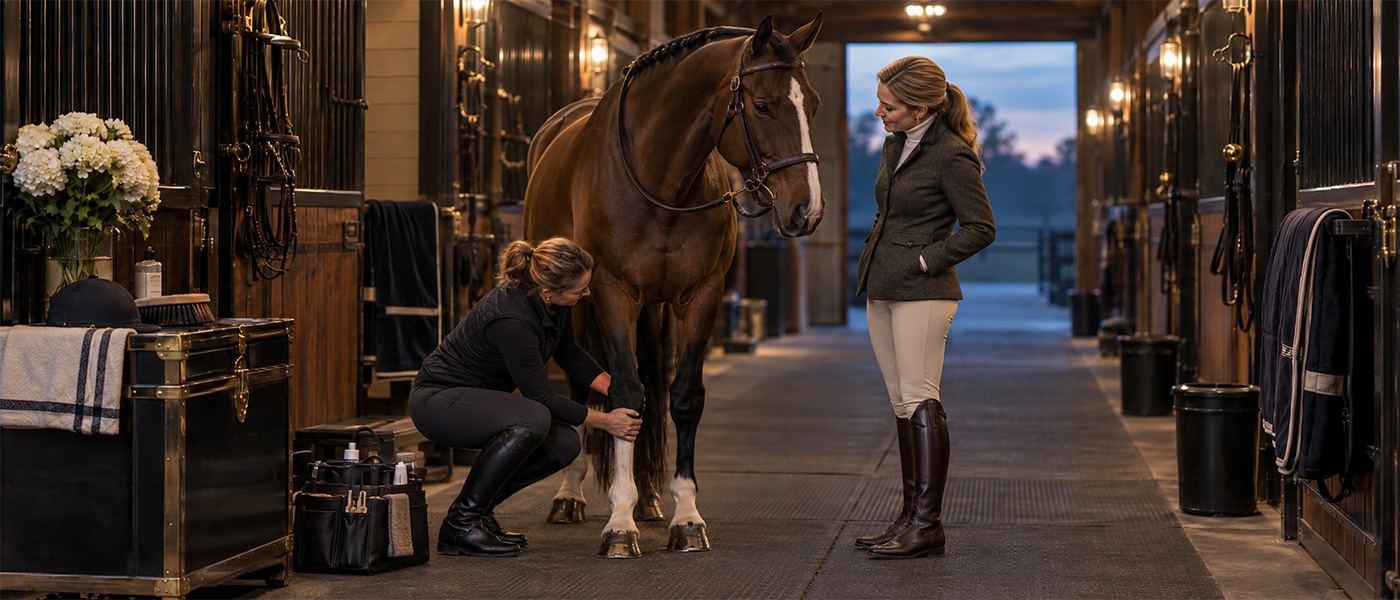
An owner is the captain of the ship. The captain sets the course. The captain pays for the voyage and answers for where it ends up. That is real authority, and it belongs where it sits.
But the captain does not check the hull.
Ownership and responsibility are two different things. The owner owns the horse. The groom is responsible for the horse being ready. The second job is the one with hands on the animal every day, in the dark, at both ends of the clock.
A ship that is not seaworthy does not sail well, no matter who is at the wheel.
What the job is at home
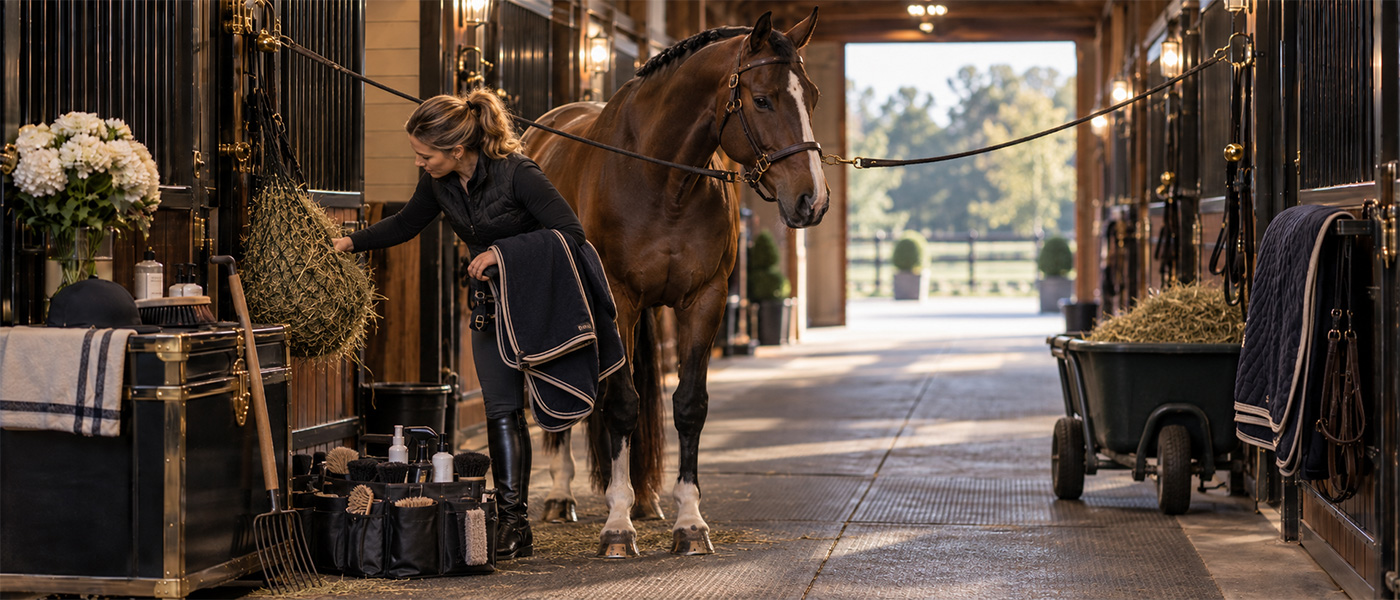
Strip away the show and the job is still enormous.
At home, a groom mucks stalls and paddocks. Feeds and waters. Turns out and brings in. Changes blankets as the temperature moves through the day, which in much of the country can mean several changes, not one. Grooms and bathes. Clips. Pulls manes. Trims. Cleans tack and does the horse laundry, which never ends and which nobody thanks anybody for.
Then comes the part that takes real knowledge.
Wrapping legs. Icing after work. Poulticing. Giving morning medications and supplements. Holding for the veterinarian and the farrier, which means knowing the horse well enough to tell the professional something useful. Adjusting feed when a horse comes off a hard week light. Watching the manure. Watching the water bucket.
A groom in a busy barn may be responsible for eight or ten horses. Every one of them is an individual with a different feed chart, a different set of legs, a different temperament, and a different opinion about being clipped.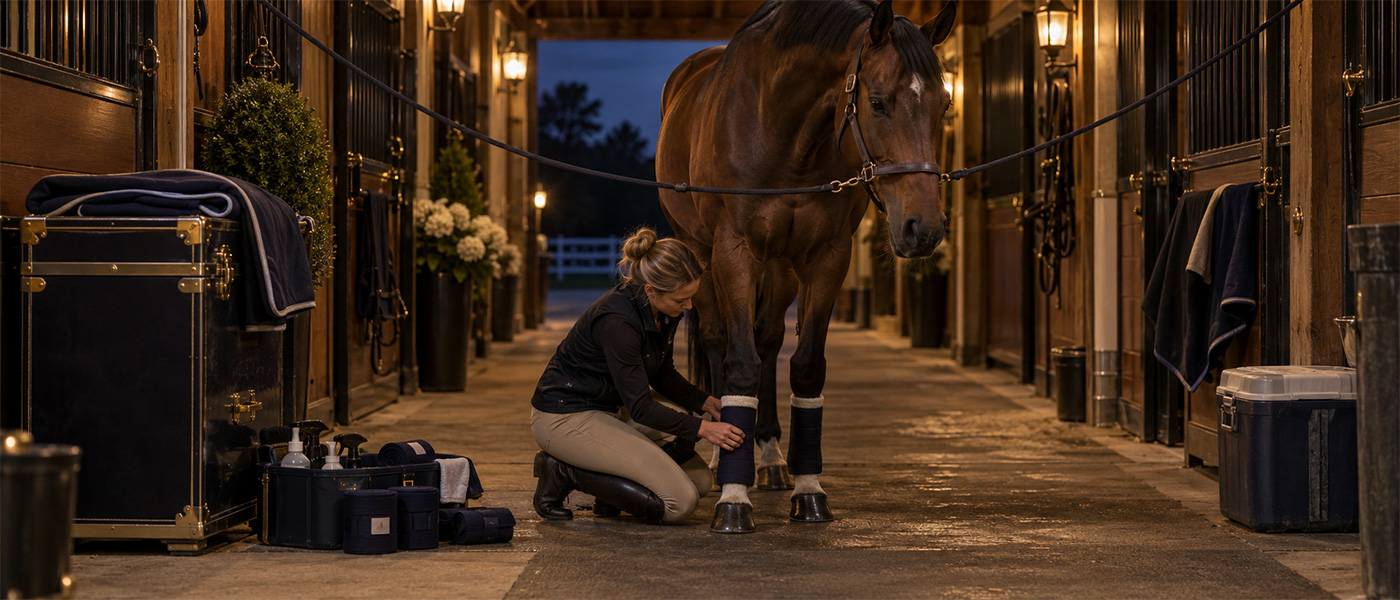
The day starts before the horses are awake.
It ends after they have settled.
What the job is at a show
The show is where the job becomes something else entirely.
Braiders work through the night. Grooms on the American circuit routinely start their day at three or four in the morning, and at some barns the groom is also the braider. By five in the morning, the show grounds are dark and nearly empty except for the people in the stabling.
Before that there was the packing. Tack, spare tack, grooming kit, feed, hay, buckets, fans, first aid, rider’s boots, rider’s coat, and the number holder nobody can ever find. Shipping boots on, shipping sheet on, horses loaded.
At the show the groom sets up the stalls, hangs the water, sorts the feed, and builds a working barn out of a row of empty boxes.
Then the day runs.
Horses have to be clean, tacked, warmed up, and standing at the in-gate at a specific minute, and the schedule moves. Studs in for one ring and out for the next. Boots on for the warm-up and off before the round. Tack wiped between horses. Fly spray. Hoof oil. Water.
The rider comes back with a horse blowing, hands over the reins, and walks off to the next thing.
The rider has one horse and one job at a time.
The groom may be tracking four horses across three arenas with overlapping times.
Then the day ends and the real work starts.
Cool out. Bathe. Legs done. Ice or poultice or standing wraps. Feed. Hay. Water checked. Stalls picked. Tack cleaned for tomorrow.
Somewhere in there, the groom eats.
And tomorrow it begins again at three.
The groom knows first
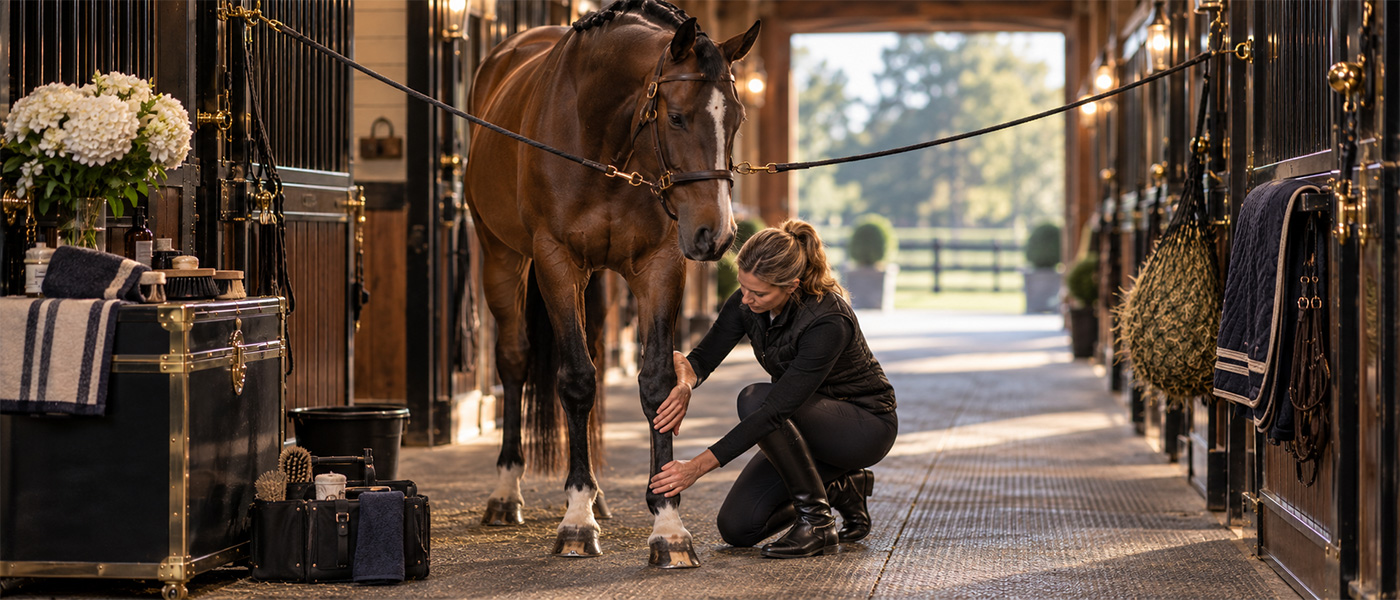
This is the part that matters most and gets said least.
A groom has hands on the same horse every single day. Not once a week when the trainer comes. Not on the weekend when the owner drives out.
Every day. Often more than once. In the same order. On the same legs.
That repetition is a diagnostic instrument.
It is how a person learns what normal feels like on one specific animal, which is the only way to know when normal has changed.
The groom is the one who notices that a horse did not finish a feed tub. That he is standing with his weight shifted. That there is filling in an ankle that was not there yesterday. That he did not come to the door this morning when he always comes to the door. That the manure looks wrong. That he is quiet, and he is not a quiet horse.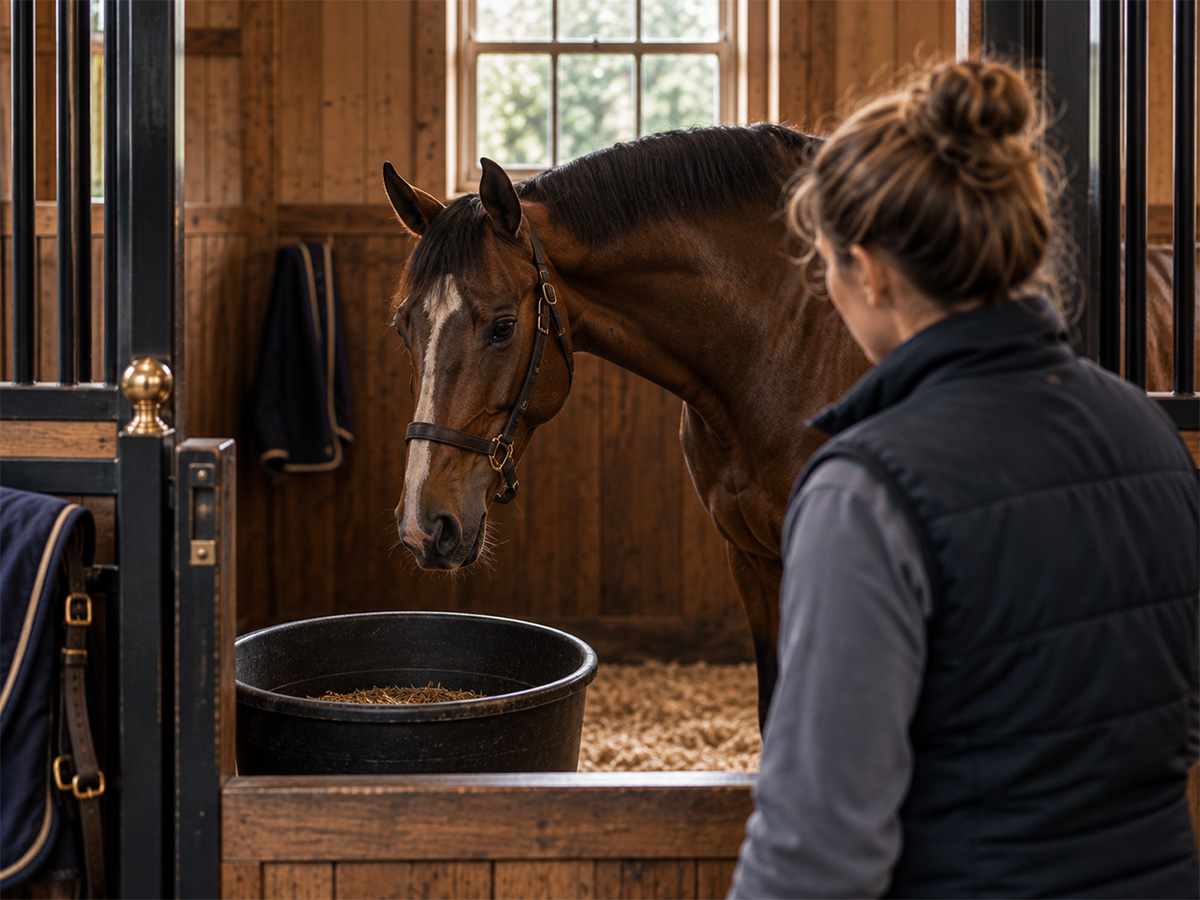
Long before a problem becomes obvious, a good groom may already be watching the little things that say something has changed.
That is not a nice extra.
That is the job.
The groom is the early warning system for the horse’s welfare, and the earlier something is noticed, the sooner the veterinarian, farrier, trainer, or owner can decide what needs to happen next.
A horse cannot tell you what hurts.
Somebody has to notice.
How much of the result belongs to the groom?
Nobody has ever put a number on it, and nobody ever will.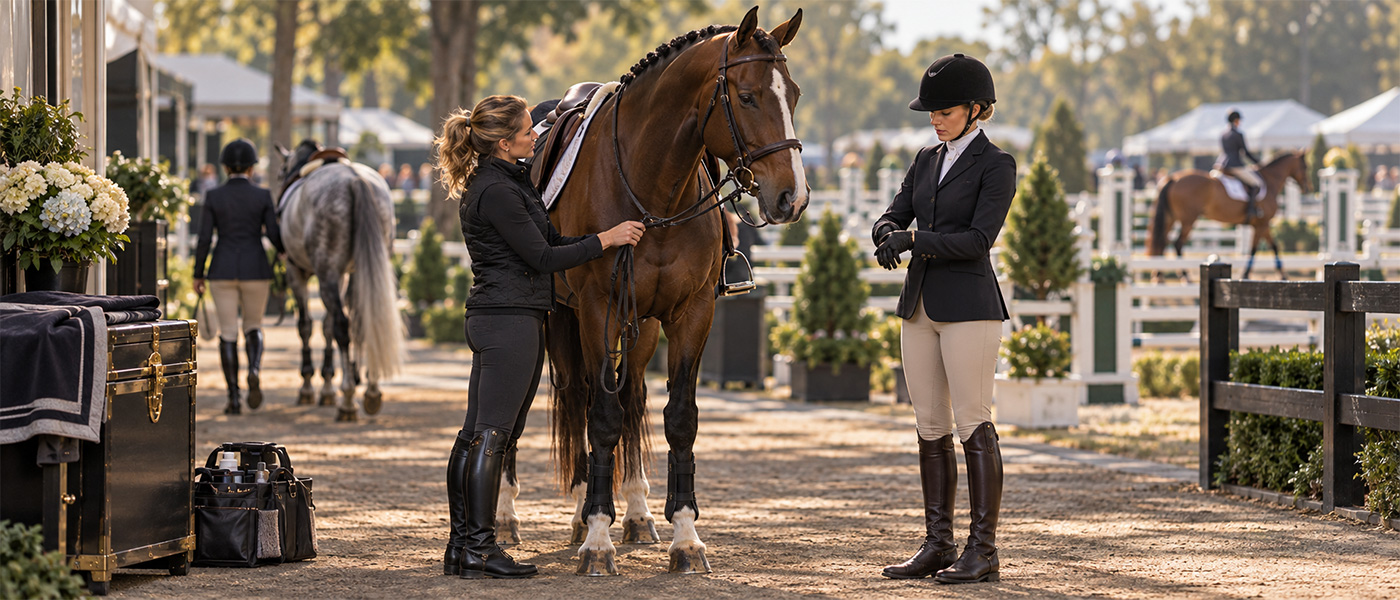
But listen to who wins, and listen to who they thank.
Lee McKeever served as groom and barn manager for McLain Ward for more than thirty years, through Olympic team golds, a World Cup title, World Equestrian Games medals, and countless international victories.
Ward has said publicly that he never had a moment of doubt about the care and preparation of his horses in McKeever’s hands.
McKeever won the FEI Best Groom Award in 2018, chosen half by the public and half by an expert panel.
When a rider at that level says the horses were always ready, that is not a courtesy.
That is a description of the machinery that makes a career possible.
A horse arrives at the in-gate fit, sound, calm, clean, correctly tacked, and mentally in a good place, or it does not.
Almost everything on that list was somebody else’s work.
What it pays, and how the package really works
Base salary is the wrong number to look at, and anybody quoting it by itself is telling you half the story.
Full-time grooms at American show barns commonly advertise base salaries somewhere in the range of the mid-twenties to around forty thousand dollars, although pay varies considerably by barn, experience, discipline, responsibilities, and location.
Read the salary alone and the job can look impossible to live on.
Often, it is not the whole arrangement.
A serious competition barn may also provide housing. In some jobs that means actual housing, not merely a discount on rent. Some groom positions include housing at home bases and during show circuits. Others include board or a stall for the groom’s own horse.
At shows, the barn may cover travel, lodging, and meals or provide a per diem.
Then there are client tips.
At many rated shows, tips are not merely a nice extra. They are an expected and meaningful part of a show groom’s income.
An owner should understand how much work went into getting that horse to the ring clean, prepared, cooled out, cared for afterward, and ready again the next morning.
Add the entire package together and the picture can change considerably.
Housing in a high-cost horse community has substantial value. A stall for your own horse may be worth several hundred dollars a month. Travel to major competitions can also provide extraordinary career experience that many amateurs pay heavily to obtain.
So the honest answer is that a good groom job at a good barn can be a considerably better deal than the salary line suggests.
Two things pull the other way, and this article is not worth publishing if it leaves them out.
The first is hours.
An hourly wage may sound reasonable until you look at a schedule running fifty or fifty-five hours a week across five and a half or six days.
Show weeks can be longer.
The second is the floor.
Not every job is the good job.
There are operations paying considerably less, and a large share of the people doing some of the hardest grooming work in this country are working at that end of the industry.
Broad salary websites can also be misleading because the term “horse groom” may include racing, breeding, boarding, training, and competition operations that operate very differently.
None of this makes grooming a bad living.
It means the arrangement has to be looked at whole, and then written down.
Which brings up the rule that matters more than any number in this section.
Get it in writing.
Housing. Per diem. Days off. Tips. Board for your horse. What happens if you are hurt. What happens if you become sick. What happens when the barn goes south for the winter.
All of it.
A good employer should not be offended by being asked.
The value in a groom package is real, and value that exists only in a conversation is value that can quietly disappear.
The profession is organizing itself
The good news is that this is changing, and faster in recent years than it did for decades before.
In 2022, the FEI formally recognized the International Grooms Association, signing a memorandum of understanding with founding director Lucy Katan, herself a former international groom.
It was the result of a process that began years earlier with the FEI Grooms Working Group.
For the first time, grooms had a recognized independent voice at the level where international rules and policies are discussed.
The International Grooms Association surveys members on the practical conditions grooms face at competitions, including accommodation, working conditions, catering, and welfare. It provides employment information, resources for freelance grooms, a job board, and wellbeing support.
The FEI has also presented a Best Groom Award since 2009.
At major international championships, organizers have increasingly begun recognizing grooms publicly and providing dedicated groom facilities and support.
In the United States, the United States Eventing Association has a Grooms Committee focused on education, career sustainability, and equine welfare. The Usea also presents the Liz Cochran Memorial Groom’s Award to honor work done behind the scenes.
More recently, HorseGrooms launched a nonprofit foundation with a long-term goal that says a great deal about where the profession stands.
It wants to help create a recognized education and certification pathway for grooms.
Because right now, there largely is not one.
Think about that.
A farrier can apprentice and certify. A veterinarian has a license on the wall. A trainer can hold credentials.
A groom has a reputation and a phone number.
The knowledge is real, and it is deep, and right now much of it is still transmitted by one experienced horse person teaching the next one in a barn aisle.
That works.
It also means the skill has little formal standing, and skills with little formal standing are easier to overlook and easier to underpay.
If you are thinking about doing this for a living
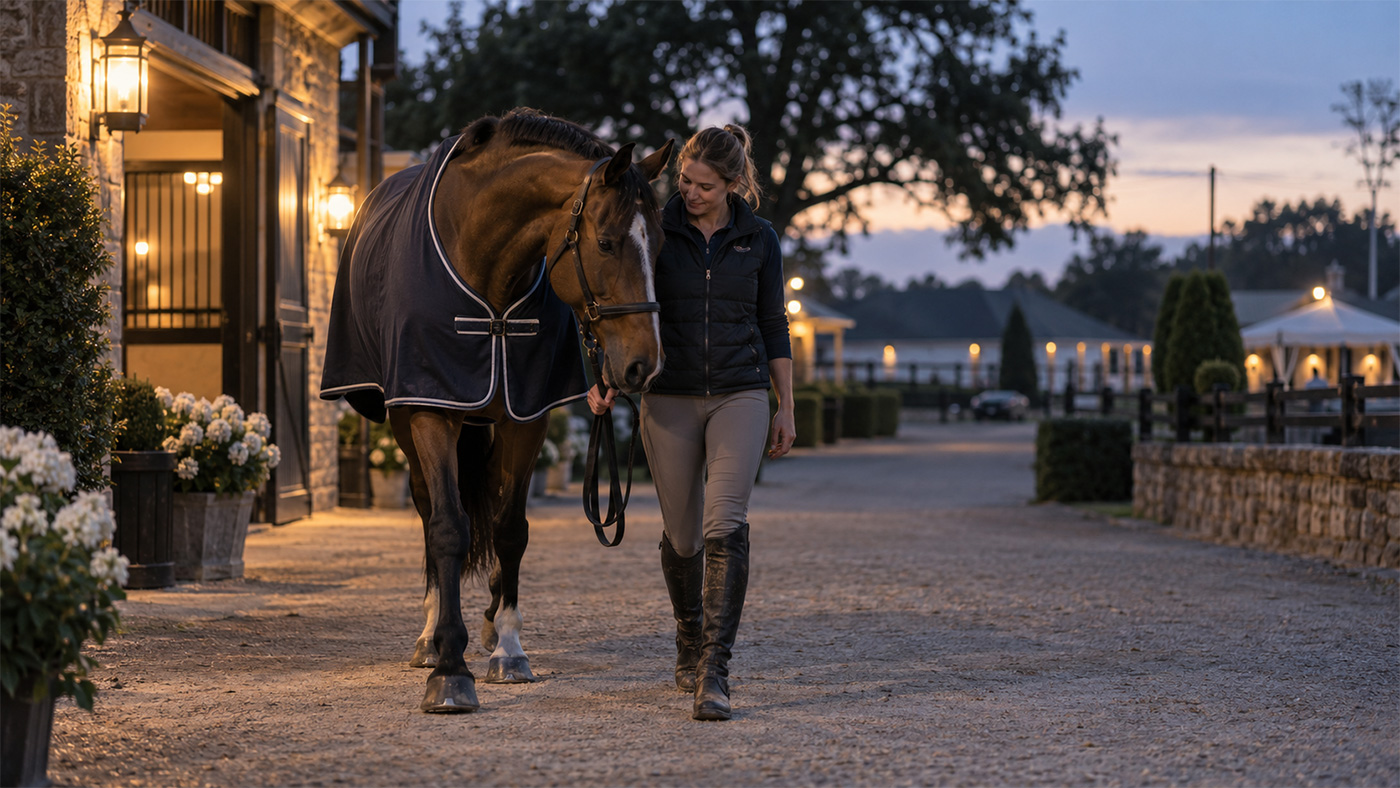
It is a real career.
It is not a holding pattern for people who could not make it as riders.
Learn the hard skills, because they are what separate a barn helper from a professional.
Clipping and trimming. Mane pulling. Wrapping and poulticing. Fitting studs. Reading a leg well enough to know what yesterday felt like. Recognizing early signs that a horse is not right. Giving medications and supplements correctly. Loading a horse who does not want to load. Packing a trailer so that nothing is missing four hundred miles from home.
Every one of those takes hundreds of repetitions.
And every one of them has value.
Braiding sits in its own category, and it is worth understanding before you plan a career around it.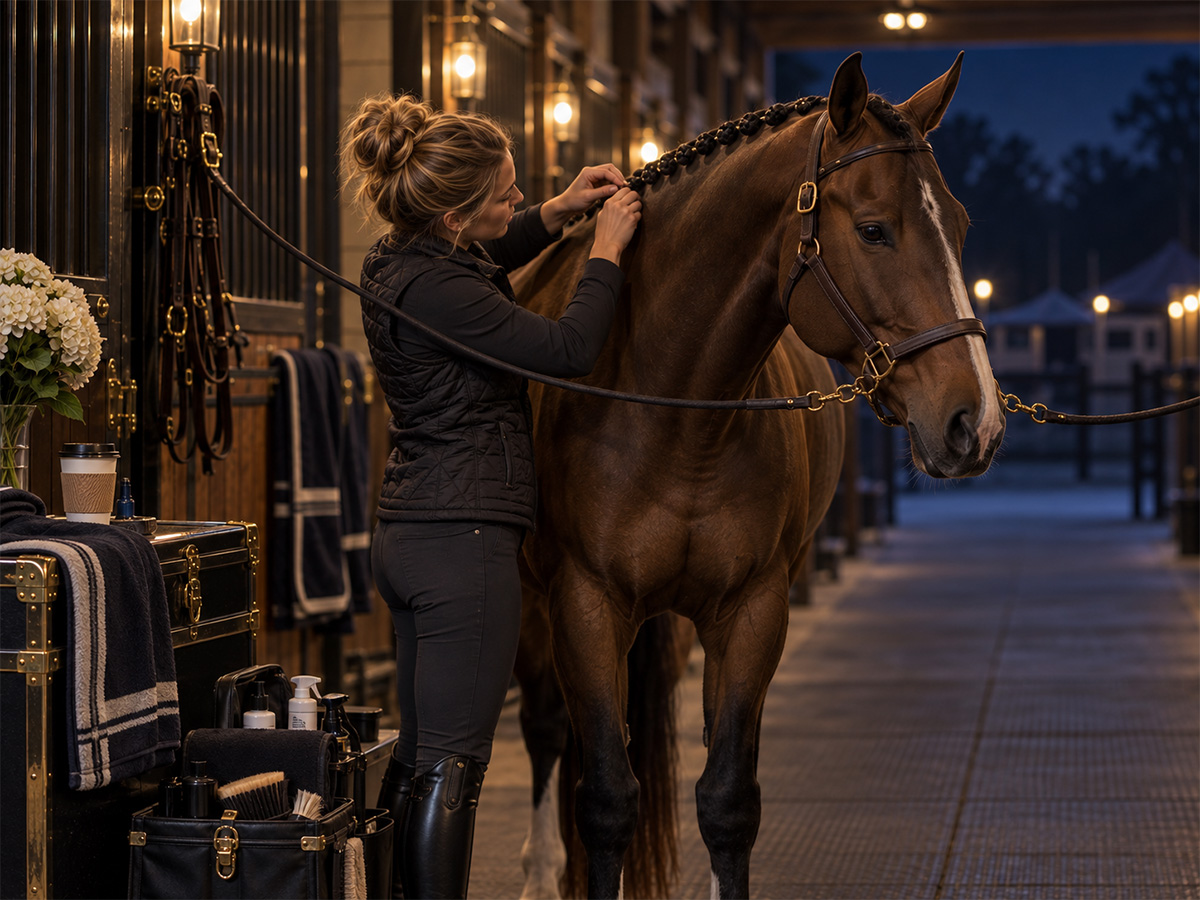
At rated hunter and jumper shows, braiding is often its own trade. Independent braiders may work overnight and through the morning, charge by the mane and tail, book entire barns, and travel the circuit as their own businesses.
Some can earn very good money doing it.
In eventing and dressage, braiding may more often fall to the groom.
The head groom for an upper-level event rider may be at the stalls before the rider, setting up and putting in braids.
Either way, learn it.
If you groom in eventing, you may need it. If you groom hunters, you may not do it every day, but braiding is one of the few skills in this business you can sell independently, by the horse, to other barns at the show.
Good braiders are valuable.
Go in with your eyes open on the working-student track, too.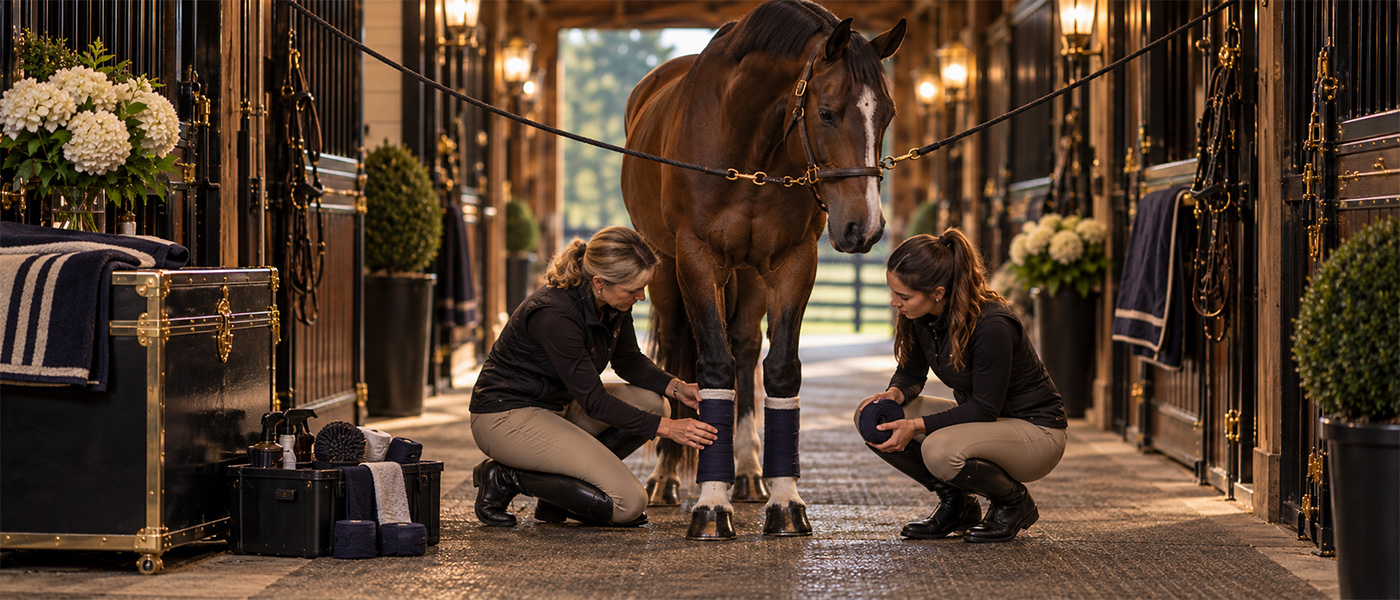
A good working-student arrangement can be one of the best educations in the horse world.
A bad one is unpaid labor wearing a nicer name, and the difference is often whether the instruction, riding opportunities, and education that were promised actually happen once the stalls need doing.
So ask before you go.
What are the hours?
What is the pay?
Which day is off?
What happens when you are sick or hurt?
Who covers travel?
What training or riding is actually included?
Is any of this in writing?
A good employer should be able to answer those questions.
And join something.
The organizations exist now.
Use them.
If somebody else takes care of your horse
Then you are the captain, and there are things a good captain does.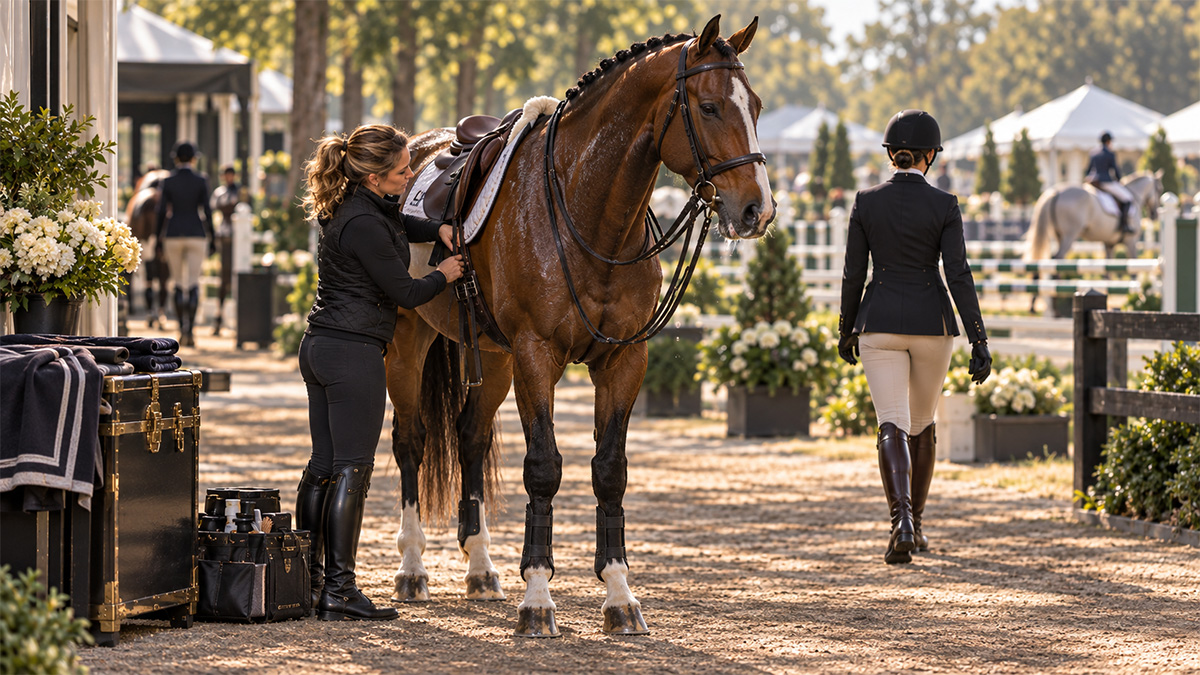
Learn the groom’s name and use it.
Pay on time, every time.
Put the arrangement in writing, which protects both of you.
Ask what they are seeing in your horse and then actually listen, because they have information you do not have and cannot get from occasional visits.
Do not ask for a day off to be given up as a favor.
Do not blame a groom for a rail.
And say the thank-you where other people can hear it.
The person who knows your horse best may not be you.
That is not a failure on your part.
It is what a partnership looks like when it is working.
The hull
The rider takes the victory gallop.
That is right, and it should stay that way.
The horse gets the flowers, and that is right too.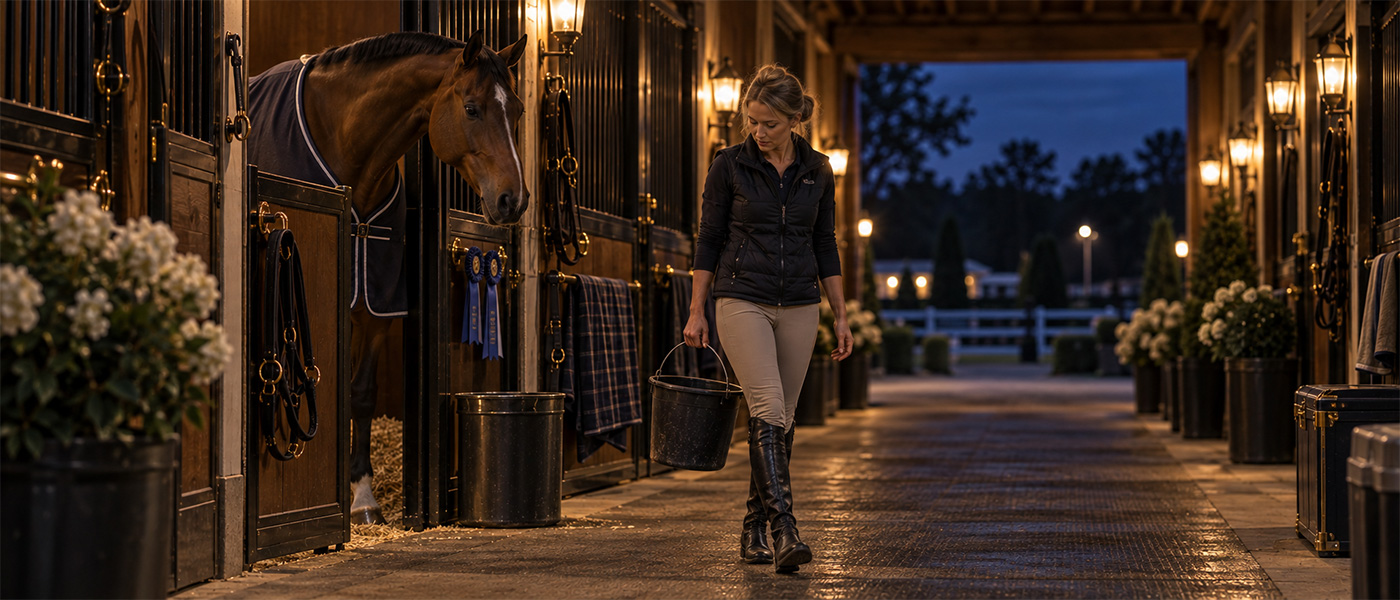
But back at the stabling there is somebody unwrapping legs and running cold water down a tendon, checking a water bucket one more time, and setting an alarm for three in the morning to do it all again tomorrow.
The ship sails because somebody checked the hull.