

Meta description: Many English riders have never ridden outside the arena and are quietly afraid to try. A horseman's guide to the first hack, meeting scary objects, building up safely, and why time outside the fence makes a better horse and a better rider.
Estimated read: Fourteen minutes
KEY Question: How does an arena rider start riding outside the arena without frightening themselves or their horse?
I have met riders who have owned a horse for years and have never once ridden him outside the arena.
Not because they did not want to. Because they were afraid, and because nobody ever offered them a way to start that did not begin with getting on and riding out the gate.
If that is you, I want you to know two things before we go any further. The first is that you are not unusual. There are far more riders in your position than the horse world generally admits, and most of them are not talking about it because it feels like something they should have got past by now. The second is that this is fixable, and the fix is not bravery. It is a sequence, and anybody can follow a sequence.
So this article is written for the rider who is worried about leaving the lesson arena. Step by step, and easy as we go. Eventually it will be the best time you spend with your horses.
Why your horse is sensible in the arena and stupid in the field
The honest answer is that he does not have the experience to be comfortable outside the arena. That is all it is.
Start here, because understanding this will change how you feel about everything that follows.
In the arena, nothing has ever come out of the hedge. Your horse has worked in that space hundreds of times. The footing does not change. The fence is in the same place. The scariest thing that has ever happened in there is a jump pole falling over.
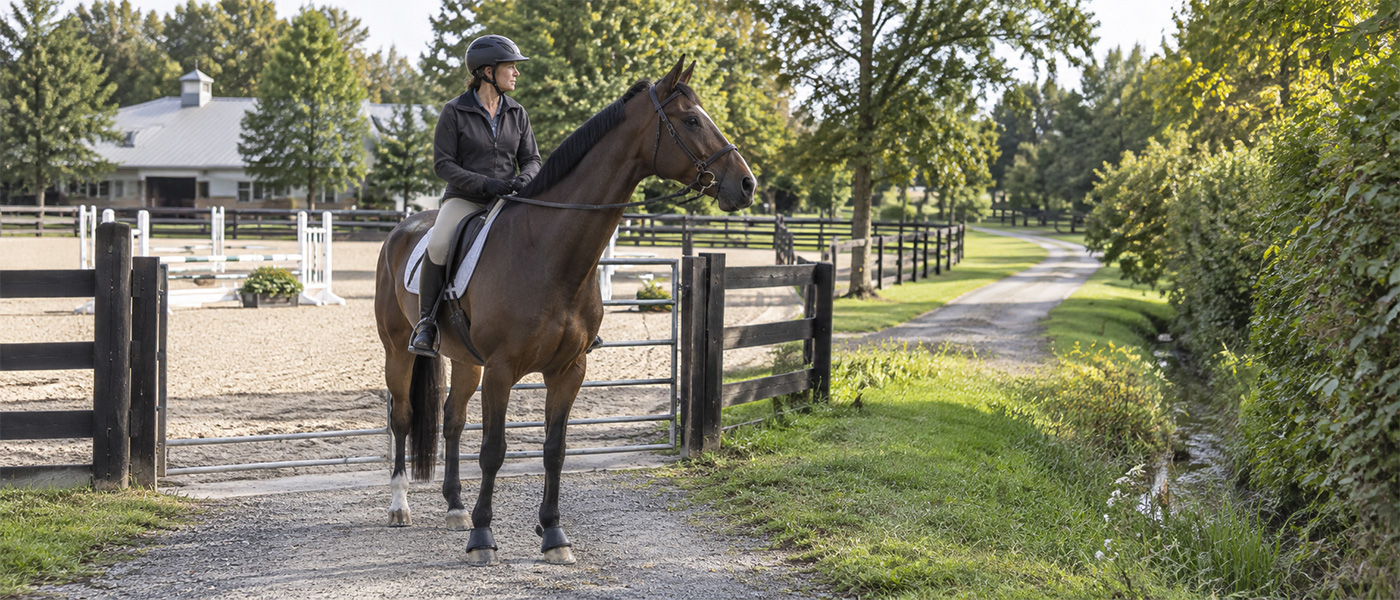
Outside, he is doing exactly the job that nature gave him. He is a prey animal in unfamiliar country and his entire survival design tells him to look at everything, assess it, and be ready to leave. That is not disobedience. That is a functioning horse.
Riders take it personally. The horse who is soft and attentive in a lesson becomes a giraffe the moment he crosses the gate, and the rider feels embarrassed, then frustrated, then angry. The anger is what turns one spook into a bad ride, because now the horse is worried about the thing in the hedge and worried about you.
Get this straight in your head before you go.
He is not being naughty. He is being a horse in a place where he has not yet learned that nothing bad happens.
Start on the ground, not in the saddle
Your first trip outside the arena should not be a ride at all.
Put a halter on him, or a bridle if you prefer, and lead him out. Around the outside of the arena. Past the muck heap. Down to the end of the drive and back. Ten or fifteen minutes, and then put him away.
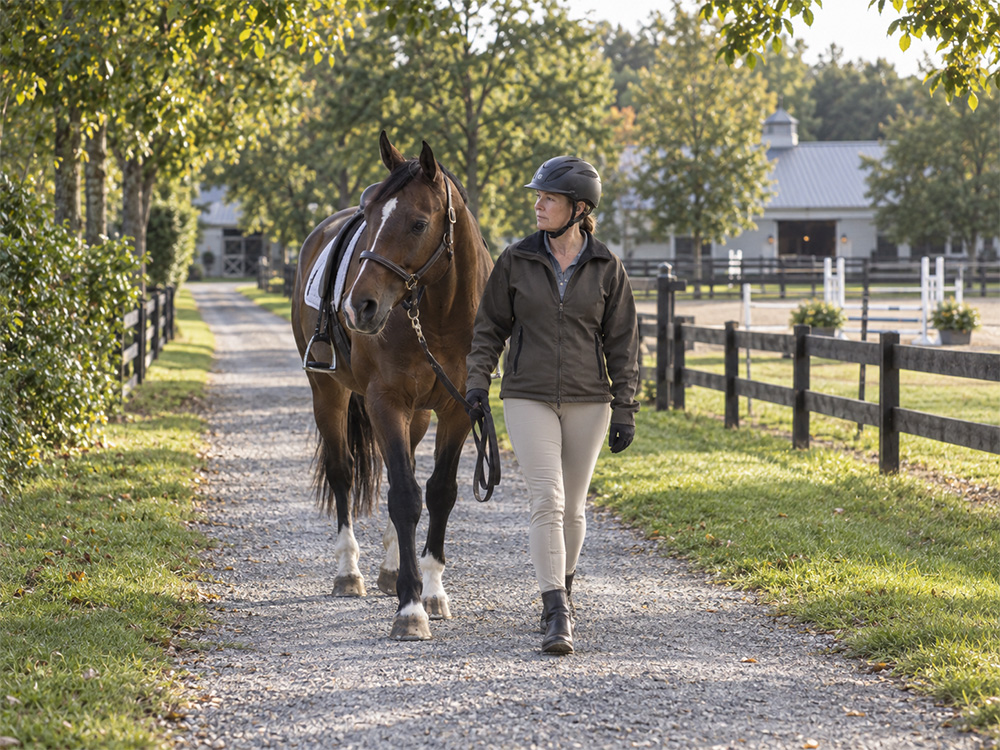
Do that three or four times, on different days, before you ever think about mounting.
This does more than it looks like it does. It takes your own fear out of the equation completely for the first several outings, which means you are not feeding nerves down the lead rope. It lets the horse see the new country from the ground, where he is far more comfortable and far less likely to do anything dramatic. And it means that the first time he goes out under saddle, it is not the first time he has been out.
If you are the one who is frightened, this is the single most useful thing in this article. Nobody has ever been hurt badly leading a horse fifty yards down a driveway. Start where the risk is almost zero and let your own confidence build alongside his.
Choose the day, the route and the company
Three decisions before you get on, and they matter more than anything you do in the saddle.
The day.
Not windy. Wind makes every horse sillier and it takes away his hearing, which makes him rely on his eyes and jump at everything. Not the day after two days off. Not at feeding time, when the whole barn is calling to each other and your horse wants to be in it.
The route.
Short. Out of the gate, along one edge of a field, and back. You should be able to see home for the whole of it. The first hack is not a hack, it is a lap.
The company.
Go with one calm older horse who has done this a thousand times and whose rider you trust. A sensible companion in front does more for a nervous horse than any technique in this article. Horses read each other constantly, and a horse who is walking on a loose rein and swinging along is telling your horse that there is nothing here worth worrying about.
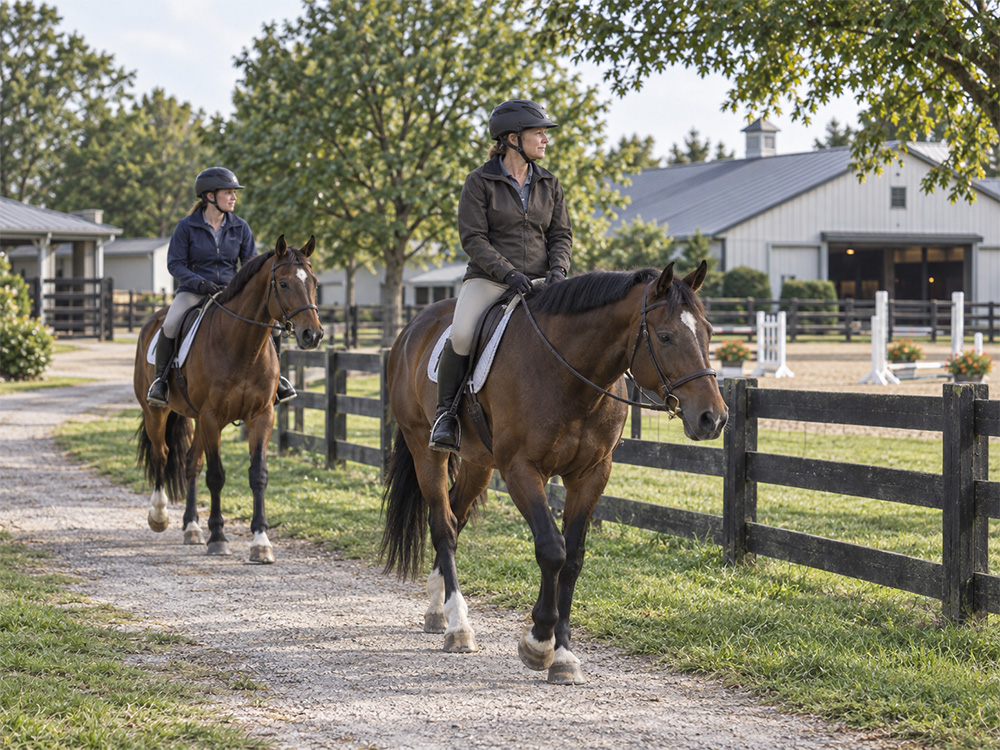
Ask for the quietest horse in the barn, not the fastest friend. And tell the other rider honestly what you are doing, so they know to walk the whole way and not to trot off without warning.
Meeting something new
Your horse is going to see things he has never seen. A mailbox. A tarp. A round bale wrapped in white plastic. A drainage grate. A plastic bag in a hedge that moves when the wind touches it.
Here is what to do, and then here is when not to do it, because the second part is the part most articles leave out.
The approach.
When he stops and stares, let him stop. Do not drive him forward into something he has not finished looking at. Sit quietly and let him have a good look. Then ask him to back away a few steps, and walk toward it again. Back away, approach. Each time he will usually come a little closer.
The reason this works is that his feet are moving. A frightened horse needs to feel that he still has the option to leave, and the moment you take that away by clamping on and pushing, his fear goes up rather than down. Backing away is not retreating, and it is not rewarding the spook. It is giving him the thing he needs in order to be able to think.
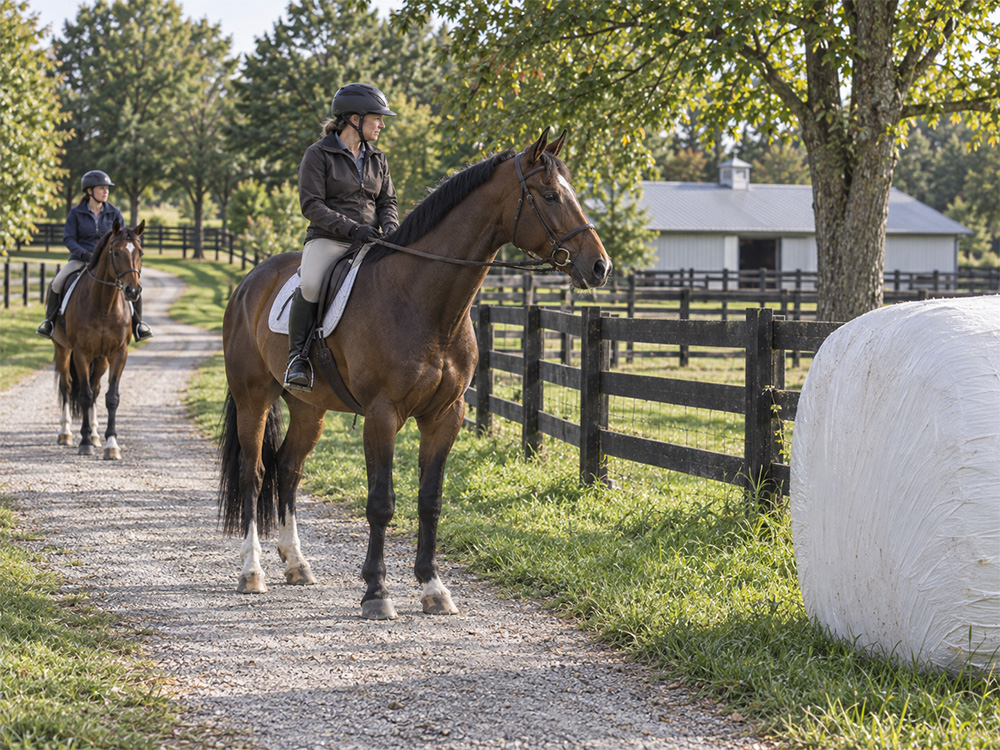
Wait for the big exhale.
When he stands and lets out a deep breath, or drops his head, or licks and chews, he has processed it. That is the moment. Give him a pat, tell him he is good, and walk on past. Rewards are remembered.
What you do not want is to make a production of the object itself. No circling back to show him again, no ceremony. He looked, he decided it was fine, you told him he was right. That is the whole transaction.
And through all of it, do not overreact yourself. Keep your body relaxed. I talk to my horse the whole time, which settles me as much as it settles him. What he takes from it is something like this. Bob is not worried, so I think this is fine even though it is new.
And here is when not to do all that.
Sometimes making a ceremony of the scary thing confirms to the horse that it deserved one. If he is only half worried, and you stop the whole ride, back him up, and approach in stages, you have just told him that the mailbox was indeed a significant event.
On those days the better answer is to keep riding. Give him a job. Put a little leg on, look where you are going rather than at the object, keep the rhythm, and let it pass under his feet without comment. Horses take an enormous amount from where the rider is looking and whether the rider's body has changed. If nothing about you changes, very often nothing about him does either.
Both are tools.
Approach and retreat is for genuine fear, where the horse has stopped and cannot think. Ride on is for the ordinary looking and spooking that is part of being outside. Learning which day calls for which is the actual horsemanship here, and you will get it wrong sometimes. Everybody does.
Getting off is allowed
I want this to have its own heading because riders need to hear it from somebody.
If it starts going wrong, get off and lead him home.
That is not a failure. That is not giving in to him. That is not a lost battle that you will have to win back tomorrow. It is a rider making a good decision with the information available, and it is infinitely better than the alternative, which is staying on a horse you have lost and finding out how that ends.
I have got off horses. Every honest horseman has. You lead him home, you have a think about what went wrong, and you go out again another day on a shorter route or with a quieter companion.
The riders who get hurt are very often the ones who felt they were not allowed to get off.
And getting off when nothing is wrong is allowed too.
Walking a little can just be part of the ride. We look for places along our regular routes where there is something to mount from, a stump or a bank or a low wall, and a bit of shade. That is where I get off, stretch my legs, reach into my pocket and give my horse a treat. Make the time out the gate something he enjoys and he will look forward to the next one.
One practical note. Before you get off somewhere new, be sure you can get back on. A long walk home in riding boots teaches a lesson you only need once.
Building it up
The first few rides out are short. Fifteen minutes. Out and back on the same route, so both of you know exactly what is coming.
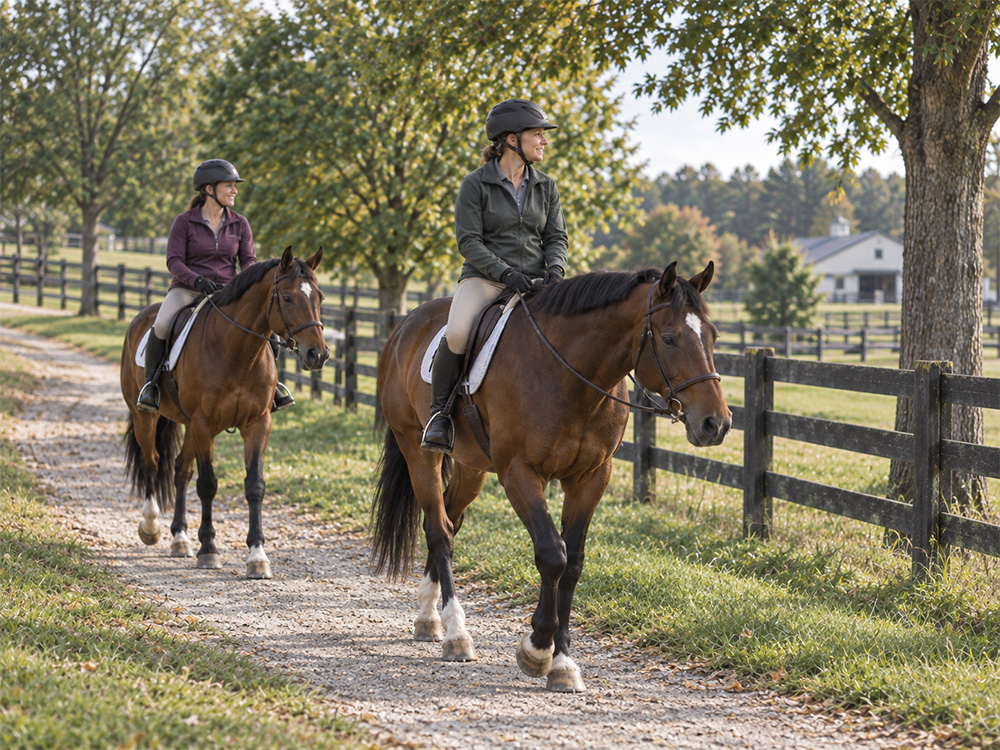
Then you add. A little further each week. A different direction. A route that goes out of sight of the barn. A gentle hill. A stretch where you can trot, once walking has become boring for both of you.
Do not add two new things at once. A longer route or a new route, not both. A new companion or a new direction, not both. The whole method is that every ride should be only slightly harder than one you have already done successfully.
When something goes badly, go back a step and stay there for two or three rides before you move on again. There is no schedule here. The only thing that matters is that the pattern in your horse's head is that going out is uneventful.
Why this makes a better warm-up than the arena
Now the argument that will convince the English riders reading this.
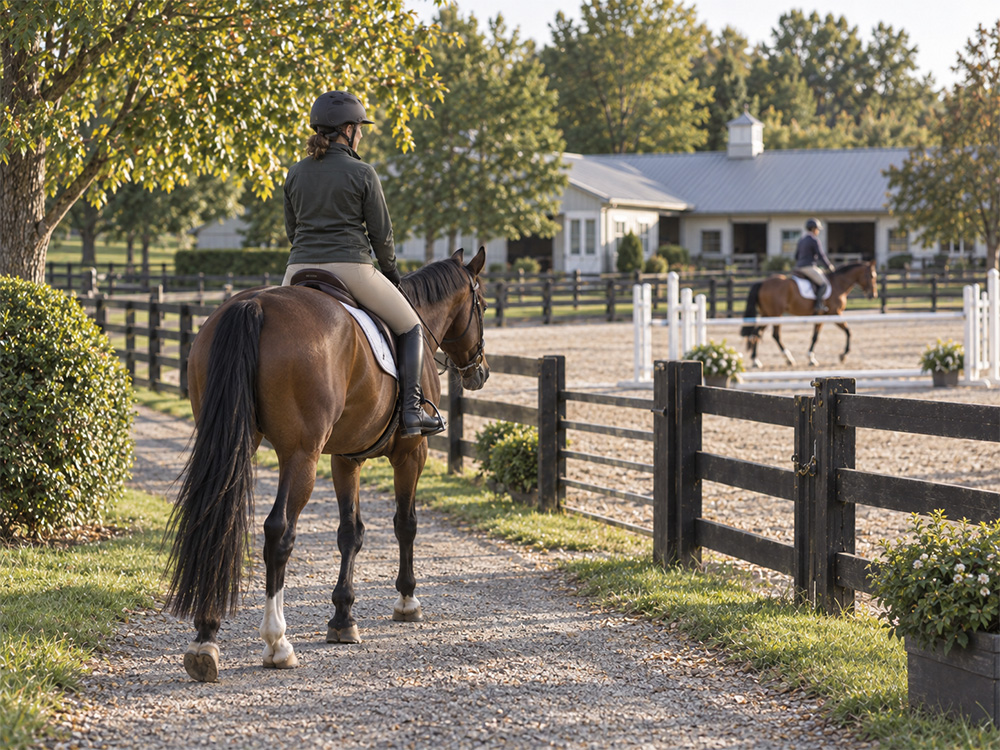
Twenty minutes of walking out on varied ground before a lesson is a better warm-up than twenty minutes of circles. It is better for his body, because he is walking forward on changing footing and using himself in ways that going around and around does not ask for. And it is better for his head, because he has already looked at everything he needs to look at and got it out of his system.
A horse who comes into the arena off a twenty minute hack arrives loose, forward and ready to listen. A horse who comes out of the stall and straight into a lesson spends the first fifteen minutes of your paid instruction time waking up.
This is the same principle as the long walking warm-up we cover in the rider fitness article. Loosen first, then work. The only difference is that you did the loosening somewhere more interesting than the short side of the arena.
And a fitter horse, and a fitter rider
Hacking builds fitness that arena work does not.
Hills and varied footing develop the hindquarters and the topline in a way that flat circles cannot. Long forward walking conditions tendons and ligaments gradually, which is the way conditioning is supposed to happen. And the constant small adjustments a horse makes on uneven ground are exactly the balance and proprioception he needs when the footing at a show is not what he expected.
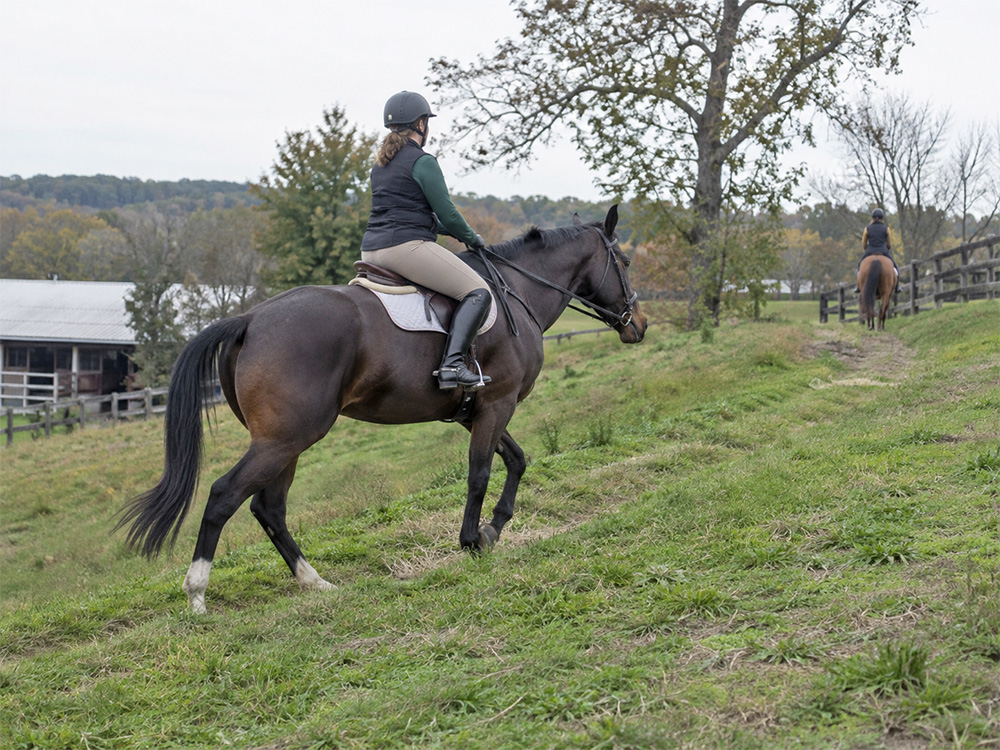
It does the same for you. Riding on uneven ground with the horse changing underneath you builds an independent seat faster than any exercise a trainer can set for you in an arena. The rider who hacks twice a week turns up to lessons stronger and better balanced, and usually does not know why.
These rides also build a stronger and more trusting relationship with your horse, and they break up the boredom. I promise you that will show up in your regular arena training as well.
Riding with others
Most first hacks are in company, so here are the manners.
Match the least confident horse.
The pace of the ride is set by whoever is having the hardest time, not by whoever is having the best time.
Say it before you do it.
No trotting off without telling the others. No cantering because the ground looks lovely. A horse whose friend disappears at speed will go after him, and the rider on top is a passenger.
Never pass without warning.
Coming up behind another horse unannounced is how people get kicked.
Leave a full horse length, more if anybody is wearing a red ribbon in the tail, which traditionally means this horse kicks.
Call out what you see.
Hole, wire, glass, loose dog, car coming.
Single file on roads, or double file if that is genuinely safer for a young horse being escorted, and never more than that.
Nobody goes home alone.
If one rider has to turn back, somebody goes with them.
The safety part, which is not optional
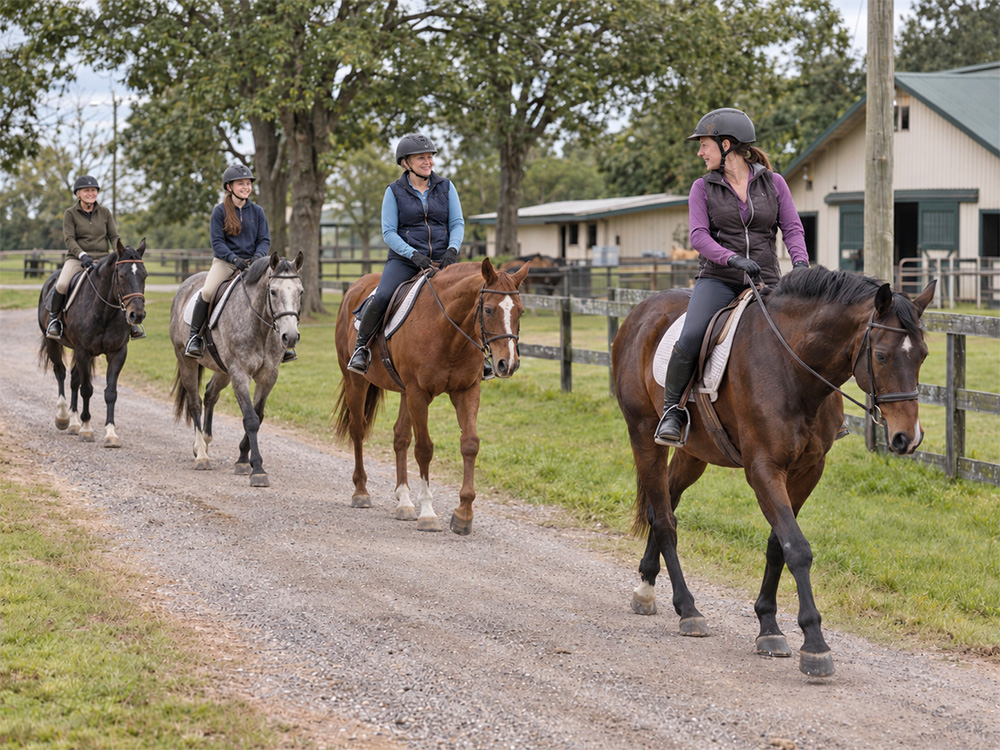
Hacking is more dangerous than arena work. I am not going to soften that, because the riders who get hurt are usually the ones who treated it as casual.
Wear a helmet.
Every ride, every time, no exceptions and no discussion.
Tell somebody your route and when you expect to be back.
Then tell them when you are back.
Carry your phone on your body.
In a pocket, not in a saddle bag. If you and the horse part company, the saddle bag leaves with the horse and your phone goes with it.
Do not hack out on a horse you cannot stop in the arena.
Brakes do not improve outside the fence.
Check your tack properly, especially anything that gets less use than your schooling equipment. Look at the stitching on the stirrup leathers and the girth billets.
Wear high visibility gear near any road, and do not take a horse near traffic until you are genuinely confident he is steady with it. That is a separate piece of training, not something to find out about on a hack.
Know where you are going.
Getting lost turns a pleasant hour into a horse who is tired, a rider who is anxious, and a ride home in the dark.
Hacking out alone comes much later
A horse who is steady behind a companion can be a completely different animal with nobody in front of him. There is no lead to follow, no other horse telling him things are fine, and every decision comes from you.
Your margin for error is also smaller. Nobody catches the horse. Nobody rides for help.
It is absolutely a thing worth working toward, and there is a great deal to enjoy about a horse who will go out alone and be happy about it. But it is a different skill and it deserves its own article rather than a paragraph at the end of this one.
What this is actually for
I have given you a lot of method, so let me finish with the reason.
Riding outside the arena is where you and your horse get to be together without a job to do. No trainer in the middle. No mirrors. No one watching. You walk, he looks at things, you look at things, and after a while the two of you fall into a rhythm that does not happen anywhere else.
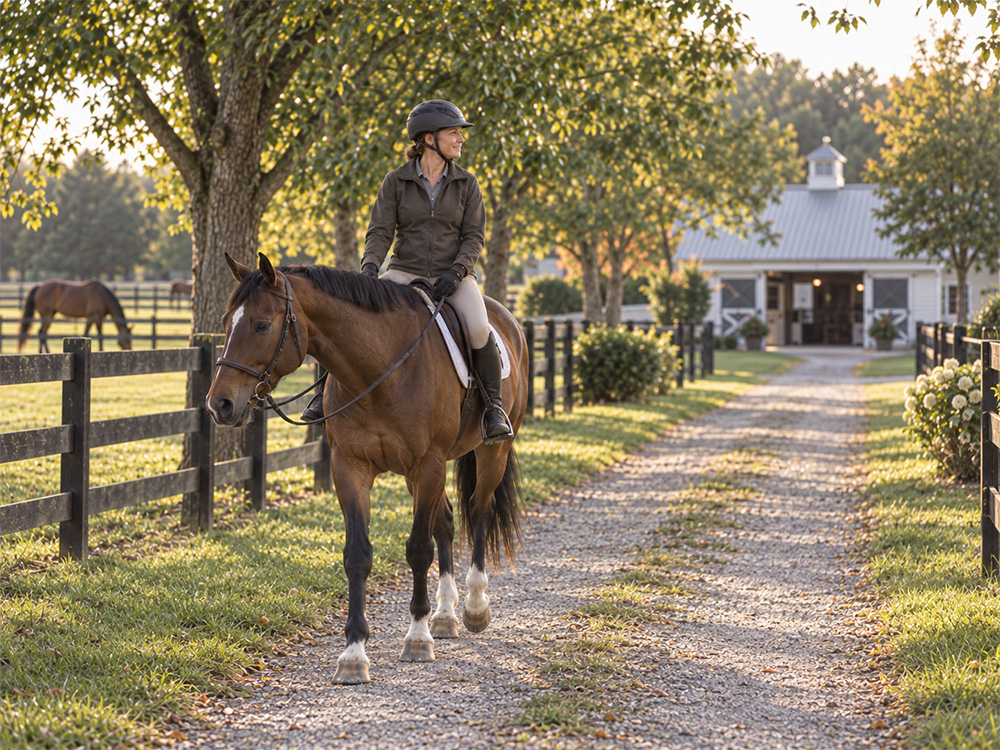
Some of the best hours I have spent on a horse have been hours where we did nothing in particular. No training objective. Just a long walk in good country on a horse who was happy to be there.
Your horse spends most of his life in a stall and a rectangle. Twenty minutes outside the fence is not time taken away from his training. For a great many horses, it is the best part of the week.
To those of you who have never taken your horses outside the arena, know that we are going to take this slowly, and that in time we will be seeing each other out along the trail. I look forward to that.
Start with the gate.
The rest follows.