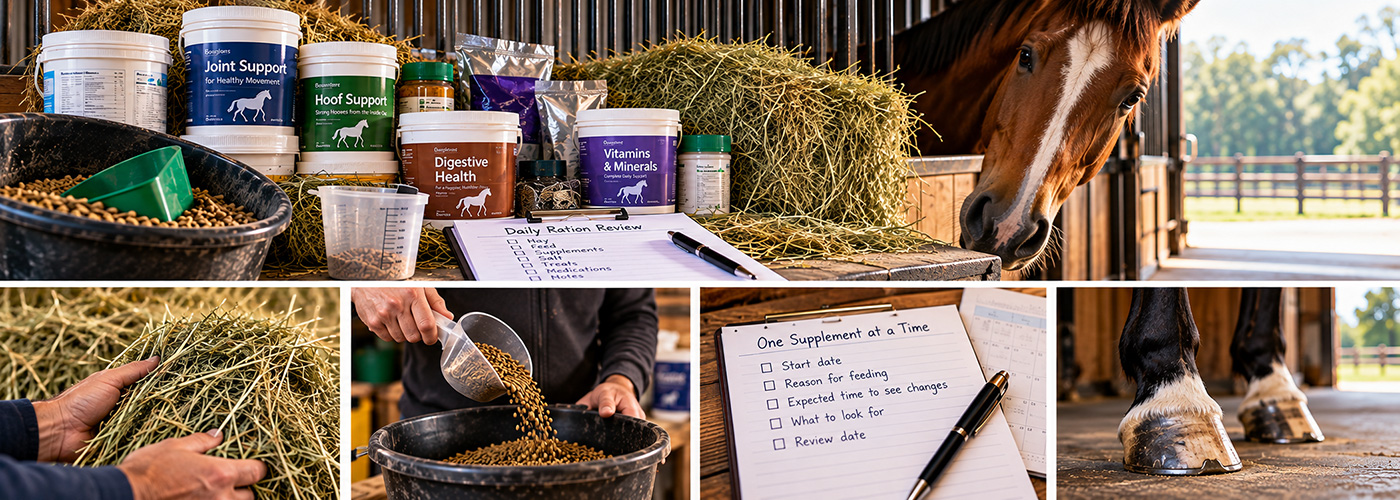


Walk into almost any feed room and you may find several supplements lined up on the shelf: one for hooves, another for joints, something for digestion, perhaps a vitamin and mineral product, and one more that was recommended when the horse was having a particular problem six months ago.
Most of those products were probably added for a good reason. The problem is that horses change. Their hay changes. Their workload changes. Their health changes. Their feed may change. But once a supplement becomes part of the daily routine, it is very easy for it to stay there without anyone asking whether the horse still needs it.
That is why I believe supplement decisions should begin by looking at the whole horse and the whole feeding program.
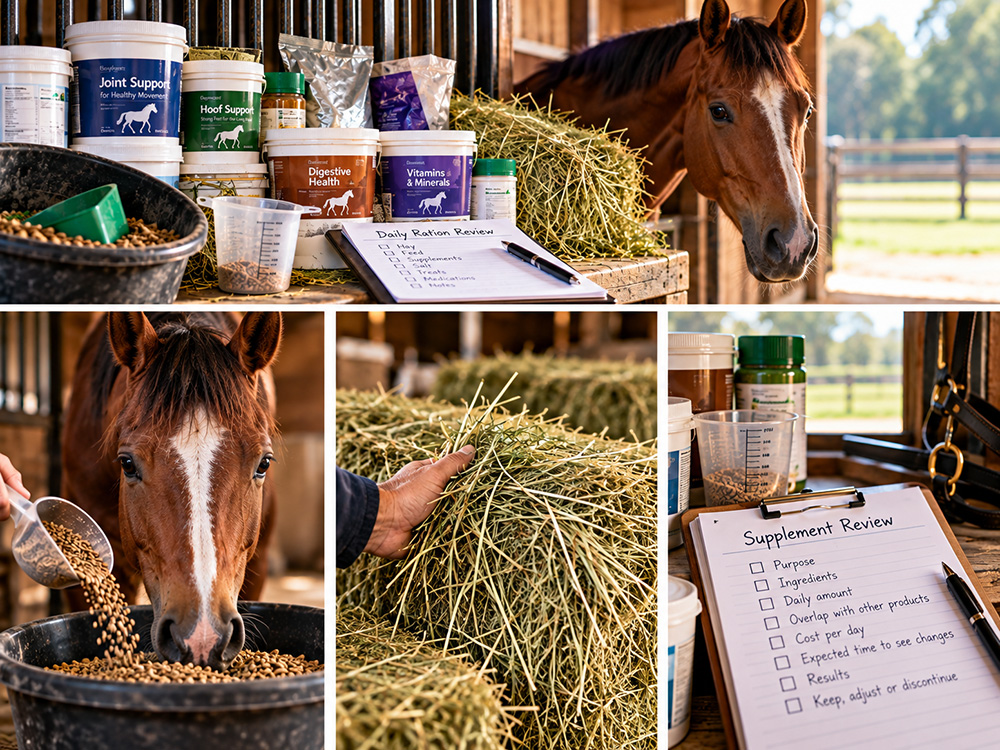
The important question is not simply, “Is this a good supplement?” A better question is: Does this particular horse need what this product provides, at this amount, as part of everything else he is already eating?
Here are five questions I encourage horse owners to ask when reviewing their horse's supplements.
1. What Does Your Horse Actually Need?
Start with the horse in front of you.
Age, workload, body condition, health history, forage, environment and current concerns all matter. A growing horse, a lactating mare, a performance horse and a retired gelding do not have identical nutritional needs. Even two horses living in the same barn and eating similar hay may require different feeding programs.[3]
Try to describe what you are seeing as specifically as possible.
Instead of simply writing, “My horse needs a better topline,” ask when the change began. Has the horse also lost weight? Has the workload increased? Has appetite changed? Is the horse chewing normally? Has there been a recent dental examination? Has the veterinarian identified anything that deserves attention?
Those details matter.
For example, if an older horse is losing condition, immediately adding a muscle-building supplement may not address the real problem. The horse's teeth, ability to chew forage, total calorie intake, protein intake and overall health may all need to be evaluated.[1]
Symptoms and changes in your horse are valuable information. They give us clues about what deserves a closer look. But a symptom alone does not prove that a horse has a particular nutrient deficiency.
That distinction is important.
A supplement should ideally be chosen after we understand the goal, rather than choosing a supplement first and hoping it solves the problem.
2. What Is Your Horse Already Getting From Hay, Feed and Pasture?
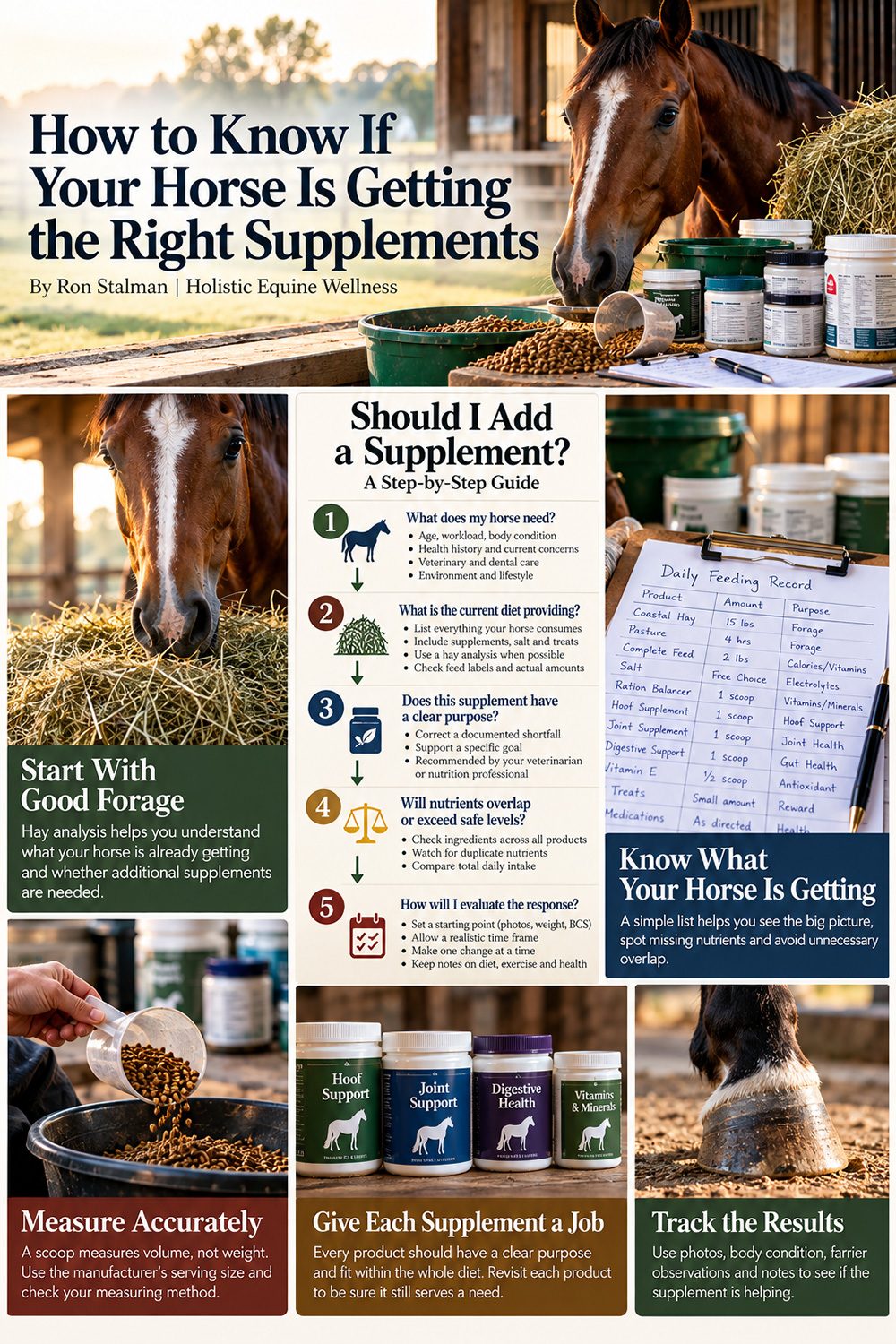
Before adding another supplement, write down everything your horse consumes during an average day.
Include:
- Hay
- Pasture
- Concentrated or complete feeds
- Ration balancers
- Salt
- Vitamin and mineral products
- Hoof, joint, digestive or other supplements
- Herbal products
- Regular treats
- Medications
Most importantly, record the actual daily amount.
This is where many feeding programs become difficult to evaluate. We may know that a horse receives a particular product, but not how many ounces are actually being fed or whether the horse receives the manufacturer's full recommended serving.
I suggest making a simple list with the full product name, the recommended serving, the amount you actually feed and the reason you are feeding it. Taking a photograph of the ingredient list and guaranteed analysis on each bag or container can also be extremely helpful.
Start With The Forage
Forage is the foundation of most equine diets, so that is where a nutritional review should begin.
A hay analysis can provide valuable information about protein, energy, minerals and, when the appropriate testing is requested, sugars and starch. A representative sample of the hay actually being fed gives you much more useful information than simply knowing whether the hay is coastal, timothy, orchard grass or alfalfa.[2]
Hay can change from one cutting, field or supplier to another.
If your horse's feeding program was developed around a particular hay analysis and the hay changes, the ration may need to be reviewed again.
Look At How Much Fortified Feed You Actually Feed
Commercial fortified feeds are formulated to provide certain nutrients when they are fed at the manufacturer's recommended rate.
If a horse only receives a small amount of that feed because he does not need the additional calories, he may also be receiving less of the intended vitamins and minerals.[3]
That does not necessarily mean he needs more grain.
Depending on the horse and the rest of the diet, a properly selected ration balancer or vitamin and mineral supplement may be a more appropriate way to fill nutritional gaps without adding unnecessary calories.[3]
This is why the entire ration matters more than any single bag or bucket.
3. Why Are You Feeding Each Supplement?
Every supplement in your feed room should have a job.
Ask yourself: Why did I start feeding this?
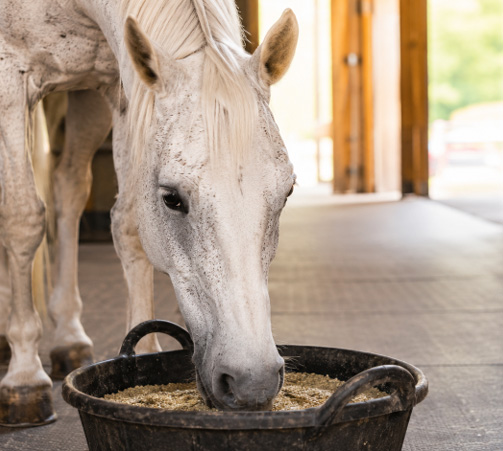
Perhaps your veterinarian recommended it. Maybe you are correcting a nutritional shortfall identified through the ration. Perhaps you are supporting hoof quality, digestion or another clearly defined goal.
Write that reason beside the product.
Then ask the harder question: Does it still have that job today?
Sometimes supplements remain in a program long after the original reason for using them has changed.
When evaluating a product, look beyond the front of the label. Find out what ingredients are included, how much of the important ingredients the horse actually receives at the daily serving, and whether there is equine research relevant to the intended use.
The presence of a researched ingredient does not automatically mean every formula containing that ingredient will produce the same result. The amount supplied, formulation and how it fits into the complete diet all matter.[4,7]
It is also reasonable to ask manufacturers questions.
What quality-control procedures are used? Are ingredient amounts disclosed? What evidence supports the intended purpose of the formula? How much should your particular horse receive?
Specific answers are more useful than broad promises.
And remember that price alone does not tell you which supplement is the better value. Compare the cost per day at the appropriate serving, not simply the price of the container.
The least expensive bucket is not necessarily the least expensive feeding program.
4. Are Several Products Supplying The Same Nutrients?
This is one of the most common things worth checking when a horse receives multiple supplements.
A hoof supplement may contain zinc and copper. A general wellness supplement may also contain zinc and copper. Your ration balancer or fortified feed may supply them as well.
Selenium is another nutrient that may appear in more than one product.
Different product names do not mean different nutrients.
This does not mean that feeding more than one product automatically creates a problem. It means you need to look at the combined daily intake from forage, feed and supplements and compare that total with the horse's nutritional needs and appropriate upper limits.[3,5]
Some nutrients, including selenium, can be harmful when excessive amounts are consumed.[3,5]
Measure What You Feed
Serving size deserves attention too.
A scoop measures volume, not weight. One manufacturer's scoop may hold a very different weight than another product's scoop.
When possible, use the manufacturer's stated serving weight and verify what your scoop actually holds. Do not assume that a scoop from one container can be used to measure another product accurately.[5]
Then consider the practical side of feeding. Is the horse eating the entire serving? Is powder being left in the bottom of the bucket? If several people feed at the barn, is everyone giving the same amount? Could the horse accidentally be receiving a supplement twice?
A carefully designed nutritional program only works when it is consistently followed.
5. How Will You Know Whether The Supplement Is Helping?
Before changing your horse's program, establish a starting point.
What exactly are you hoping will improve?
If your concern is body condition, record your horse's estimated weight and body condition score and take photographs from consistent angles.
If you are evaluating a hoof supplement, take dated photographs and include your farrier's observations.
If the goal involves performance or recovery, keep simple notes about what you are seeing.
Then give the program an appropriate amount of time.
Some changes cannot be evaluated in a week. Hoof supplements are a good example because improvements must appear through new hoof growth.[5]
When practical, I also prefer making one planned change at a time.
If you change the hay, add two supplements, change the horse's workload and begin another treatment all at once, the horse may certainly improve—but it becomes much harder to know what contributed to that improvement.
Keep notes about changes in forage, feed, exercise, medications and veterinary treatment so you have a clearer picture.
And if your horse is losing weight, becoming uncomfortable, showing persistent symptoms or developing a worsening condition, do not rely on a supplement trial in place of veterinary evaluation.[6]
Sometimes The Best Supplement Decision Is Not To Add Another Supplement
Horse owners care deeply about their horses. That is one reason our supplement shelves can gradually become crowded.
We see something that might help, someone recommends a product, or a horse develops a new concern. We add something to the program.
Over time, however, it is worth stopping and asking whether every product still belongs there.
A good supplement program does not necessarily mean feeding more products. Sometimes the best decision is identifying what the horse truly needs, filling genuine nutritional gaps and simplifying everything else.
That requires looking at forage, feed, supplements, medications, workload, body condition, health history and the horse's individual needs as parts of the same picture.
At Holistic Equine Wellness, this whole-horse approach is the foundation of our Equine Ration Review. We evaluate the horse's forage, feed, ration balancers and supplements together rather than considering each product separately. The goal is to identify possible nutritional gaps or excesses, unnecessary ingredient overlap and practical adjustments that may help the feeding program better match the individual horse.
Sometimes that means recommending a change. Sometimes it means confirming that what an owner is already doing makes sense. And sometimes it means discovering that the horse does not need another supplement at all.
Because ultimately, the goal isn't to build the biggest supplement program.
It's to build the right program for the horse standing in front of you.
Learn more about the Equine Ration Review and the whole-horse approach to nutrition at HolisticEquineWellness.com.
Sources
- University of Minnesota Extension. Caring for Your Senior Horse.
- University of Minnesota Extension. Understanding Your Hay Analysis.
- University of Minnesota Extension. Providing Your Horse Vitamins and Minerals.
- Oke S, McIlwraith CW. Review of the Potential Indications and Contraindications for Equine Oral Joint Health Supplements. AAEP Proceedings, 2008.
- Williams C, Rutgers Cooperative Extension. Does My Horse Need Supplements? Bulletin E373.
- University of Minnesota Extension. Caring for the Underweight Horse.
- Equine Veterinary Education, 2021. The Safety and Efficacy in Horses of Certain Nutraceuticals That Claim to Have Health Benefits.