


For decades the standard advice was simple: rotate dewormers every couple of months and hope for the best. The trouble is that blind, calendar-driven deworming tells you nothing about what is actually living inside your horse, and it has quietly bred dewormer-resistant parasites on farms across the country. Horsemen's Laboratory exists to replace that guesswork with a number you can trust. For roughly the price of a single tube of dewormer, you mail in a small manure sample and learn exactly what your horse is carrying before you treat.

The stool examination accurately identifies the adult roundworms and strongyles that cause most worm-related problems in horses, which is exactly where the resistance battle is being fought. Bots and pinworms do not reliably show up in a stool sample, and tapeworms are difficult to detect this way, which is why the separate tapeworm kit exists for owners who want that added screen. After you deworm, a follow-up count is the real proof of success: if eggs do not drop by at least 90 percent, it means either the worms were not sensitive to that dewormer or the horse did not get an adequate dose, both of which are vital to know before you waste another treatment.

Horsemen's Laboratory was established in 1993 by Dr. John W. Byrd, a lifelong horseman as much as a veterinarian. Before vet school he showed horses in pleasure and reining classes, and through college he built his interest in Quarter Horse breeding, ownership and racing across eight states. He graduated from the University of Illinois College of Veterinary Medicine, completed the first large-animal medical residency at the University of Florida in 1977, and went on to practice equine medicine in California for thirteen years, serving as the official sales veterinarian for the Pacific Coast Quarter Horse Racing Association and as show veterinarian at the Orange County Fairgrounds.
Watching how a horse's internal health shaped its performance is what led him to found the lab, and that hands-on horseman's perspective still drives its mission: make smart parasite monitoring genuinely affordable for every owner.

A single standard equine fecal egg count is $26. Order two to five kits and the price drops to $23 each; six or more is $21 each. Every price includes postage both ways, the collection kit, sample processing and your results.
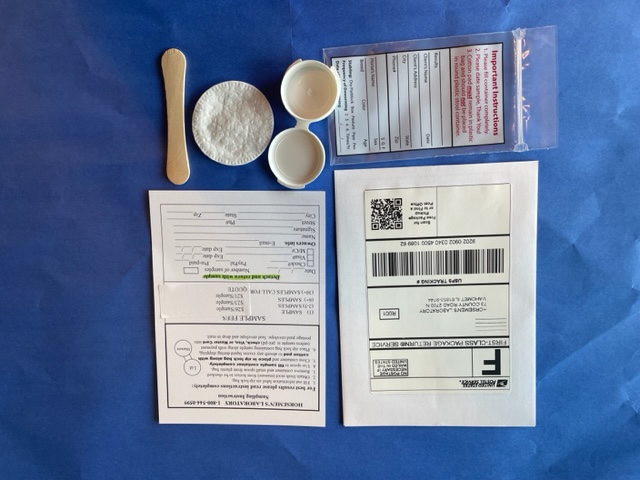
Each kit contains a sturdy sample container, a sealed plastic bag, a small scoop, instructions and a prepaid self-addressed return envelope, so postage is covered in both directions.
Results are emailed directly to you. If you do not have an email address on file, your results are mailed back through USPS instead.
Horsemen's Laboratory recommends rechecking most horses every three months and automatically sends repeat containers on that schedule, unless there is a change in the horse's environment that calls for testing sooner.
The standard stool examination accurately identifies adult roundworms and strongyles, which cause most parasite problems in horses. Bots and pinworms do not reliably appear in a stool sample, and tapeworms are hard to detect this way, so a separate $60 tapeworm kit is offered for owners who want that added screen.
No dewormer on the market is fully broad-spectrum anymore, and many parasites have developed resistance. Without a count you cannot tell whether a product is working or whether you are breeding resistant worms. Testing replaces guesswork with a measured number you can act on.
Run a follow-up count after treatment. If the egg count does not drop by at least 90 percent, it indicates either that the worms were not sensitive to that dewormer or that the horse did not receive an adequate dose, both of which you need to know before treating again.
Yes. Orders of twenty or more samples earn one free sample for every ten ordered, and buying ten or more counts at one time includes a full year of consultation on your horses' worm-control program, a $100 value.
About this listing: Product and service details on this page, including any results described, are provided by Affordable Worm Infestation Testing by Horsemen's Lab. InfoHorse.com verifies the business behind every listing — for decisions about your horse's health, talk with your veterinarian.
Explore more from the InfoHorse.com directory






Explore expert guides on topics related to your business
By Bob Pruitt
By InfoHorse Editorial Team
By Bob Pruitt
By Bob Pruitt
By Ann Pruitt
By Bob Pruitt