

Founder Treatment
Shoeing Founder with Plastic Shoes Monique Craig, EponaShoe.com
Founder in horses can be treated by shoeing with flexible plastic shoes—generally glued on rather than nailed, which spares the hoof wall—combined with trimming that gradually lowers the heel to restore the rotated pedal bone’s angle, plus silicone-based packing so the foot loads evenly. Because plastic flexes and shock-absorbs far more like natural hoof keratin than steel or aluminum, it aids circulation and new horn growth and makes the horse comfortable enough to move, which helps atrophied tendons and ligaments regain their flexibility. Monique Craig of EponaShoe reports being involved with over 35 founder cases treated with this flexible-shoe approach.
Visit Founder Treatment for Horses for More Products and Information For the past five years, I have been applying plastic shoes to horses. I also have ‘regular’ horses in plastic shoes, not just horses with soundness issues. Over the past four years I’ve been involved (either directly or indirectly) with over 35 founder cases which have all been treated using flexible shoes as this article will discuss. Why do I choose plastic over metal shoes? Well, the answer is simple: I want a prosthetic that is friendlier to the hoof’s function.
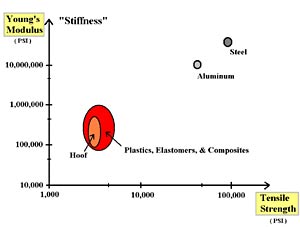
Metal does not flex nor shock absorb nearly as much as the natural hoof. In other words, the mechanical properties of metals (steel and aluminum) have little in common with those of hoof keratin (see fig. 1). Let’s make an analogy concerning the relative flexibility of these things: If hoof keratin is the infield of Yankee stadium, then man-made flexible synthetics occupy the entire infield and outfield of Yankee stadium; aluminum is one mile beyond the centerfield fence, and steel is three miles beyond the centerfield fence! I think that to protect and support the hoof, we should be using something that’s at least in the ballpark!
The three horses in the case studies presented here were initially shod with Marathon shoes (from Germany) and now with the EponaShoe. I generally glue on the shoes rather than nail – less hoof wall damage, and in some founder cases there is no good wall to nail to. The glue spreads the load evenly and avoids concentrations at nail locations. The EponaShoe provides good caudal support which is important, since in these cases loading of the hoof wall often needs to be minimized.
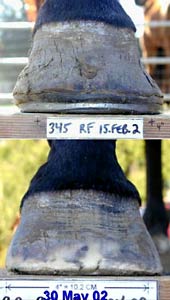
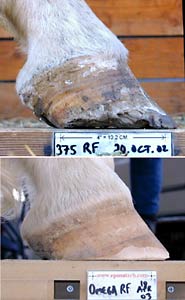
I have chosen to write about these three particular horses because of the severity of the founder, and because I have been able to follow their progress for a minimum of two years. Two of the three horses ended up being part of our herd here at EponaTech ranch (now 11 horses total…we hope this will be the final number!) One of the three horses went back to its home.
All these foundered horses came to me by veterinarian referral, and none were diagnosed with metabolic problems. I started treatment on these horses after the acute founder episode.
Although the use of plastic shoes is beneficial to the hoof, it is NOT a miracle cure to founder or any other serious hoof-related problems. To me, the plastic shoe is a means to an end -- its use enables me to eliminate some mechanical constraints placed on the hoof by the application of metal shoes. The key to any shoeing ‘success’ rests in enabling proper function of internal hoof structures, trimming for a specific situation, and using appropriate shoe placement.
Using plastic shoes, the added flex to the hoof capsule helps circulation which in turn simulates new growth. I have data on over 400 horses in plastic shoes -- the common denominator with all of them is improved horn quality and healthier horn growth. Trimming the hoof to help attain better joint alignment and giving arch and sole support will also contribute to improved circulation. Under the right conditions, the hoof capsule can restructure itself very quickly. I must point out that some images of hoof resections I see in professional (farrier and veterinarian) magazines have me somewhat concerned –
Is it truly necessary to resect hoof walls?
Hoof wall resection is perhaps more often appropriate when using a metal shoe. With plastic shoes, it may not be done as routinely. I think that before doing radical horn removal, one should ask “is there really necrotic tissue that cannot be resolved by the animal ‘on its own’?” The exact mechanism under which a hoof is able to restructure itself is poorly understood at this stage but suffice to say that the hoof is amazing in its capability to regenerate itself when allowed to do so (see figures 2 and 3). The old-fashioned notion that the wall grows down from the corium seems not to be strictly true: there is some amount of new wall growth from within the hoof capsule [3].
Deep resection can cause permanent change to molecular structure of the hoof keratin [4], this means that the biochemical and biomechanical stability of the horn may become compromised. I suspect that any long term aggressive trimming of the horn will eventually cause loss of its mechanical integrity.
It is also crucial to understand the mechanical properties of tendons and ligaments, especially how they react after immobilization. Tendons and ligaments will lose their flexibility if not put to work (see figure 4.) It is harder to ‘de-rotate’ the pedal bone of a foundered horse that does not get sufficient exercise. The tendons/ligaments tend to return to their atrophied state.
In the case of tendons, the muscles to which they attach are the real issue – it is these muscles that need to stretch and come back to some normalcy. It has been shown in rehabilitative human medicine, that after a tendon/ligament has been immobilized, the time required to go back to its original elasticity is three times the length of time it was immobilized [5]. The foundered horse needs to be made as comfortable as soon as possible in order for the horse to resume ‘reasonably normal’ motion and exercise.
It greatly helps the tendons and ligaments regain their flexibility.
I think that people misuse the term ‘chronic founder’. To me, a chronic founder is a horse that continues to have laminitic episodes due to undiagnosed metabolic problems. Sometimes horses are called chronic because they have not been treated properly and keep returning to their old founder stance due to the lack of movement. We need to distinguish between metabolic issues and mechanical problems.
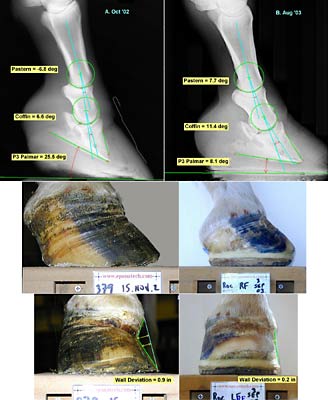
Whereas many veterinary and farriery books present the ‘correct’ joint alignment for the last three phalanges as a straight line, I have never felt this is quite right. The bones P3 (coffin joint), P2 (short pastern), and P1 (long pastern) are weight-bearing, and should align so that each bone is slightly more inclined than the previous as we move up the leg. That is, there should be a small rotation angle between phalanges, each a bit more up-right as we move up the phalanges [6].
I use software that I have developed, called Metron-PX, to assess the position of P3 within the hoof capsule and the alignment of the phalanges. A discussion of the Metron software is beyond the scope of this article, but there is a lot of information at the EponaTech web-site [7].
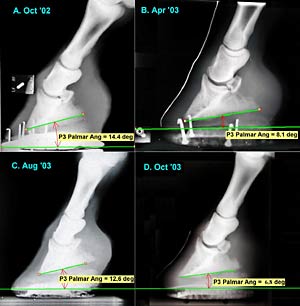
In many founder cases (including the three covered in this article) there has been a substantial rotation of the P3 bone. In such cases, a primary aim of my approach is, over time, to lower the heel to attempt to restore the angle of the P3 bone relative to ground. This process involves removing heel gradually, which is the opposite of some approaches that recommend the use of wedge pads to “relieve stress on the deep digital flexor tendon (Ddft)”.
However, I feel that eventually we need to restore a more normal stance and we need to work against the tendency to atrophy. I also feel that with the heels elevated, a concentrated loading towards the toe occurs, which may contribute to the decalcification at the tip of P3 that occurs in some cases.
I try to bevel the shoe at the toe, and place the shoe on the foot so as to minimize the ‘lever arm’, and reduce Ddft forces in this way (see fig. 5). Most importantly, using my “method” in conjunction with the plastic shoe and packing, the horses have been almost immediately comfortable. It takes some attention to detail to change hoof angle by reasonable amounts over time for the process to succeed.
It is often the case that foundered horses kept on artificial high heels will eventually have to have tendon/ligament surgery to correct this problem. In human medicine, it is known that surgery to tendons and ligaments often has a side effect of irreversible damage to proprioceptors [5, page 310] among other things. I believe the same is true for the horse, and so in my opinion, such tendon and ligament surgery should only be used as an absolute “last resort”.
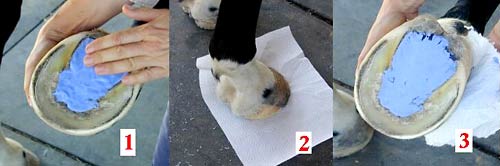
Finally, I pack the bottom part of the hoof to allow the hoof to load evenly (figure 6). The main complaint sometimes heard about packing is that it can make horses sore. I think that it is true if people are not careful. Excessive sole removal – meaning creating a big cup in the sole and then placing too much packing can make the horse very sore. Preparing the sole carefully with only minor clean-up if needed, followed by selective use of packing and placement of packing almost always succeeds.
Also, there are many possibilities in pedal bones shapes. This requires some thinking prior to packing. It is important to choose the right material or materials to place under the sole. In difficult cases I deal with problems like this by packing in multiple layers of material. A layer of foam under the pedal bone does wonders in sore toe areas or when P3 has gone through the sole.
In cases like these I use a thicker layer of glue to lift the shoe off the sole. A judicious use of the glue will often allow you to work around hoof problems, such as abscesses. You can choose to not apply glue in some areas.
Due to the many variations and special situations that arise in the treatment of founder cases, I think it is unwise to promote a strict “method” to be followed. But adherence to some of the basic principles discussed in this article, in particular the use of a flexible shoe and a good means of frog/sole support, can help you achieve beneficial results. There are many other important aspects to trimming and shoeing which could not be covered in this article.In summary, flexible shoes make sense in treating founder cases for the following reasons: 'They shock absorb and make the horse more comfortable 'A more comfortable horse moves more, and this is beneficial in not allowing the tendons and muscles to atrophy further, and to start rehabilitation 'The plastic wears easier than metal, so the horse (or you) can adjust the various bevels (at the toe and also lateral-medial sides) as needed 'The shoe does not inhibit flexing of the hoof, and so aids in normal hoof function to pump blood, bringing nutrients to help rebuild damaged walls.
Reduces the need for resection. 'Since they are softer than any metal shoe, there is less chance of causing a hard pressure point to any region of the sole.
Contact: John or Monique Craig P.O. Box 361 Creston, California 93432 Phone: 1-866-376-6283 or 805-239-3505 Email: [email protected] Website: www.eponashoe.com
References [1] Bertram, J. and Gosselin J., “Functional Design of Horse Hoof Keratin: The Modulation of Mechanical Properties through Hydration Effects”, Journal of Experimental Biology 130, 121-136, 1987.
[2] Van Vlack, L., “Material Science for Engineers”, Addison-Wesley, 1970.
[3] Bowker, R., “The Growth and Adaptive Capabilities of the Hoof Wall and Sole: Functional Changes in Response to Stress”, in the proceedings of the 49th Annual Convention of the American Association of Equine Practitioners, New Orleans, 2003.
[4] Cope, B., Hopegood, L. et al, “Studies of Equid Hoof Horn Material by EPR Spectroscopy”, in Journal of Materials Chemistry, 8(1), 43-45, 1998.
[5] Martin, R.B. et al, “Skeletal Tissue Mechanics”, Springer Verlag, New York, 1998.
[6] Craig, J. and Craig, M., “Measuring the Hoof”, a presentation at the 2nd International Hoof Care Summit, Cincinnati, Ohio, January, 2005.
[7] www.eponatech.com Monique Craig is the founder of both EponaShoe ( www.eponashoe.com ) and EponaTech ( www.eponatech.com )