
Helping Horse Owners Make Informed Decisions
Horse Sleeping Habits, Horse Stall Comfort
Sponsored Article

Horse Sleeping Habits, Horse Stall Comfort

By Michael Lowder · Health

Working on your barn and want a practical read on Horse Sleeping Habits, Horse Stall Comfort?

Sponsored Content

Horse SleepingHabits, Horse Stall Comfort
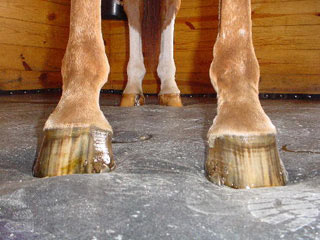
SoftStall Stall Comfort

There is so much resting on your stall floor decision!

Article from Equine Products By SoftStall Official Supplier FOR THE 2010 Alltech World Equestrian Games

When it comes to stall flooring, stable flooring, stall bedding, horse stalls… or which ever term you prefer… how many of you have heard, or experienced first hand the saying “my horse never lies down in its stall.” I have heard this way too often.

In my quest to understand this reason behind this statement, I have spoken with many equine practitioners and the response is quite similar. Some horses do not lay down because stall floor beneath them is too hard. This can create discomfort for the horse during the process of laying down or getting up. This becomes more obvious with older horses or horses with lameness issues. Even with up to ten inches of shavings in a horses stall they can compress shavings paper thin leaving them without a much needed cushion. Rubber mats as the base can help minimally but remember, rubber mats can be as hard as a hockey puck, especially in colder temperatures and most do not offer much, if any, insulation or protection from dampness.

Being involved with the equine industry on both the business and personal side I have taken a great interest in understanding how important it is for horses to get quality rest and how a their stall can greatly effect this achievement. In my ongoing research I came upon an article by Michael Lowder, DVM, MS a renowned equine practitioner from the University of Georgia who wrote the following: Do horses sleep? Have you ever noticed that there are days when your horse appears more rested than others? We all know how a good bed affects our sleep, and recent research indicates that the bedding material we provide our horses may influence their sleep as well!

Our horses spend most of their lives in an artificial environment, and tradition along with myth dictates how we manage their lives. We often create the horse's environment from a human point of view without giving much thought to what our horses really need. So what bedding should you use? Think about it when you want your horse to perform at his best, you must give him the opportunity to rest and a good bed to sleep in.
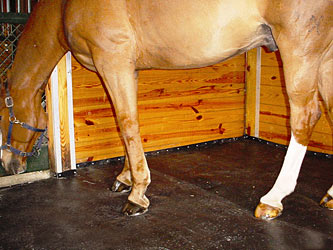
Horse Standing on SoftStall

Many of us have never given any thought as to how a good sleep affects our horse's potential. Give your horse the best opportunity for rest, and he will give you the performance of a life- time. On the average, a horse requires up to two hours rest each day. Much like ourselves, a horse requires rem sleep to help rejuvenate its body and mind. We know a horse can rest standing up but to get quality rem sleep they need to lay flat out. As the innovator of SoftStall, the therapeutic equine bed for horses I ask you this question. How do you think you would perform during a vigorous exercise program the morning after sleeping on your carpeted floor and not on your mattress?
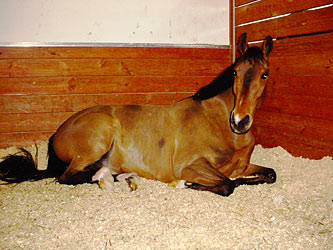
Horse laying down.

Unlike stall mats or rubber mats Soft Stall invites a tired horse to lay down and rest for longer periods of time with out the discomfort or getting up or down and will actually insulate them from cold and dampness which can onset arthritic and other muscular and joint conditions.. With SoftStall your horse just will not develop a hock sore as there is no friction created when they get up and down. As the one chosen to muck the stalls daily you will find that your time doing so will be significantly reduced and you will save money on shavings as they are required only to absorb the urine. The amount of shavings required with SoftStall depends on the behaviour of your horse in its stall and the turn out time it gets.

As horse owners we take a lot care and pride in our horses, our farms, from the actual buildings to the stalls we put in our barns. It’s time to pay closer attention to what we actually put in our horses stall… for their sake!

Contact: SoftStall 5298 Wellington Rd 27 RR#1 Rockwood, Ontario Canada N0B 2K0 Phone: 866-333-7638 Email: laurie@softstall.com Website: www.softstall.com

Sponsored Content — Contact information provided by the sponsor
Key Article Takeaways
  • In my quest to understand this reason behind this statement, I have spoken with many equine practitioners and the response is quite similar.
  • Some horses do not lay down because stall floor beneath them is too hard.
  • This can create discomfort for the horse during the process of laying down or getting up.
  • This becomes more obvious with older horses or horses with lameness issues.
  • Even with up to ten inches of shavings in a horses stall they can compress shavings paper thin leaving them without a much needed cushion.
Questions readers commonly ask:
How do I know if my horse isn't getting enough rest?

Per the article, citing Michael Lowder, DVM, MS (University of Georgia): horses can rest standing up, but they need REM sleep — and to get REM, they need to lie flat out. On average, a horse requires up to two hours of rest each day, much like humans require sleep to rejuvenate body and mind.

The most common signal that a horse isn't getting enough quality rest is the often-heard owner statement: "my horse never lies down in its stall". Per the article, the most frequent cause among equine practitioners' experience is that the stall floor is too hard — the horse experiences enough discomfort during the process of lying down or getting up that it just doesn't bother. This shows up more obviously in older horses or horses with lameness issues. The article frames the analogy: how would you perform during vigorous exercise after sleeping on a carpeted floor instead of a mattress? Performance and rest are linked, and a horse that isn't lying down is a horse that's running on standing-rest only.

What should I do to improve my horse's stall comfort?

Per the article: the highest-leverage move is rethinking the surface the horse stands and lies on. Even with up to ten inches of shavings, horses can compress shavings paper-thin, leaving them without the cushion they need. Rubber mats as a base help minimally — but rubber mats can be as hard as a hockey puck, especially in colder temperatures, and most don't offer much insulation or protection from dampness.

The article's framing per Michael Lowder, DVM: traditional stall management often reflects human preferences rather than what horses actually need. Bedding material can influence how well horses sleep, just as bed quality influences human sleep. The practical implication: when a horse seems off-pace or reluctant to lie down, the stall surface is one of the first things to evaluate before assuming the cause is medical or behavioral. Pair surface upgrades with adequate turnout, social contact, and a routine that matches the horse's natural rhythms — rest is the foundation that lets the rest of the management work.

What's the difference between rubber mats, deep shavings, and a therapeutic bed?

Per the article: each option has tradeoffs that show up over time.

  • Rubber mats alone — a hard base that's "as hard as a hockey puck" in colder temperatures. Most don't offer meaningful insulation or moisture protection. Useful as a foundation, inadequate as a sleeping surface on their own.
  • Deep shavings (up to 10") — comfortable initially, but horses compress them paper-thin during lying down, removing the cushion just when it's most needed. Requires high-volume bedding turnover.
  • Therapeutic bedding — designed to invite the horse to lie down for longer rest periods without discomfort during getting up or down, and to insulate against cold and dampness (which the article notes can contribute to arthritic and other muscular/joint conditions). The friction-related issue of hock sores is reduced because there's no friction during getting up and down.

The decision drives as much off the horse's age, joint condition, and stall hours as it does off cost.

How much sleep does a horse actually need?

Per Michael Lowder, DVM, MS: on average, a horse requires up to two hours of rest each day. The amount itself is modest, but the quality matters more than the quantity. Like humans, horses require REM sleep to help rejuvenate body and mind — and getting REM is the part that requires lying flat out. Standing rest doesn't deliver the same neurological benefit.

The implication for owners: it's not enough that a horse is "resting" if you only ever see it standing. Look for evidence the horse actually lies down. Watch for the indirect cues — a horse that performs sluggishly, recovers slowly from work, or shows the classic owner-noted pattern of "never seen lying down" may be running on a chronic sleep deficit. Quality of bedding and stall comfort directly affects whether the horse takes the rest it needs. Per the article: give your horse the best opportunity for rest, and he will give you the performance of a lifetime.

Related Products & Services

LaSal Animal Health
InfoHorse Advertiser
LaSal Animal Health
Nebulizer La Sal Animal Health offers the only chelated silver nebulizing solution on the market. Find LaSal Animal Health on InfoHorse.com.
Markie's Choice
InfoHorse Advertiser
Markie's Choice
Markie's Choice — Horse Health Products. Find product details, reviews, contact info and more on InfoHorse.com, America's #1 horse product directory.
The Hay-EZ
InfoHorse Advertiser
The Hay-EZ
The Hay-EZ Hay Bag Filler — the smart way to fill your slow-feed hay bags or nets. Hold the bag open at the top for easy hay loading. Filling has never been easier.
Ann Pruitt
Contact Ann Pruitt
InfoHorse.com