

EPM Treatment for Horses, Preventing EPM by Heartland Vet Supply
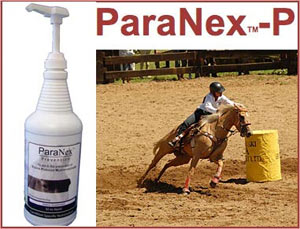
Because EPM spreads when horses eat hay, grain, or drink water contaminated by opossum feces, prevention means attacking the protozoa before they can leave the gut or travel through the bloodstream to the spinal cord and brain. Paranex-P, a non-prescription daily product, does both—given at one ounce a day on feed, it attacks the protozoa in the gut and is absorbed to attack again in the bloodstream, with a gallon jug lasting a horse 128 days for around $119.95. The product is safe for all classes of horses, including pregnant mares, stallions, weanlings, and competitive horses, and contains no components banned by the USEF.
EPM Equine Protozoa Myeloencephalitis Prevention Any horse that eats hay, grain, or grazes in a pasture is susceptible to getting EPM
Equine protozoa myeloencephalitis (EPM) is an infection of the brain and spinal cord of horses by single-celled parasites known as protozoa which is carried by opossums. Opossum feces can contaminate hay and grain out in the field or hay bales stored in sheds. The protozaon responsible for EPM gets mixed with the hay or grain and is then ingested by the horse.
EPM, which is the most commonly diagnosed neurological disorder in horses, can be a permanently debilitating or fatal disease, and is currently running rampant in the United States and Canada. The disease is most commonly (probably greater than 95% of cases) caused by the protozoa Sarcocystis neurona; occasionally, another protozoa known as Neospora hughesi also can cause EPM. In a small minority of cases (probably less than 2%), the organism invades the spinal cord or brain of the horse and grows, resulting in the clinical signs recognized as EPM.
The organism is carried to the nervous system either directly by the blood stream or within white blood cells that have engulfed the organism The clinical signs of EPM in the horse are quite variable and depend upon the anatomic location in the nervous system in which it resides. Chance seems to favor the spinal cord, and the most common clinical signs expressed are stumbling, a weak, weaving gait, and atrophy of muscles.
If the brain is affected, which is far less common, the clinical signs might include blindness, inability to chew or swallow, atrophy of muscles of the head (such as the masseter in the cheek that closes the jaw during chewing), head tilt, or seizures. Horses are exposed to Sarcocystis via contaminated feed or water. The opossum feces that carries the protozoa can get into your horses feed in several different ways but most commonly gets baled up in the hay or contaminates pond or even water tanks.
Some symptoms of EPM include:
Severe -- difficulty standing -- difficulty walking -- difficulty swallowing -- convulsions
Mild -- laryngeal hemiplesia (roaring) airway noise -- facial paralysis -- dropping ear -- intermittent lameness -- depression -- muscle atrophy -- narcolepsy
Subtle -- refusing to back-up -- mild loss of athletic ability -- slower times in the barrels, racing or jumping -- poor performance in general -- poor hair coat, dull appearance -- weight loss
Diseases that mimic EPM Symptoms -- West Nile Encephalitis -- Eastern Encephalitis -- Western Encephalitis -- Equine Herpesvirus I -- CVM Cervical Vertebral Myelopathy (wobbles) -- Emnd Equine Motor Neuron Disease -- Rabies -- Venezuelan Encephalitis
Because there are so many diseases that mimic the symptoms of EPM, it is imperative that a definitive diagnosis be made for EPM treatment.
Since the protozoa must first enter the blood stream via passing through the gut wall it makes sense to attack the protozoa before it can leave the gut, or attack it in the blood stream before it can enter the spinal cord or brain. There is a new product available that actually does both. Paranex-P the “P” stands for prevention. Paranex-P given daily attacks the protozoa in the gut and is absorbed by the horse to attack again in the blood stream. For more information go to www.heartlandvetsupply.com or www.paranex-p.com .
Is it safe?
This product is not an antibiotic or biocide and is very safe. This product can be used on all classes of horses (pregnant mares, stallions, weanlings, and competitive horses). According to the USEF, The United States Equine Federation, the national governing body for equestrian sport, ParaNex-P contains no banned components. If you show, jump, race, or other you can be assured this product will have no negative effect on performance.
There have been several horses on Paranex-P, the prevention product, for over a year now, and not a single horse has shown symptoms of EPM yet. Some of these horses had been treated for EPM previously, and went on the Paranex so symptoms of EPM would not come back. These are horses that are being continually exposed. Other horses in this group are running with horses that have come down with EPM, and they wanted to protect their horse or horses. In any case the Paranex-P product has done what the Manufactures (Elara) has said it would do and that is prevent symptoms. D. L. Biehl, DVM
Where to Purchase Heartlandvetsupply.com is located in Hastings, Nebraska, USA. Heartland has been in business since 1981 as a functioning veterinary clinic involved with the diagnosis and treatment of health problems in the equine, canine, and feline species. We are America's horse, dog and cat discount supply headquarters and award winning discount cataloger. We carry and supply the information and products you need in order to keep your pet(s) and/or horse(s) healthy.
For the Horseman, we have a complete line of animal health care products for your horse or horses mules or donkeys. When shopping with us, you will find our prices among the lowest anywhere. Paying less means better profit margins for the farm & ranch.
We have made a reputation for responding to your needs as a horse and pet owner. We offer a complete line of discount horse supplies and products as well as discount pet products and supplies to ensure the health & longevity of your horse and pets. Shop for all your horse health products at www.heartlandvetsupply.com, or call 1-800-934-9398 for a free catalog.
If you have any questions regarding veterinary health care, you can email Dr. Biehl at [email protected]. You may also fax us at 888-424-0484.
Contact: Our Friendly Staff 401 W. 33rd Street Hastings, Nebraska 68901 Phone: 800-934-9398 Email: [email protected] Website: www.heartlandvetsupply.com