

Check out- Fire Protection for Horse Barns
Barn Fire Prevention
Buy Your Horses a Fan That Won’t Kill Them By Laurie Loveman author of Fire House Novels Book Series
To prevent barn fires, use only fans designed for agricultural use in horse barns—never residential box fans—because dust gets into their unsealed motors, which seize, burn out, and drop melting plastic onto bedding, while the burning housing emits toxic smoke that can kill a horse within minutes. Agricultural fans have sealed motors with thermal protection, galvanized construction, welded wire guards, and heavy-duty power cords; if you can see wires at the back of a fan, the motor is not sealed. Treat extension cords as strictly temporary, and make sure every stall in the barn has the correct type of fan—one light-duty fan puts all the horses at risk.
Now that the weather is warming up, many of you are preparing to buy and install box fans in your barns. Before you buy a box fan, though, make absolutely sure it’s designed for agricultural use! The motor must be sealed to prevent dirt and dust from getting into the motor and starting a fire. The inexpensive box fans we use in our homes are too dangerous to use in our barns. Two fillies died in Paris Pike, Kentucky, in July when a box fan overheated and ignited straw, and that’s just one example of hundreds of similar incidents.
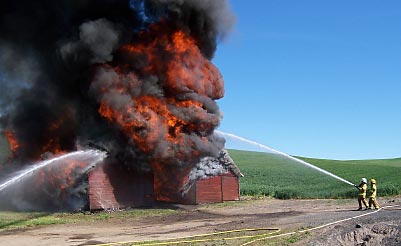
When dust gets into the motors of these light-duty fans, the motors seize up and burn out. The plastic housing then melts and falls onto bedding. If the fan is mounted on the outside of the stall, and the aisle way is not swept clean (our horses always dropped hay between the front bars of their stalls or over their door), the hot plastic can ignite the hay pieces and send flames in both directions in the aisle way.
In the meantime, the burning plastic housing of the fan will be emitting toxic smoke that can kill a horse within minutes. You could have a barn full of dead horses before you even realize a fire has started.
Another problem with residential type box fans is that the electrical cord is light-weight and without
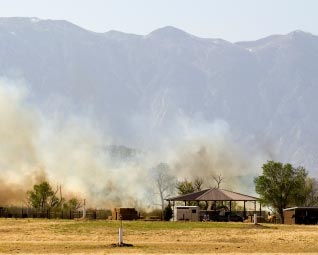
much insulation. It takes very little to break through the insulation, exposing the electricity conducting wire. If a short circuit occurs in a cord that is hanging near or lying on hay, bedding, cobwebs or accumulated dust a fire can easily start. Any animal in your barn (invited or otherwise) is capable of breaking the insulation with as little as a single bite. An added hazard to the light duty fan cord is created when you have to use an extension cord to reach an outlet.
Even if the extension cord is heavy duty, if it is draped over beams or nails or woven through stall-front bars, if it is left in place slight rubbing of the cord insulation over time can expose the wires, allowing a short circuit. As a general rule, extension cords should never take the place of wiring enclosed in conduit, especially in places where the cord can be reached by any of the barn occupants.
In fact, extension cords must always be considered temporary, to be used only for a specific purpose and removed when the job is done.
The fans to use are designated for agricultural and industrial settings and their motors are sealed so no dust can get in. If you look at the back of the fan and see wires, the motor is not sealed. There are many brands of agricultural fans that are available with different kinds of mounts so you can hang the fan from either a beam or a wall. Standard features on almost all agricultural fans include galvanized construction, enclosed motors with thermal protection, welded wire guards on the intake and exhaust sides, and a heavy-duty power cord. You can buy these fans at an agricultural or electrical supply store or through catalogs.
Here’s something to consider regarding box fans. If you are boarding your horse in a large stable where everyone is using box fans, it doesn’t do you much good if you have a top-of-the-line agricultural fan when other people are using box fans they bought at the local hardware or discount store. If the motor in one of those light duty fans burns out, your horse is in just as much trouble as if you had a residential box fan yourself. Every stall has to have the correct type of fan if the barn is to remain safe.
Another option for cooling your barn is installing a wall-mounted box fan at one or both ends of the barn, or there are large (42”) portable circular fans that do a great job of moving air to keep the barn comfortable. Again, you want to purchase an agricultural or industrial grade fan that meets Osha requirements.
Finally, you do have another choice. You can recognize that if your horses are kept inside during the hot daylight hours they really don’t need a fan. They are not exerting very much energy by being in their stalls, except for munching hay. If they spend nights in pasture they will spend most of the day sleeping in their stalls. So, if you have decent ventilation, being shielded from the sun and heat with the walls and roof of the barn is pretty much as Nature intended.
We are the ones who need a fan! While our horses are snoozing after a night outdoors, we’re the ones exerting energy keeping the barn and stalls clean! Even if your horses don’t have the “luxury” of spending their summer nights outdoors, the temperature in the barn will still fall to comfortable levels during the night.
John and Kimberly Linger suffered the loss of 44 horses when a fire started by a residential type box fan destroyed their barn. Kimberly wants everyone to be warned of the dangers, and my correspondence with Kimberly is posted on my website, www.firesafetyinbarns.com following my article on Electric Appliances. You will also find on my download page, a warning sign that you can provide to your local tack and feed shops and to any store in your area that sells residential type box fans. Remind the retailers that they will be seen as very good neighbors if the warning prevents a barn fire!
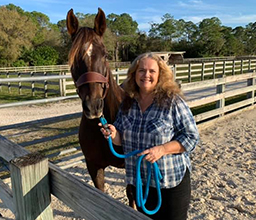
Laurie Loveman is an author and writer of novels and articles and is a recognized expert in the area

of fire safety in horse barns. Her articles have been published in many leading fire and equine journals and one of her fire safety articles was adapted for a booklet by the Humane Society of the United States. Her novels also deal with the topics of horses and firefighters in the 1930s in the fictional town of Woodhill, Ohio.