

Equine Dentistry
Horse dentistry is a field that’s under constant discussion – how to perform equine dentistry and how conservative or aggressive to be when doing it. Article from Allison Kuhl written by Walt Friedrichfor Omega Fields®, Inc.
Good equine dentistry comes down to a qualified practitioner and a conservative touch. A proper equine dentist always works with a full-mouth speculum—the hindmost molars simply can’t be examined or floated without one—and because a horse’s teeth erupt only about a tenth of an inch per year, an annual float should never remove more than that. A thorough, careful job takes about an hour, should leave no blood or soreness afterward, and any sedation must by law be administered and monitored by a veterinarian.
There are only a couple of cars that make our horses nervous when seen coming up the driveway – the vet’s often tops the list, and the dentist’s isn’t far behind. But those folks are necessary visitors, and we must schedule them for the good of our beloved equine friends. Scheduling the vet is a given, but let us not forget the importance of dental visits – it’s a big part of the responsibility we take on when we make a home for and share our lives with horses.
Besides, after observing the acceptance horses have for those equine dentists who really know what they’re doing, it appears not all of them feel quite so queasy about the subject as do some of us. So sit back, relax, and be happy we’re talking about someone else’s mouth full of those intimidating metal tools – but do pay attention; it may make your next dental event, horse or human, a little easier.
Right up front, understand that the results of the next dental encounter your horse has depend entirely upon the dentist, his skill, attitude, demeanor, and the tools he uses, and you get to select just who he is, so do your homework to find a good one. Look on Angie’s List, talk to people whose opinions you trust, including your vet – but note that many vets also practice dentistry, and I would urge you to be skeptical about actually using a vet for this purpose unless he’s more dentist than vet. Although I have the greatest respect for vets, most don’t specialize in dentistry and don’t have the experience and expertise that dedicated practitioners do.
Having made your selection, you need to vet your choice to be sure it’s truly a good one. This is your chance: he’s going to inspect your horse’s mouth, looking for problems, and he should tell you and show you what he’s doing and why. He’ll show you how to feel the upper molar teeth through the horse’s cheeks, looking for sharp points or pain. He’ll demonstrate how to check for free lateral movement of your horse’s lower jaw and explain why it’s important.
He’ll show you his tools and explain what they do. He’ll put a speculum into your horse’s mouth to keep it wide open so he can work safely; you should see and feel for yourself what is going on inside your horse’s mouth. The hindmost molar sits just below his eye, a bit hard to get at, and some dentists miss or improperly float those rear molars. He should show you any hooks or ramps or waves or improper slope along the tooth line.
Further, some don’t take pains to angle the incisors correctly – if they are not properly adjusted the molars won’t meet correctly, food will not be chewed thoroughly, and the horse's condition will deteriorate.
Now, that’s an impressive list – but take note that all of it requires the dentist to work inside your horse’s mouth, and in order to do that he needs a device called a speculum. It forces the lower jaw away from the upper and locks in place, but is totally painless for the horse. It is also absolutely essential that the dentist use a speculum; he cannot reach the back molars without using one, and if he doesn’t even have one, get him out of there now -- he’s not a a proper “dentist” for your horse.
Equine dentistry is a field that’s under constant discussion – how to perform equine dentistry and how conservative or aggressive to be when doing it. It is all based upon your horse’s teeth; here are the basic facts-of-life about those teeth: a horse has all the teeth he’ll ever have by the age of about five. They don’t grow from there on, they “erupt” from his jaws and gums, very slowly, throughout his lifetime or until there’s no more tooth left, whichever comes first.
A tooth erupts at about 1/10th of an inch (2-3 millimeters) per year, allowing the tooth to last up to about 30 years; thus simple arithmetic tells us that if his teeth are floated once per year, the dentist must not take off more than that mm or two lest the horse run out of tooth before he runs out of life. That restriction must be rigidly followed to prevent the need for a porridge-only diet in his last years.
Admittedly, this is a conservative approach, but the dentist’s job should be more than just making sure the horse can chew, he should also do what he can to ensure that life will be comfortable for the horse and that he can have the longest life span reasonably possible.
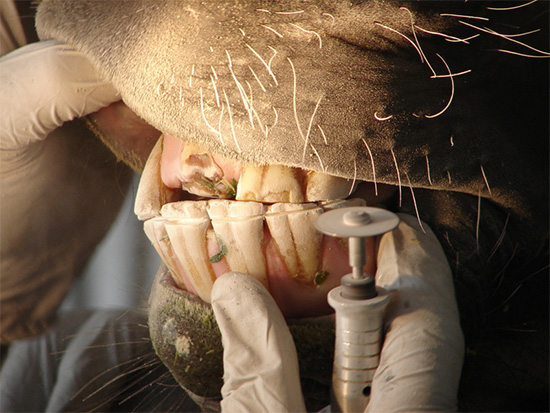
Most dentists will show up at your barn carrying a bucket filled with the tools of his trade – a collection of file-like devices called “floats” that will take off surface material from the teeth; probably a large syringe to rinse the horse’s mouth, and a bottle of what he may refer to as “Listerine”, which he’ll use for that rinsing – it cleans and it tastes good. There’ll also likely be a full speculum and probably two half-speculums to fit one side or the other of your horse’s mouth.
These are all manually-operated devices, but let us not forget to mention the power dental tools used by some dentists; although quite popular now, they remain a controversial subject, particularly as regards the life span of our horse’s teeth.
Power tools allow fast work and can be a great help in severe cases, but some dentists use them for routine tooth maintenance; the problem is that it’s too easy to take off too much substance to do this at every treatment. Always bear in mind that overdone power trimming will come back to haunt you and your horse as he approaches the end of his life contract. The conservative approach is your horse’s only protection against that ultimate porridge diet.
When routine dentistry is done with proper care, there should be minimum, if any, soreness afterward. But there are some conditions that can show up during dentistry, especially with the Temporomandibular Joints (TMJs), located behind the eye and under the ear – they are the hinges that hold the lower jaw onto the horse’s skull. These joints become quite painful when inflamed, and can cause the horse to fuss during dental procedures, yet routine dental care is imperative for proper TMJ functioning.
The dental procedure itself can cause problems. Horses should receive frequent periods of rest from the speculum, which is sometimes not possible when extensive dental work is under way, or with difficult patients. It is wise to have a chiropractic or acupuncture evaluation of the jaw, head, and neck following any oral procedures, just to be sure he’s not in some residual discomfort.
There shouldn't be blood either; it most often appears when the horse is fussing about while the dentist is trying to work. If the horse is unruly during dental procedures, then at the request of the dentist and with your permission, Bute or even sedation might be applied.
So let’s talk about sedation. In some situations, sedation is necessary to do a proper job without the horse bleeding, as well as to make it as pleasant an experience as possible for the horse, and to prevent your needing dentistry for yourself when the horse is done. A panicky horse is not safe for either the horse himself, the dentist, or an assistant (you, maybe?) who is in danger of being knocked in the head by the speculum while the horse is wearing it. Thus, sedation seems like an option.
Please note, however, that sedation is a procedure that must be administered and monitored by a vet, as required by law, because there can be some danger to the horse. An experienced vet will administer no more than is necessary for the dental treatment, so that it will not take hours or more for the horse to come out of it. And don’t argue with that vet when he tells you no sedation because it’s too dangerous. He knows what he’s talking about.
On a philosophical note, consider that the more natural you can keep your
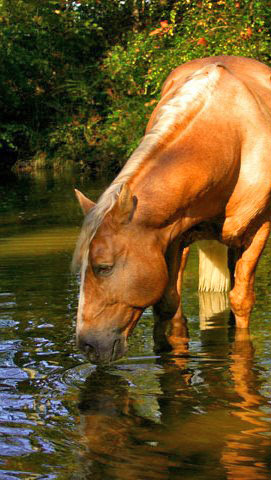
horse, the more correctly he will wear his teeth. Experienced equine dentists will tell you that in their practices they see major differences between the dental condition of livery-stabled horses or those living at a track and "free range" horses. Regular confinement of the horse and/or an unnatural diet will change his feeding pattern, affecting the movement of his lower jaw when chewing, and cause many of the problems we see when practicing dentistry.
Here are a few ideas you can use to see if your dentist knows what he’s doing:
1. The golden rule; you should determine if the person you have out to do your horse's teeth has a full mouth speculum. If not, it is a clear sign that he or she is not an experienced and professional equine dentist. There is no way a horse can be properly and thoroughly examined and treated without the use of a full speculum.
2 Many of the conditions that need attention occur on the hindmost cheek teeth, and there is just no way they can be gotten to without a speculum
3 Your dentist should have and use his own source of light to have a good look inside the mouth
4 The dentist should routinely check the horse’s head, looking for swellings and muscle atrophy
5 A thorough job of proper dentistry should require about one hour
6 Don’t be angry with your horse if he acts up at sight of the dentist or during the procedure
7 If your dentist shows up with a bucket with one universal float, he or she probably lacks sufficient dentistry training
8 Tartar should be removed from the canines and the incisor teeth
9 No power tools should be used on an unsedated horse and no power tools on a wet floor
10 If you use a non-vet dentist, then he should have an agreement with a vet in the area to come and sedate for him
11 The dentist should always fill out a chart to illustrate the examination and the treatment he has done for future reference – and should leave a copy with you
Allison Kuhl Director of Business Development Omega Fields®, Inc. [email protected] 1-877-663-4203