

Why Buckaroo Leather Will Only Use Quality USA Raised & Cured Cowhides and How to Care for Your Leather Tack
The quality of the leather in horse tack determines its strength, safety, and feel—which is why Buckaroo Leather manufactures its Western tack exclusively from USA-raised cowhides tanned by Hermann Oak Leather, a St. Louis tannery that has been tanning since 1881. Most working tack originates from harness leather, tanned with primarily natural organic waxes and oils to protect against the elements, horse sweat, and the heat of the sun while staying supple against the horse’s face and body. Keeping that leather sound comes down to four stages of care: cleaning, conditioning, polishing, and protection.
Years ago when the Buckaroo Leather family decided to manufacture Quality Leather Western Style Horse Tack and Accessories the decision was made to begin with the Best Quality Leather available.
Our decision to choose only the finest American Leather led us to engage Hermann Oak Leather to be our Major Supplier. Lewis Charles Hermann started tanning in St. Louis in 1881 to handle the local harness trade and to supply the wagon trains of settlers traveling west along the Lewis and Clark trails. The tannery grew, and Fred Hermann Sr. joined the company in 1907. He proceeded to supply leather for our soldiers throughout both World Wars.
Fred Hermann Jr. joined the company soon after World War II, in 1948. The country was experiencing rapid growth and development and the demand for specialized leathers increased. Using the firm's detailed knowledge of specialty vegetable tanning, he expanded into a range of leathers each of which share the superior tooling, carving, and molding characteristics leather workers have come to value. Shep Hermann joined the company in 1985. He is also committed to the traditional tanning process of the past while investing in new technology for the future.
Both Shep and Fred actively manage the business today.
Because Buckaroo Leather is also a Family Business, we were not only impressed with the Hermann Family's strong belief in Family, we knew we could rely on our Customers receiving the best Quality Leather money could buy. With our hectic paced Lifestyle today, it is comforting to know when the Western Horseman and Women tacks their Horse with Buckaroo Leather equipment, manufactured with Hermann Oak Leather, they can have confidence in the strength and safety provided by properly Tanned and Cured American Leather.
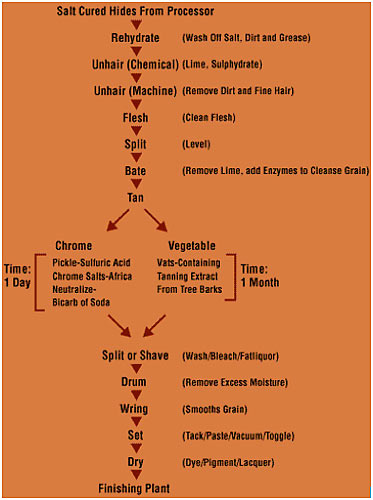
Here is a chart, courtesy of Hermann Oak Leather to show the difference in the curing and tanning processes
The Leather Cycle
Care of Leather Tack There are four stages in leather care: cleaning, conditioning, polishing, and protection. When perusing the store shelves for a product that fits your needs, be watchful for what kind of product you’re purchasing. It can be confusing to try and figure out which product is for which stage, but look for words that explain how the product is to be used. It is also important to remember to work on your leather in a well-ventilated area. Some leather care products are very strong and can cause irritations.
Cleaning
To start off with, you will need a bucket of warm water, a rag or sponge and a soft brush, such as an old toothbrush. If the brush scratches you, it’s too stiff. Brush the dust and dirt off your tack before starting to remove the dust and dirt from the intricate parts of the leather. Wet your sponge or rag and wipe down the leather to remove surface dirt and dust. Then select a leather cleaner that will help preserve the natural lubricating oils instead of stripping them.
Before applying any product to your leather, test it for effect and possible color distortion on an area that isn’t visible to the eye. Once you’ve determined the product is safe to use, apply it using the directions. Don’t allow soap to foam, as this indicates the use of too much water, which will actually dry out your leather.
Remove the cleaner with a slightly dampened cloth or sponge, making sure to remove all the soap as well as the dirt from your tack. Your cleaner should not leave any residue behind — residue makes leather susceptible to bacteria and breaks down the stitching. If your tack is still dirty, repeat the cleaning process. For light dusting, cleaning wipes can be used to keep your tack clean between rides.
Conditioning
Determine if your leather needs to conditioned or oiled. Leather conditioners are meant for occasional use. Leather should be soft and supple and free of cracks. Use a one-inch paint brush to apply oil in thin layers. Work the oil in by hand by bending the leather back and forth as well as rolling it in your hand. The heat from your hands combined with the rolling action allows the oil to soak into the leather. Do not dip your tack into a bucket of oil. Over-oiling is not good for leather. Also beware of any conditioners that include petroleum or mineral oils. While petroleum by -products won’t immediately damage your leather, they can over time.
Polishing
Polishing is done for special occasions when you want a more glossy finish on your leather. There are a couple things to be wary of when purchasing a polishing agent. Some products contain coloring factors that will brush off on things you come in contact with. Some products also have a tendency to clog the pores in leather or dry leather out. Just as with cleaning, be sure to test out the product on a small area and when ready, buff to a shine.
Protection
Moisture barriers are extremely crucial in preventing rain or other liquid hazards from damaging leather. Stiffness and spouting will happen if leather isn’t protected beforehand. There is a drawback in protecting leather with a moisture barrier product. They tend to fill in the pores with a greasiness that makes cleaning, conditioning, and polishing difficult, but it’s a necessary process to ensure leather isn’t destroyed.
Periodically apply a moisture barrier and allow it time to penetrate and dry before using your leather item. Equally important to leather care is the removal of mildew, drying wet leather and storing your leather items. To remove mildew from leather, create a mixture of equal parts rubbing alcohol and water. Wipe the mildewed area with a cloth dipped in the diluted alcohol, then allow it to dry.
If the mildew persists, use mild soap and water that contains a germicide, then remove with a clean dampened cloth and allow to dry. To keep leather in top -notch condition, treat wet leather before it has a chance to dry. Remove any dirt, mud, or other stains with a cleaning agent, then condition while the pores are still fully responsive. It is critical to remember that leather should be dried away from heat. Remember that leather is a natural material and should never be stored in plastic because it encourages the growth of mildew and bacteria and will ruin the leather. Always store leather in a cool, dry place away from heat. Do not keep horse tack in direct sunlight or a hot trailer.
About Buckaroo Leather Our family has been dedicated for 28 years in serving the western horseman the safest most durable Quality Leather Horse Tack and equipment. We at Buckaroo are pleased to offer these fine products and would respectfully call your attention to our selection of western riding equipment. Buckaroo Leather Products is owned and operated by John & Michele Brand. Begun by John and his father Bob Brand in 1979, the business remains family owned and operated to this day.
Buckaroo has built its reputation on offering riding equipment that is high in quality at a fair price along with customer service that is second to none. We only use the finest, highest quality leather available. In over 28 years, we have never compromised our standards by using inferior, less expensive or imported leather; that IS NOT an Option!
At Buckaroo Leather Products, we use Hermann Oak US hides exclusively.
Contact Us Buckaroo Leather 6090 Enterprise Dr. Suite "E" Diamond Springs, CA 95619 Phone: 1.800.873.0781 Email: [email protected] Website: buckarooleather.com