

Looking for a Horse Trainer?
When choosing a horse trainer, look for references from past customers, ask about the trainer’s experience and education, insist on a written contract, and favor someone who invites you to watch the work—both with other horses and with your own. A good trainer also has a detailed plan for the owner as well as the horse, because once your horse comes home you take over the trainer’s role. Even excellent training can be undone by an owner who never learned the cues the horse was taught.
By John Lyons for The Josh and John Lyons Horse Trainer Certification Program Many horse owners at some time or another seek out a trainer to work with their horse.
With today’s sources, magazines to Internet, finding a trainer may be quite easy. Knowing what to look for in a trainer may be a different matter, therefore, I would like to give you a few suggestions to consider as you search. I can think of three common reasons (but not limited to three) for sending a horse to a trainer – starting to train the unbroke horse, fixing a problem(s), and refining the performance of a horse.
No matter what the reason or regardless of the training that you seek out for your horse, the most important aspect of the entire experience is your responsibility to learn what it is that your trainer has taught your horse and your ability to follow through with what has been taught. Otherwise, no matter how good the trainer is, you may undo his excellent work due to your lack of knowledge and/or lack of skills that are specific to his training method. Don’t misunderstand - you do not have to be perfect or have the exact skills as your trainer, otherwise you would have done the work yourself.
What I am saying is that you need to commit yourself to learning and to do the best you can to learn the cues that your horse will know when leaving the trainer. The horse will allow you to have trial and error. He is adaptable. At the same time he will know if you are really off the mark. One important concept that you must understand is that after your horse leaves a trainer you take over his/her role as the trainer.
Every time you come in contact with your horse, you are teaching him/her something. The horse is a learning machine and is expecting to be taught all the time. An example of this can be as simple as when you lead the horse. If you allow the horse to dive for grass when you are trying to lead him from the barn to the arena, he learns that is it okay to do so.
If you allow the horse to take 20 steps before he comes to a complete halt, when you really wanted him to stop much sooner than that, then he learns that it is okay to do so. Although, these are simple examples, the concept applies in all that you do with your horse.
Let’s look at the horse as your car and you as the mechanic. If your car is not running you need to know how to fix it to keep it running. You also need to do general maintenance on the car as well (oil changes, tire rotation, etc). You really need to know how to keep it running and how to maintain the engine and its parts. If you compare this to the horse, it is the same as you training the horse as well as knowing how to care for the horse.
You want your horse to do the things you want (trail ride, show, etc) as well as to have the proper care in order to do these things. Often what can happen though is that you spend the majority of your time caring for your horse, but don’t know how to fix “engine problems” when there is a training problem. You find yourself in a situation where you are changing the oil and rotating the tires but the engine doesn’t run.
When this happens, you may make the decision to involve another mechanic, a trainer, to fix the problem. When you do so you must learn the method of training used by this trainer. Otherwise, you may find yourself out on a trail far away from home and if a problem surfaces, you may have a long ride back. My point is, then, know what cues will make your horse be responsive to you.
In many cases it is our fault if the horse is not doing what we ask - not the horse’s fault and not the trainer’s fault. Many trainers get blamed when an owner is not being successful with his/her horse. Unfortunately, there are times when this is true, but the owner must take a realistic look at the time and effort that he/she has invested with learning what the trainer has taught the horse and make evaluations from this perspective.
Now I would like to share some suggestions when looking for a trainer.
1 Look for references from past customers
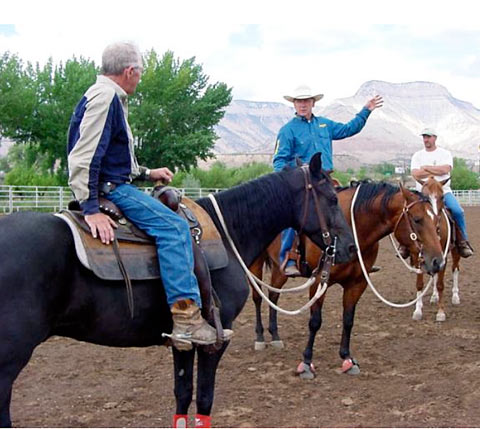
2) Ask about the trainer’s experience and education. A good trainer doesn’t have to have formal education in the sense that he/she has participated in course work, but does have to have a well thought out plan when training your horse. Think of all there is to know about horses. We can never learn it all. Your trainer should have that attitude as well. There are trainers that will find time in their busy schedules to attend clinics, symposiums, expos or maybe purchase educational materials.
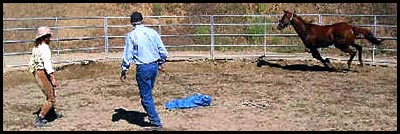
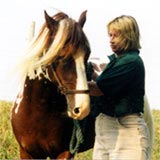
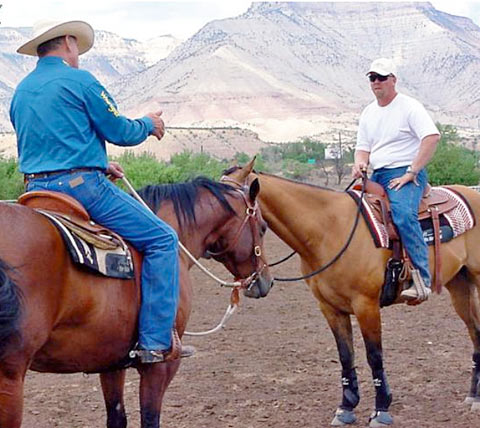
Don’t hesitate to find out what a trainer has done to expand his/her knowledge. These professional trainers each have very successful horse training businesses. They take time in their busy schedules to learn more about horse training. Here they are involved in an advanced training seminar with John.
3 A trainer should have a contract
4 Look for a trainer that invites you in to watch what he/she does with other horses and then extends the invitation when working with your horse
5 A good trainer will have a detailed plan, not only for the horse but also for the owner
The life of a horse trainer can be a rewarding one. It can also be frustrating as well. What I have found, though, is that the frustration does not come from working with the horse, but with the lack of commitment that is seen with some of the clients/owners. It is easy to place blame on a trainer when things do not go as planned. This is often seen when an owner gets hurt when working with the horse.
No one can ever guarantee you that you will not get hurt when working with your horse.
What you can be assured is that the more you commit to having your horse learn the proper cues that he/she needs to know (either from a trainer or from you) and the time it takes for you and your horse to learn these cues the more you can minimize the chances of having bad experiences with your horse. We all know that bad news travels faster than good news. It’s human nature. A good trainer may be incorrectly evaluated and not be at fault. The way owners describe their experience with their trainer can have a huge effect on that trainers repeat business.
Some people will buy a horse that is “bomb proof” or “dead broke”. This is wonderful but you still need to know the horse’s cue system. Some well-trained horses, if not the majority are that way due to consistent training and handling. On occasion you will find the well-trained horse that will forgive lots of mistakes and “take care of” the owner. No doubt there are those horses out there.
The reality of the horse experience is that a person that doesn’t know how to stay consistent with what a horse has been taught will quickly undo the training of the horse. If you are in a position to purchase a well-trained horse, that is great! Unfortunately, most of the people that desire to own a horse cannot or choose not to afford a horse with training of this level. When this happens, be prepared to spend time in your education.
Horse trainers and owners need to have a good understanding what is expected of each party. The horse trainer’s responsibility is to do the job that the owner wants. It is the horse owner’s responsibility to learn the cues and signals that the trainer will be teaching the horse. If your goal is to spend a lot of time with your horse and cover ground, put your horse in a horse trailer and drive down the road. You will be a lot safer and your horse will thank you. If your goal is to have a horse and a meaningful relationship, including care, grooming and safe rides, then take the time to find out what makes the horse operate.
Contact: Andrea - Josh Lyons Events Coordinator 8606 Guthrie Court Cross Plains, Tennessee 37049 Phone: 615-379-1056 Email: [email protected] Website: joshlyons.com