

No Rein Contact Meant Go
What an English-Trained Morgan Taught a Western Rider About the Reins
Welcome to Wenglish Horsemanship.
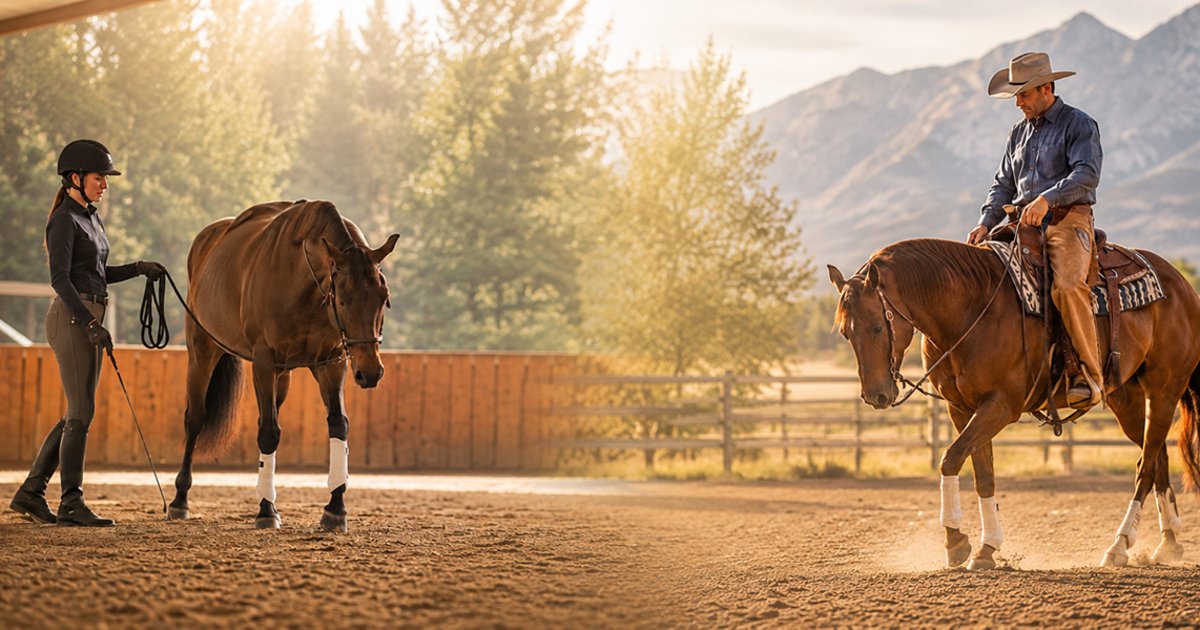
This is the first article in a series about what English riders and Western riders can learn from each other, written by a man who has spent more than fifty years on the Western side and is now getting an education from an English-trained mare. The premise is simple. Good horsemanship is good horsemanship. The two traditions use different words, different tack, and different rings, and they are often describing the very same thing to each other without knowing it. When they do disagree, the horse is usually the one who pays for it.
Riders have been crossing this fence for a long time. Western dressage has its own tests and its own judges. Ranch riding rewards a way of going that a dressage judge would recognize on sight. Good horsemen have been borrowing quietly from each other for generations without making a fuss about it. What almost nobody has done is sit down and translate, plainly, so that a rider from one side can understand what the other side is actually saying. That is what this series is for. One subject at a time, both languages side by side.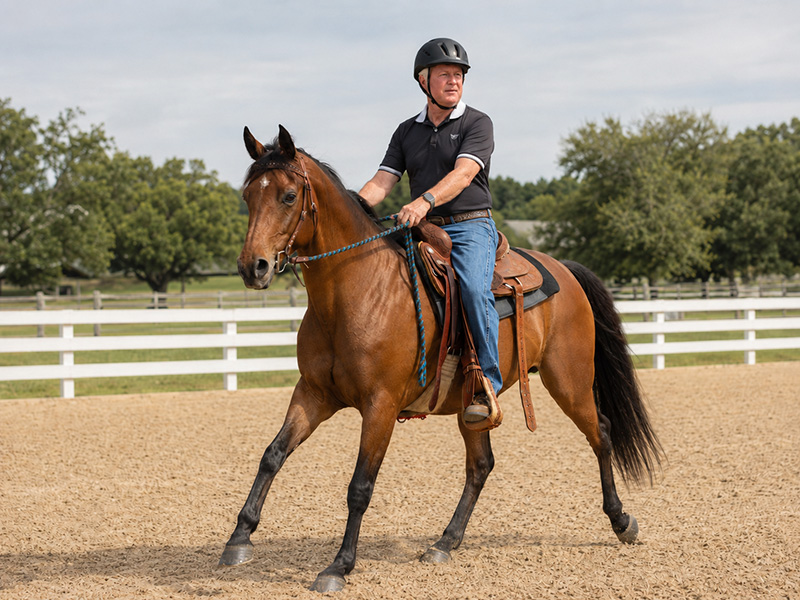
We start with the reins, because that is where I got in trouble first.
Zoey is a show-type Morgan mare I brought down from Alberta.
She was trained and shown in English pleasure. Sarcoids ended her show career, which is how a horse of her quality ended up standing in my barn in Texas. She is well made, well bred, and she was trained by people who knew exactly what they were doing. That last part is important, because for the first several rides I was convinced she had a hole in her training. She did not. I did.
Here is what happened. I asked her for a trot, got a nice one, and did what fifty years of Western horsemanship taught me to do when a horse gives you the right answer. I softened. I let the reins go loose. I told her, in the only 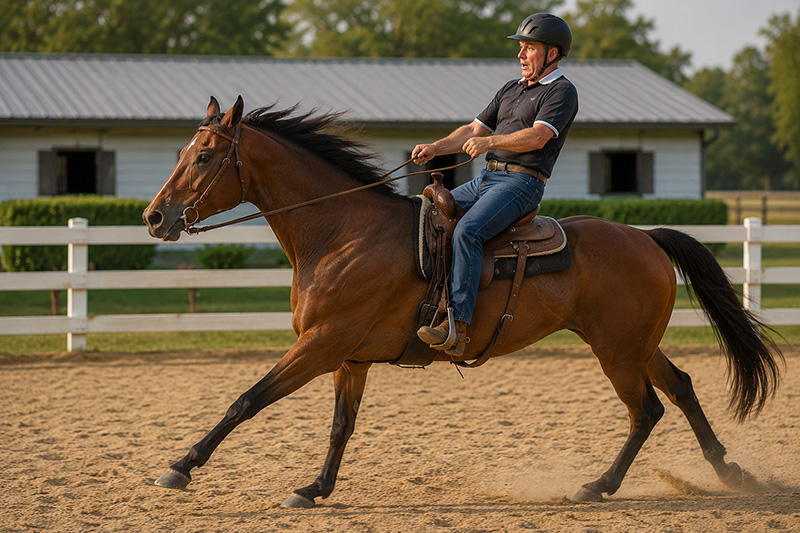 language I knew, that she had done well and I was going to leave her alone about it.
She took off. Not a bolt, not a fit, just a clear and immediate increase. So I picked the reins back up, and she came back, and I softened again, and she took off again. We did that for about ten minutes before I quit and stood there in the middle of the arena feeling like the greenest rider in Texas.
What my Western training taught me picking up the reins means. In the world I come from, the rein contact is a request that is supposed to disappear. You ask, the horse answers, and you quit asking. The release is not just a courtesy. The release is the entire lesson. A horse learns from the moment the pressure goes away, which means the loose rein is the paycheck.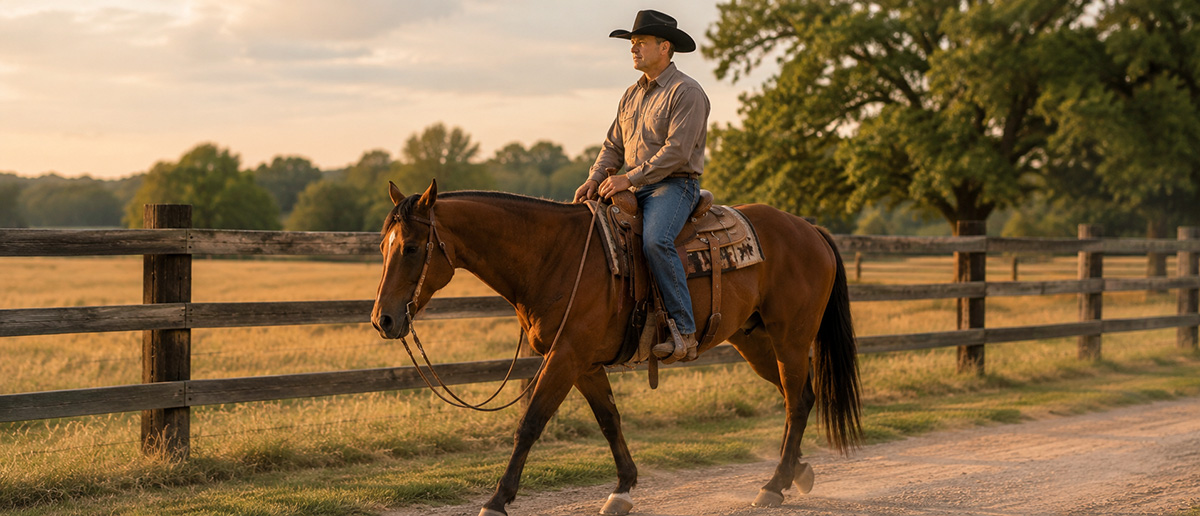
That builds a horse who understands that a quiet hand means everything is fine, hold what you have, I will tell you when I want something different. A good ranch horse will lope a straight line on a draped rein for as long as you want, because nobody is telling him to change. Silence is confirmation. That is a beautiful system and it produces a horse who is genuinely responsible for his own gait.
What Zoey's English training taught her rein contact means.
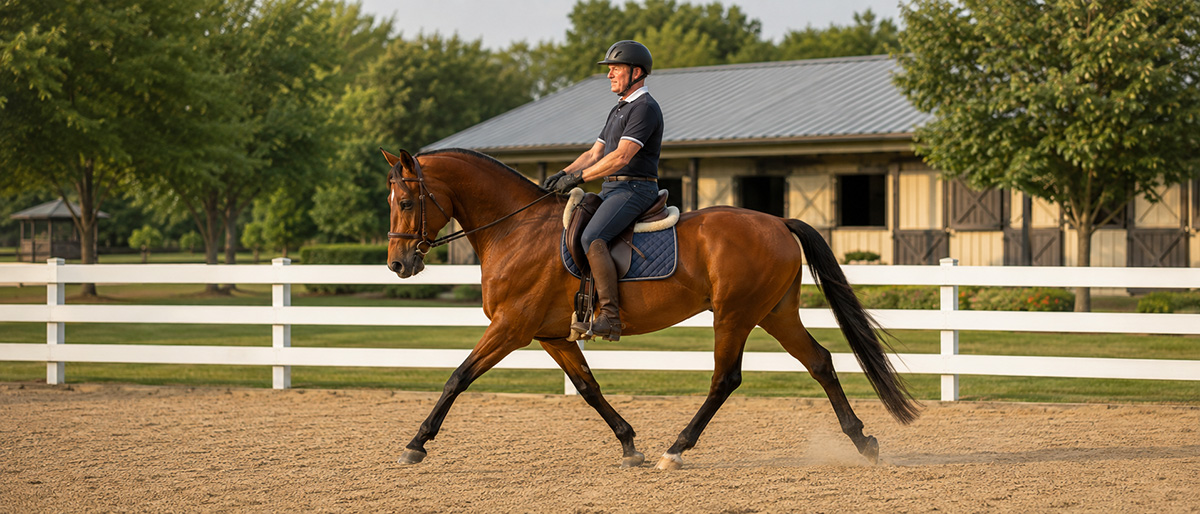
On her side of the fence, the rein is not a request that comes and goes. It is a connection that stays. The leg and seat create energy, the hand receives it, and the horse carries herself between the two. The rein is not a brake that only shows up when there is a problem. It is a live line, with a weight to it that both parties agree on, and the horse is trained to seek it and lean into the conversation.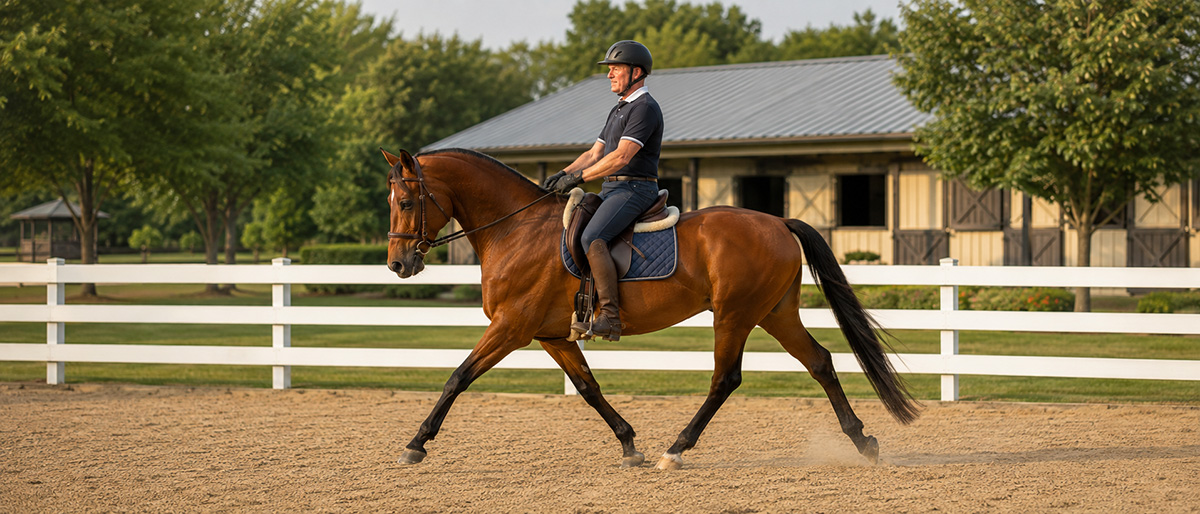
Now think about what happens inside that system when the hand suddenly goes away. The energy her hind end is producing has been arriving at the bridle and getting recycled back into carriage and rhythm. Take the bridle out of the circuit and that energy has to go somewhere. It goes out the front.
So when I threw her the reins, I was not saying good girl. I was opening the gate.
Both traditions are using pressure and release.
This is the part that took me longer than it should have to see, and it is the reason this series exists.
I had it in my head that English riding did not use release, because the hand never fully lets go. That is wrong. English riding releases constantly. It just does it at a smaller amplitude. The reward is a softening of the fingers, a giving of an inch through the elbow, a following hand that lets the horse take the neck forward and down. To a rider raised on a draped rein, that release is so small it is invisible. But the horse feels every ounce of it, because she has been taught to.
And on the other side, the Western tradition is not without connection. A finished bridle horse is not being ridden on a loose rein because the rider is uninvolved. He is being ridden on a loose rein because the connection has moved into the seat and the legs and the rider's intention, and the rein has been given the night off. That is not the absence of rein contact. That is rein contact that graduated.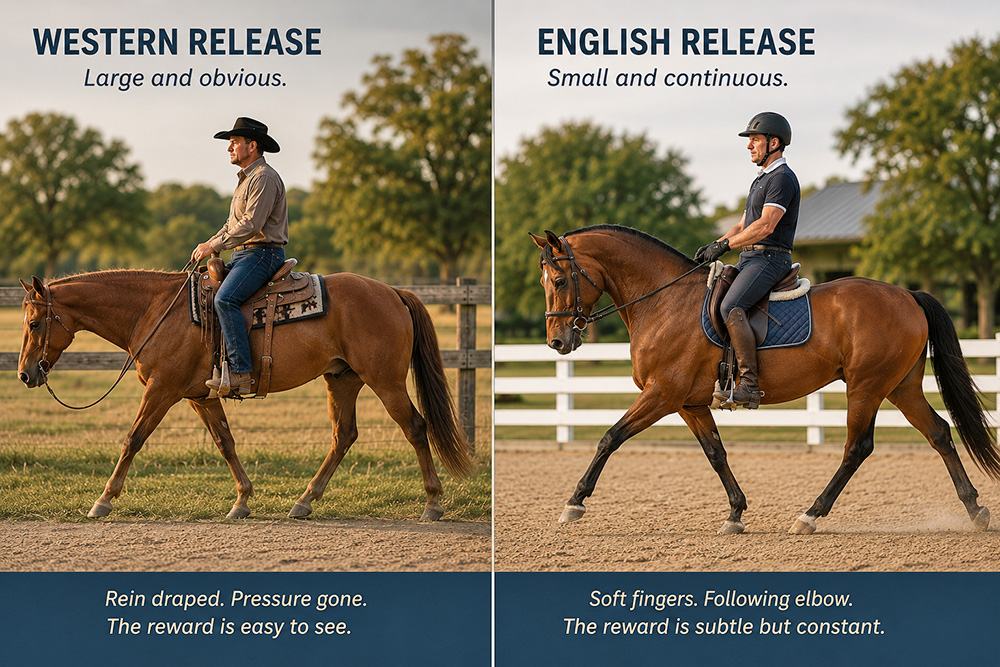
Two traditions. Same principle. Different volume.
What goes wrong when a Western rider gets on an English horse. He rewards the horse by dropping the rein. The horse goes forward, because that is what dropping the rein has always meant to her. The rider, startled, picks the rein back up firmly. Now the horse has been corrected for doing the thing she was just told to do.
Do that a few dozen times and you build a horse who no longer trusts the hand. She gets quick, she gets defensive, she starts guarding the front end, and somebody down the road calls her hot when what she actually is, is confused. I was two rides into building exactly that, and it was not her fault.
What goes wrong when an English rider gets on a Western horse. The mirror image, and it is just as hard on the horse. She takes up a steady rein contact at the jog, which to her is normal and polite. To the ranch horse, that is pressure that is not going away, and pressure that does not go away means he has not yet found the right answer. So he tries things. He slows down, then speeds up, then tucks his nose, then throws his head, then leans on her hands to see if that is what she wants.
Eventually one of two things happens. He gets anxious, or he gets dull and quits offering anything at all. Both look like a training problem in the horse. Neither is. He is fluent in a language nobody is speaking to him.
The horse always pays the interest on our misunderstanding.
That is the welfare point underneath all of this, and it is why I think the series is worth writing.
The horse does not know which discipline he is in. He has never once considered it. All he knows is whether the answer that worked yesterday worked again today. A horse corrected for a correct response does not conclude that his rider was raised in a different tradition. He concludes that the rules are unreliable, and a horse who believes the rules are unreliable starts bracing for the next surprise. A great deal of what gets called hot, or sour, or dull began as exactly that and nothing more.
Zoey never got ugly with me over any of it. She just kept doing her job harder and harder while I gave her worse and worse information.
For the Western rider learning to take up rein contact.
Start at the walk and stay there longer than your pride wants to.
Take the rein up until you can feel the corners of her mouth, and then follow. Her head and neck move at the walk, and your elbows have to move with them. If your hand is fixed, you are pulling on every stride whether you mean to or not. Think of carrying a full cup of coffee in each hand while walking across a room. That is roughly the job.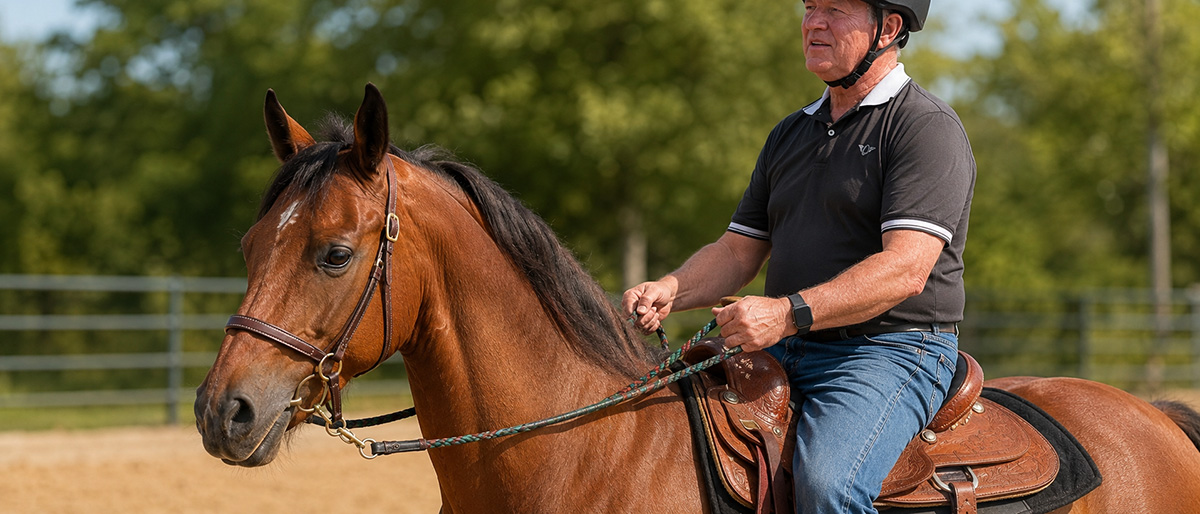
When she gives you something good, do not throw the reins at her. Soften your fingers. Give a little through the elbow. Let the weight of the rein contact lighten without the connection breaking. That is her paycheck, and it is a smaller bill than you are used to writing.
And test it honestly. Ride her forward for several strides, then deliberately give both hands forward an inch or two and see whether she maintains her rhythm on her own. English riders have a name for this. In dressage it is called giving and retaking the reins, and it is written into the tests specifically to prove that the horse is carrying herself instead of being held together by the rider's hands.
A well-schooled horse should stay in the same rhythm for a few strides on her own. An English pleasure horse, ridden her whole career in a firmer and more presentational hand, may well take that inch and go, which is what Zoey did with me. That is not a flaw in her. It is a fact about her education that I needed to learn.
For the English rider learning to ride on a loose rein.
The release has to be complete, and it has to be immediate.
Ask for the change with your seat and legs, get the answer, and then quit. All the way. Not a little less pressure. Gone. If you hold any residual rein contact after the horse has answered you, you have told him that he has not answered you yet, and he will keep hunting for the response that makes it stop.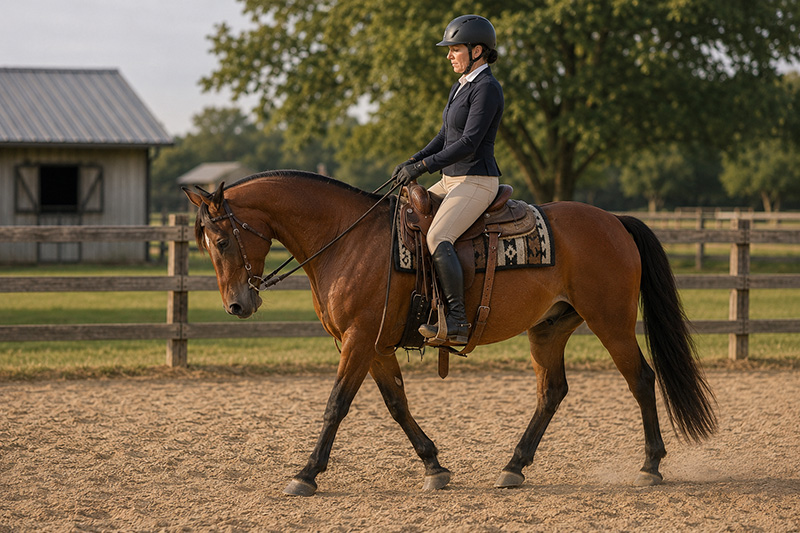
Do not fill the silence. The loose rein is not an absence of communication and it is not you being lazy. It is you telling the horse that he is right and that the gait is now his to hold. Riders coming from a rein contact discipline find that quiet almost unbearable at first. Sit in it. He is listening to your seat.
And understand that the ranch horse is not undertrained because he does not seek the bit. He was never asked to. He was asked to be responsible for himself between requests, which is a different kind of education and a very good one.
Somebody is going to tell you one of these is wrong.
You will meet a trainer on the English side who calls a loose rein neglect, and a trainer on the Western side who calls contact nothing but pulling on a horse's mouth. Listen closely and you will notice that each of them is describing the worst version of the other tradition and treating it as the whole thing.
A rider with hard, fixed hands on a steady rein is not doing English riding. A rider who has thrown the reins away and quit riding altogether is not doing Western riding. Neither one is an argument against a system. They are both arguments against poor hands, and poor hands are the one thing the good horsemen in both traditions have always agreed they cannot abide.
So when the two camps start in on each other, ask the horse. He is the only one in the arena with nothing to defend.
The thing that surprised me most.
I expected to find that one of these systems was more correct than the other. I did not find that. I found that both of them are trying to produce a horse who carries himself, who responds to a small request, and who is not being nagged. They just approach it from opposite directions. English riding builds self-carriage inside a connection and then makes the connection lighter. Western riding builds self-carriage outside a connection and then makes the request smaller. Both roads are trying to get to the same place, which is a horse who does the job on a whisper.
I have two Morgans in my barn right now. Both came out of Alberta, from different breeders, and they could hardly look less alike. Zoey is the show mare, trained and shown in English pleasure by people who do that for a living. Sugar belongs to Ann, my wife of more than forty-eight years. She is a traditional ranch-type Morgan, the old Government working type that still looks like the horses in the earliest Justin Morgan pictures, and I trained her myself, Western. Same breed, same barn, same hay, two completely different educations, and both of them are correct. I have to change my hands when I change horses, and that is not a burden. That is the most interesting riding I have done in years.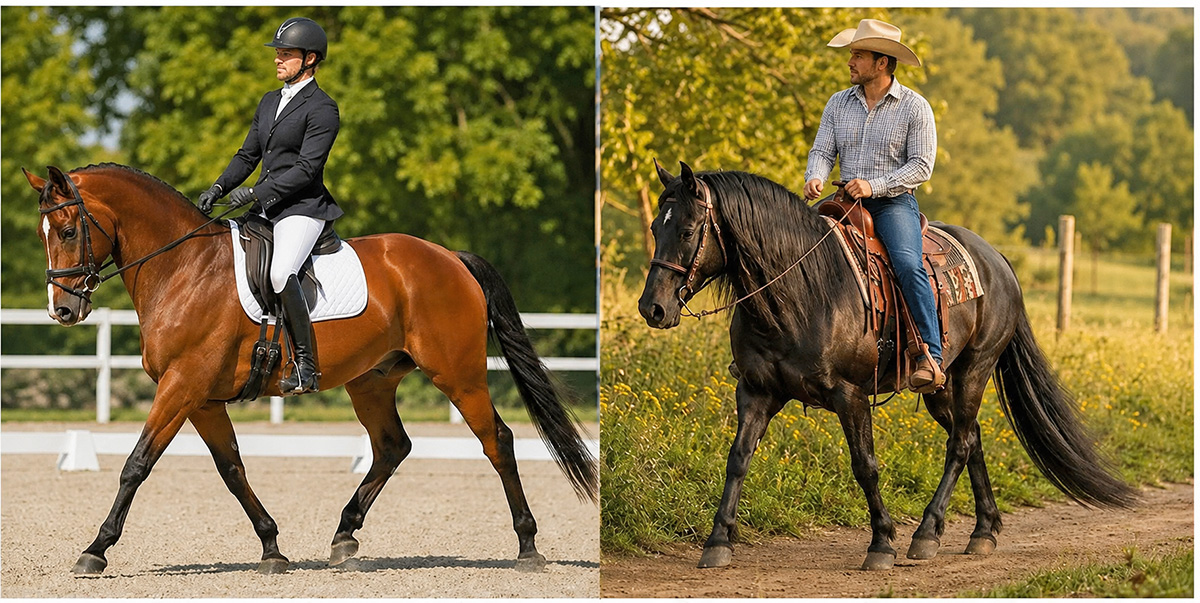
Next in this series.
The reins are only half of it. Zoey also has firm opinions about my leg, which she believes should stay on, and which my entire life has taught me to take off. We will get into that next, because it turns out to be the same argument in a different place.
Good horsemanship is good horsemanship. We are just fixing the translation.
Bob Pruitt has been around horses for more than fifty years and has published InfoHorse.com since nineteen ninety seven. He rides in Texas with Zoey, a show-type Morgan mare, and his wife Ann Pruitt, Marketing Director for InfoHorse.com, rides Sugar, a ranch-type Morgan.