

A driving horse is made in the arena and proven on the road.
Consistent footing, repeatable figures, and a total absence of log trucks are exactly what let you install the obedience you will one day bet on at a four-way stop — and ground driving is the cheapest, safest way to install it.
Riding people sometimes treat ring work for driving horses as a consolation prize — the thing you do when the weather turns or the trailer has a flat. Drivers know better. In harness there is no seat to fix a wobble and no leg to close on a shoulder that drifts toward the ditch. Everything you have with a driving horse is a conversation you rehearsed earlier, somewhere quiet. The arena is the somewhere quiet.
Is arena work good for driving horses?
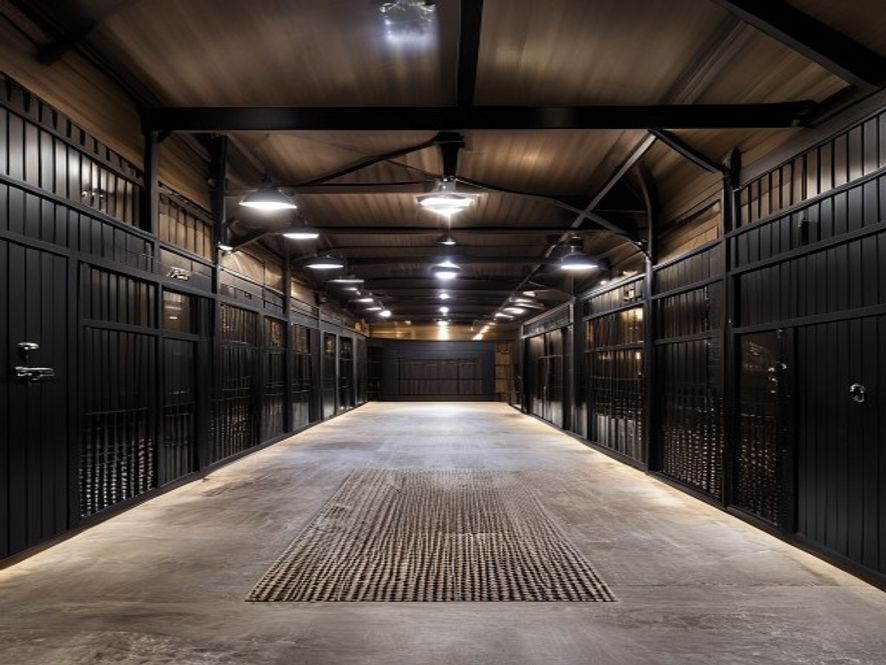
Yes — and not as a substitute for road miles, but as the reason road miles go well. An arena gives you three things the road never will: footing that is the same on Tuesday as it was on Sunday, geometry you can repeat until a response is automatic, and an environment where the only surprise is the one you planned.
That control matters more in driving than in most ridden work. A ridden horse that misreads an aid gets corrected in half a stride. A driving horse that misreads an aid has a vehicle, shafts, and momentum attached to the misunderstanding. Driving rewards rehearsal, and the arena is where rehearsal is affordable.
The honest caveat: an arena-only driving horse goes stale, and a horse that never sees varied ground never toughens to it. School in the ring, condition on the road and tracks, and let each job do what it is good at. The ring is for installing responses; the road is for spending them.
What is ground driving — and why is it useful?
Ground driving is working the horse from behind on long lines — you walk roughly where the vehicle will one day be, lines running from the bit back through the tugs or the rings of a surcingle to your hands. The horse learns to go forward with nobody at its head, to steer off two reins, and to answer a voice it cannot see. Its close cousin, long-lining, puts the horse out on a circle around you, lunge-fashion, with the same two-rein contact.
Why it earns its place: ground driving is the entire driving conversation minus the vehicle. Walk on, steady, come back, stand, turn left, turn right — every cue a driving horse will ever need can be taught, tested, and proofed with your boots on the sand and nothing behind the horse but you. If something goes sideways, you drop the lines and you have a loose horse, not a wreck.
It is also broadly useful beyond harness work. Trainers ground drive young ridden horses before backing them, restarted horses that need their steering rebuilt without an argument about weight, and horses coming back from time off that need work before they can carry a rider. If you drive, it is not an optional exercise. It is the foundation the hitching stands on.
What is your horse actually learning between the rails?
Count the aids a driver holds and the arena's job becomes obvious. No seat. No leg. You have your voice, two reins, and a whip that must serve — politely — as the leg you do not have. Three channels, and each one has to mean exactly one thing.
So arena sessions for a driving horse are less about brilliance and more about vocabulary. Transitions are the currency: the old horsemen's rule that all training happens in transitions is doubly true in harness, because a transition on the voice, confirmed by the rein, is the tool you will use at every intersection for the rest of the horse's career. Ask for a dozen a session. Then ask for a dozen more.
Straightness is the second lesson the ring teaches better than the road. A horse that drifts a hand's width off the line in an empty arena will drift the same hand's width toward the centerline of a paved road, and out there the margin belongs to someone else. Drive the quarterline, not the rail, so the fence is not doing your steering for you.
Will a riding arena work for a driving horse?
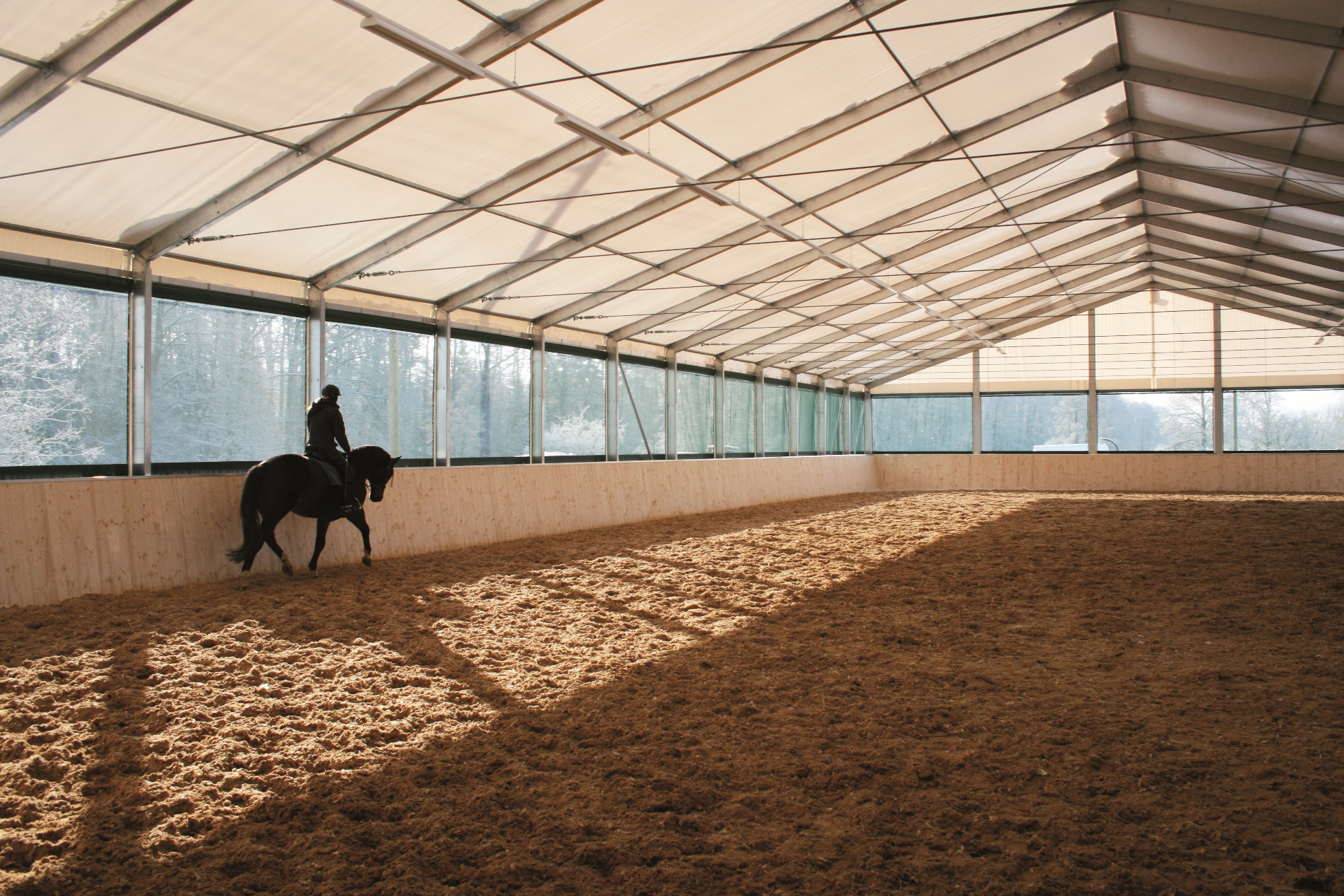
Mostly, with honest adjustments. A full driven-dressage arena measures 40 by 80 meters — twice the width of the standard 20-by-60 ridden court — and the big multiples classes use 40 by 100. The width is not vanity. A horse bends; a horse-and-carriage articulates, and it needs real estate to do it without the inside wheel writing checks the turn cannot cash.
In a typical riding-sized ring, school what the space is good for: transitions on the long sides, lengthening and collecting the walk and trot, halts that hold, serpentines with generous loops. Treat every corner as a planned event and give it more room than feels sporting. If you compete, the American Driving Society publishes size-adapted tests for arenas smaller than the full court, so a modest ring does not lock you out of the sport.
Cones work scales the same way. In competition, the clearance between cone pairs starts around half a meter of slack at the lower levels and shrinks dramatically as you climb — but that is a destination, not a starting point. At home, set your cones wide enough that the horse succeeds every pass, and narrow them only as the steering earns it. Precision built on confidence lasts; precision built on clatter does not.
What footing does a driving horse need?
Firmer and shallower than you might guess. Most sand-based riding arenas carry roughly 2 to 4 inches of worked surface, and the well-documented risk runs in one direction: footing that is too deep lets the hoof sink, loads tendons and suspensory ligaments, and makes every stride more expensive than it looks. Add draft — a horse leaning into a collar or breastcollar to move a vehicle — and deep going raises the price again.
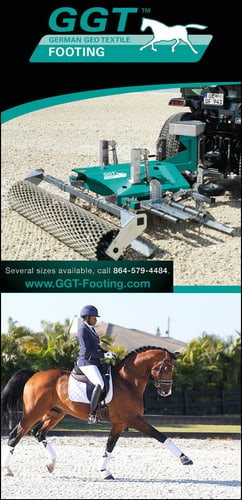
So for harness work, favor the firm end of the range and grade consistency above cushion. A surface that is 2 inches everywhere is a better driving surface than one that is 3 inches in the middle and 6 in the drifted corners, because the horse pulling a vehicle cannot pick its way around the soft spots the way a ridden horse can. Drag it level, watch the gateways and rail lines where material piles up, and mind wet patches after rain.
The Bridleway rule: a response that is not boringly reliable in the arena does not exist on the road.
How does the schooling carry over to the road?
Directly, if you build the bridge on purpose. The standing halt is the whole game: a driving horse must stand immobile — at the mounting of passengers, at a crossing, while you sort a trace — and standing is a schooled behavior, not a temperament. Halt in the arena and count. Then count longer. A horse that stands for three quiet minutes in the ring has a fighting chance of standing for thirty seconds beside a running engine.
Everything else maps the same way. The transition you own on the voice becomes the downshift before a blind curve. The straightness you drilled on the quarterline becomes a horse that holds its lane past a mailbox, a dog, a flapping trash-can lid. Ground driving even lets you rehearse the route itself: long-line the horse down the driveway and along the quiet stretch before it ever goes there in harness, and the road becomes a place it has already been.
Then graduate deliberately — arena, then lane, then lightly traveled road, ideally with an experienced helper the first trips out. Wear high-visibility gear, and know that the rules for horse-drawn vehicles on public roads vary by state and county — check locally before you assume a shoulder, a speed zone, or a trail allows a turnout at all.
Where to start this week
Three short sessions. First: ground drive large figures at the walk — big ovals, wide serpentines — and reward the horse for marching without a leader at its head. Second: transitions, on the voice first and the rein second, until the words alone move the horse. Third: halts that hold, timed, and lengthening every session.
None of it is glamorous, and that is rather the point. The road does not examine your horse on brilliance. It examines your horse on whether "walk on," "steady," and "stand" mean today what they meant last Tuesday. The arena is where you make sure the answer is yes.