
440 Fence makes a no-weld steel pipe fence system for horse owners: the strength and substantial appearance of traditional steel pipe fencing, joined with specially designed steel connectors instead of on-site welding, so it can be installed by a contractor or a capable do-it-yourself horse owner.
When you own horses, fencing becomes one of those things you think about differently than someone who simply wants to put a fence around a piece of property. We aren't just defining a property line. We are putting up something that our horses are going to live behind every single day and we know that fence better be safe, built to last and be attractive to add value to that property!
Horse owners want a horse fence to be highly visible, strong, attractive and built to stay that way. Horse owners also need to know what happens five, ten or twenty years after it goes up. That is one of the reasons 440 Fence is so valuable. They have taken the strength and substantial appearance of traditional steel pipe fencing and created a no-weld steel pipe fence system that can be installed by a contractor or a capable do-it-yourself horse owner.
440 Fence is a steel pipe rail fencing system that uses specially designed connectors to join the pipe rails without requiring the rails to be welded together on-site. That is a pretty significant difference. Traditional pipe fencing can make an excellent horse fence, but installing it usually involves cutting, fitting and welding steel pipe throughout the fence line. With the 440 Fence connector system, the rails are assembled using steel connectors instead.
For horse owners, that makes pipe fencing much more approachable. The system can be used for horse pastures, paddocks, turnout areas, riding arenas, stall runs, perimeter fencing and larger equestrian facilities. You still get the substantial appearance and strength people associate with pipe fence, but you don't necessarily need a welding truck following you around the property while you build it.
Honestly, it is really the Best! There are a number of reasons you will like a well-designed pipe fence around horses. Horses can see it easily, it creates a very definite physical boundary, and you aren't dealing with splintering boards or some of the entanglement concerns that can come with certain types of wire fencing.
440 Fence uses smooth pipe rails to create a clean, highly visible fence line. Different heights, rail configurations and other options can be chosen depending upon the property and the horses being contained. We always believe horse fencing should be designed for the particular horses that will live behind it.
A couple of quiet older geldings may have very different requirements from foals, stallions, young horses or a group of active horses turned out together. There isn't one fence configuration that is automatically right for every horse farm.
The biggest difference is simple: the pipe rails don't have to be welded together during installation. That doesn't sound revolutionary until you have priced or installed traditional pipe fence. Welding adds specialized labor, equipment and time to the project. It can also make a pipe fence seem out of reach for a horse owner who would otherwise be perfectly capable of tackling much of the installation.
440 Fence created its "connector system" to solve that problem. Instead of welding each rail connection, the pipe is joined using their connectors. That makes the system attractive not only to professional fencing contractors, but also to horse owners and ranch owners who would like to do some or all of the work themselves.
For many capable horse owners the answer is "yes". The system was designed to be DIY friendly. 440 Fence provides multiple installation videos online, including information about installation techniques and the equipment they recommend. They also provide assistance by phone if you run into a question while installing your fence.
There is obviously still work involved. This is a real steel fence, not something you put together in an afternoon with a screwdriver. But understanding how the connector system works shouldn't require weeks of specialized training. An experienced fencing contractor who has never installed their system before can generally master the installation learning curve within a few hours.
If you are a reasonably capable do-it-yourself horse owner, have access to the proper equipment and take the time to understand the installation before beginning, this gives you a very interesting alternative to having an entire pipe fence professionally welded on-site.
The answer probably isn't what most people expect. One of the hardest parts of installing 440 Fence is simply digging the holes… but, remember, you are building a fence that will last a lifetime! Before installing the fence, be sure to watch the 440 Fence installation videos carefully, particularly the sections concerning the recommended tools. The time to discover you need different equipment is before you have hundreds of feet of pipe sitting on your property waiting to be installed.
Plan first. Ideally, your basic fence layout should already be determined before you order the materials. Know where the fence is going, where your corners will be, where gates need to be located and how you are going to move materials from the unloading area to the fence line.
More importantly, have all underground utilities located before you begin digging. Don't assume you know where everything is simply because you have lived on the property for years. Think through your equipment before delivery day. What are you using to dig holes? How will you move the pipe? Where will the material be stored? Can your tractor or skid steer safely handle the bundles?
A little planning before the first post goes into the ground can save you a tremendous amount of time later.
Your beautiful 440 Fence will most likely arrive on a flatbed semi-truck. Before that truck arrives, you need a large, reasonably level and firm place where it can safely get in, unload and get back out. A muddy pasture isn't the place to suddenly decide where you are going to unload a semi.
You will need appropriate equipment capable of safely handling the load. 440 Fence recommends having a forklift or machinery such as a skid steer or tractor capable of lifting at least approximately 1,000 pounds. If you don't have pallet forks, individual pipe bundles may be handled using appropriate nylon straps and suitable tractor equipment.
Note: The important point is to make an unloading plan before the truck gets there.
Yes, and this matters because very few horse properties are perfectly flat. Pastures roll. Barns sit at different elevations. Driveways slope. Arena areas change grade. Property boundaries rarely run across perfectly level ground.
The 440 Fence connector system is designed to allow the fence to follow the contours and shape of the property. That can produce a much more natural-looking fence line than attempting to force a rigid design onto rolling terrain. People with horse properties appreciate our flexibility, because we usually aren't fencing a perfectly square, perfectly flat suburban lot.
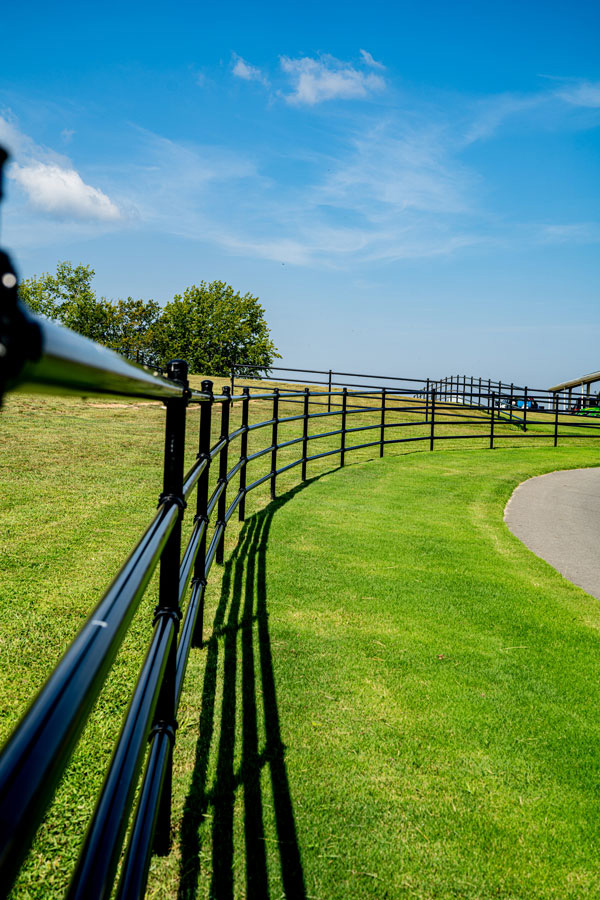
That depends upon the horses, the location and the purpose of the fence. 440 Fence can be configured with different numbers of rails, allowing the owner to build the fence around the needs of the property rather than being locked into one standard design.
Consider the size and temperament of the horses, whether the fence is perimeter or interior fencing, the height you need, whether young horses will be present and whether the area is a pasture, paddock, arena or stall run.
Yes, absolutely! Wire mesh or other appropriate infill can be incorporated into certain configurations when the property requires it. This can be particularly helpful when you have foals, miniature horses, dogs or other smaller animals that need more containment than widely spaced pipe rails alone provide.
Horse owners like fencing that can be customized. Horse farms change. We add animals. We divide pastures. We suddenly have a foal where we used to have mature horses. Having a fence system that can accommodate different needs can be very useful over the long term, and 440 Fence is designed for just those needs!
Very little! One of the reasons people are attracted to quality pipe fencing is that they want a fence they aren't constantly repairing. Wood fencing can be beautiful, but eventually boards break, horses chew, paint fades and wood deteriorates. Every fencing material has maintenance considerations, but a properly installed coated steel pipe fence is designed to be a long-term solution.
If you visit our clients that have had 440 Fence up for many years, you will notice how beautiful it still looks! White is a particularly attractive choice on horse farms because it creates such a clean, classic appearance and gives horses a very visible boundary.
White also has natural, UV-reflective properties. According to 440 Fence, they have looked at white fences that have been standing for around twenty years and found that they can still look remarkably close to a newer fence.
Obviously, every installation is exposed to different weather and environmental conditions, but viewing our customers' existing long-term installations is far more convincing than looking only at photographs of brand-new fencing. With fencing, you don't just want it to look good this year, you want to be happy looking at it many years from now.
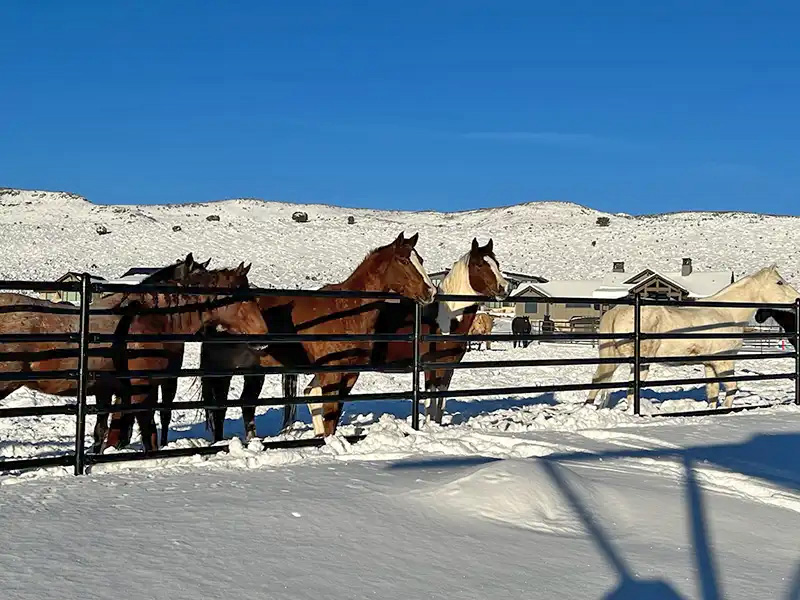
Not at all. The same basic system can make sense on a smaller horse property with a few paddocks just as it can on a large ranch, training facility, breeding operation or boarding barn. You could use it around an arena, create turnout areas, build pasture divisions or fence a much larger perimeter.
Because the system is customizable, the real question isn't whether your property is large enough. The question is what configuration is right for your horses and the way you use your property.
For most people, it comes down to visibility, strength, longevity, appearance and installation. Horse owners like fences that horses can see and keep from destroying. Wire fencing can break or lose its charge, wood fencing can be broken, and a pending lawsuit for a horse on the road that caused a serious accident can take your farm.
Make sure you have fencing that looks substantial and is designed to last. Best of all, there is no "on-site welding" and no giving up the appearance of traditional pipe rail fencing.
You need to ask: "What fence do I want to trust around my horses, and what fence will I still be glad I bought twenty years from now?" For horse owners who like the strength and appearance of traditional steel pipe fencing but want a more practical no-weld installation system, 440 Fence is unequivocally the answer!
If you are planning a new horse pasture, paddock, riding arena, barn area, perimeter fence or complete equestrian facility, talk with 440 Fence about your property before you start digging holes. They can help you determine which configuration makes the most sense for your horses, terrain and project.
Built to last, built to add real value, security and beauty to your horse property. 440 Fence is the Premium fencing for horse owners who simply must have the best for their property and horses. Built to last a lifetime, our friendly staff welcomes your calls, and is anxious to help you every step of the way. Pick up the phone and call 440 today. You'll be thanking yourself for decades to come!
A no-weld steel pipe fence uses steel connectors to join the pipe rails to the posts instead of welding every joint on-site. You get the strength and substantial look of traditional pipe fencing without a welding crew following you down the fence line. That cuts out specialized labor and equipment, and it puts a pipe fence within reach of horse owners who want to do some or all of the work themselves. 440 Fence is built around exactly this kind of connector system.
A well-designed pipe fence is one of the safest choices around horses because they can see it easily and it makes a definite physical boundary. Smooth pipe rails don't splinter like boards, and they avoid some of the entanglement concerns of certain wire fences. The safest fence is still one designed for the horses behind it: foals, stallions and active groups may need a different height or rail count than quiet older geldings. 440 Fence uses smooth pipe rails with several height and rail options.
Many capable horse owners can, because the 440 Fence system was designed to be DIY friendly. 440 Fence publishes a series of installation videos covering recommended tools, product arrival, installation and gates, and they help by phone if you get stuck. It is a real steel fence, so plan on real work and the right equipment. An experienced fencing contractor new to the system can generally learn it within a few hours.
Your fence will most likely arrive on a flatbed semi-truck, so you need a large, reasonably level, firm spot where the truck can get in, unload and get out. 440 Fence recommends a forklift or a skid steer or tractor that can lift at least approximately 1,000 pounds. Without pallet forks, individual pipe bundles can be handled with appropriate nylon straps and suitable tractor equipment. Make the unloading plan before the truck gets there.
Yes, if the system is made to follow the ground. Very few horse properties are flat: pastures roll, barns sit at different elevations and arena areas change grade. The 440 Fence connector system is designed to let the fence follow the contours and shape of the property. The result is a more natural-looking fence line than forcing a rigid design onto rolling terrain.
It depends on your horses, the location and the purpose of the fence. Think about the size and temperament of the horses, whether it is perimeter or interior fencing, the height you need, whether young horses will be there and whether the area is a pasture, paddock, arena or stall run. 440 Fence can be configured with different numbers of rails, so you build around your property instead of one standard design. Wire mesh or other infill can be added in certain configurations for foals, miniature horses or dogs.
Very little compared with wood, which breaks, gets chewed, fades and deteriorates over time. A properly installed coated steel pipe fence is designed to be a long-term solution. White is a popular choice on horse farms for its clean look and visible boundary, and it has natural UV-reflective properties. According to 440 Fence, white fences standing for around twenty years can still look remarkably close to a newer fence.
Plan your layout first: where the fence runs, where the corners and gates go and how materials get from the unloading area to the fence line. Have all underground utilities located before you dig, even on land you have owned for years. Watch the 440 Fence installation videos, especially the recommended tools, before delivery day. Then talk with 440 Fence about your horses, terrain and project so they can help you choose the right configuration.
Explore more from the InfoHorse.com directory
Explore expert guides on topics related to your business
By Bob Pruitt
By Karen Elizabeth Baril
By Bob Pruitt
By Bob Pruitt
By Bob Pruitt
By Karen Elizabeth Baril