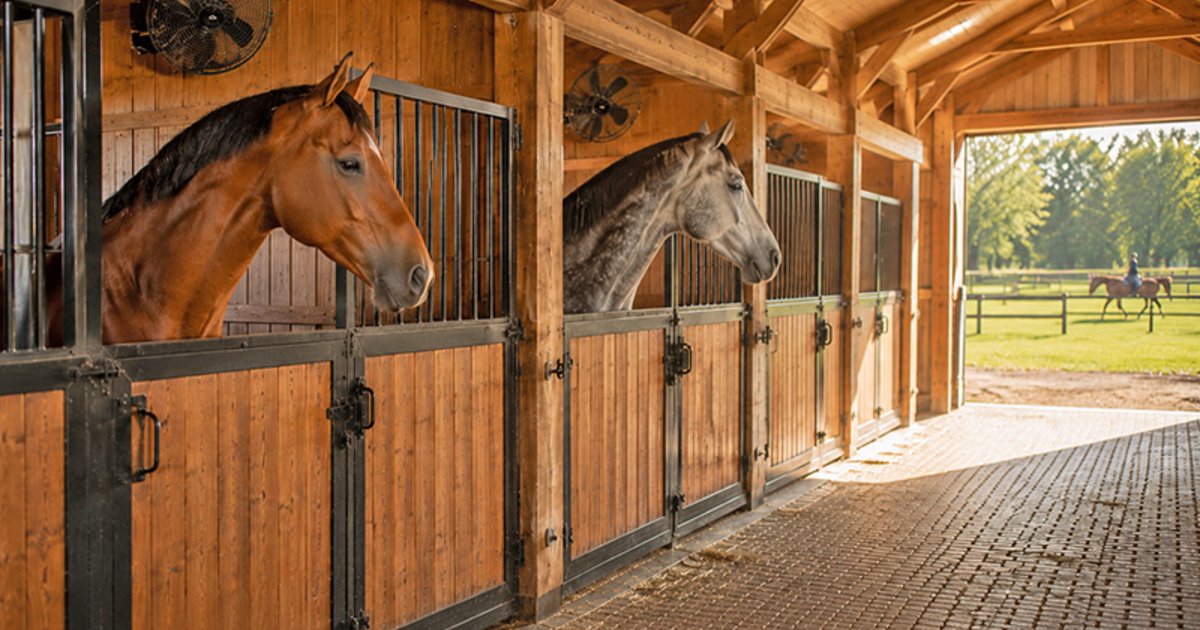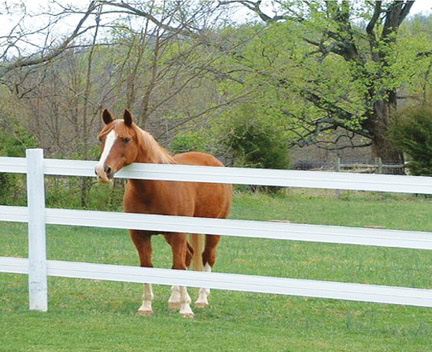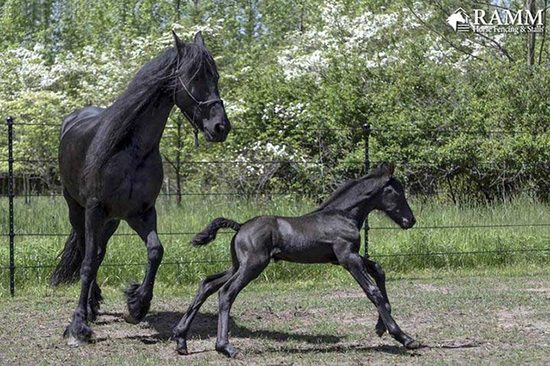

Miura Board® makes 100% recycled, fiber-plastic composite panels for horse stall walls, kickboards, stall flooring, horse trailer flooring, fencing and gates. Unlike wood or plywood, Miura Board® does not absorb water, does not rot from urine or moisture, does not splinter, and can be washed, pressure cleaned and disinfected.
Miura Board® is a 100% recycled, fiber-plastic composite panel designed as a durable alternative to wood, plywood, and plastic. For horse owners, its biggest advantages are simple: it does not absorb water like wood, does not rot from urine or moisture, does not splinter, and can be washed, pressure cleaned, and disinfected. That makes Miura Board® especially interesting for horse stall walls, kickboards, barn partitions, stall flooring, horse trailer flooring, fencing, gates, aisle walls and other areas where wood takes a beating.
Horse barns are hard on building materials. Horses kick, rub, lean, chew, splash water, spill feed and produce plenty of manure and urine. A board that does not absorb moisture and is highly resilient to the heavy use of an equine environment deserves a closer look.
Yes. Horse stalls and livestock partitions are among the many recommended uses for Miura Board®. For stall walls and arena kickboards, one of the biggest benefits is durability. Traditional lumber can crack, splinter, rot or become damaged after years of kicking and moisture exposure.
Miura Board® is made for high-impact environments and does not split or splinter the way wood can. That is especially appealing along the lower portion of a stall or arena wall, where horses are most likely to kick, lean, paw or rub. A material that stays solid and does not splinter eliminates one of the common hazards found in aging wooden stalls.
Yes, and this may be one of its most important advantages in a horse barn. Miura Board® is non-porous and has zero water absorption, so horse urine and moisture do not soak into it the way they soak into wood.
Anyone who has pulled an old stall mat knows what can happen underneath. Wood that looked acceptable from the top may be soft, swollen, stained or rotting underneath after years of exposure to urine and moisture.
Miura Board® does not require staying dry to prevent rot. That makes it worth considering for stall walls, stall flooring, flooring beneath mats, barn partitions, wash areas and other places that regularly encounter urine, manure or water.
Yes. Stable flooring, livestock flooring and flooring beneath mats are among its equine applications. This is particularly useful in stalls where rubber mats are installed over a structural floor, because moisture and urine can work their way underneath the mats and remain trapped.
With traditional lumber, trapped moisture can eventually cause deterioration. Miura Board® does not absorb water and will not rot from moisture exposure. The correct thickness, framing, support spacing and installation method still matter, particularly where horses will be standing on the material; a flooring system must be designed for the load it will carry.
For horse owners looking for a waterproof alternative to plywood or wooden stall flooring, Miura Board® deserves serious consideration.
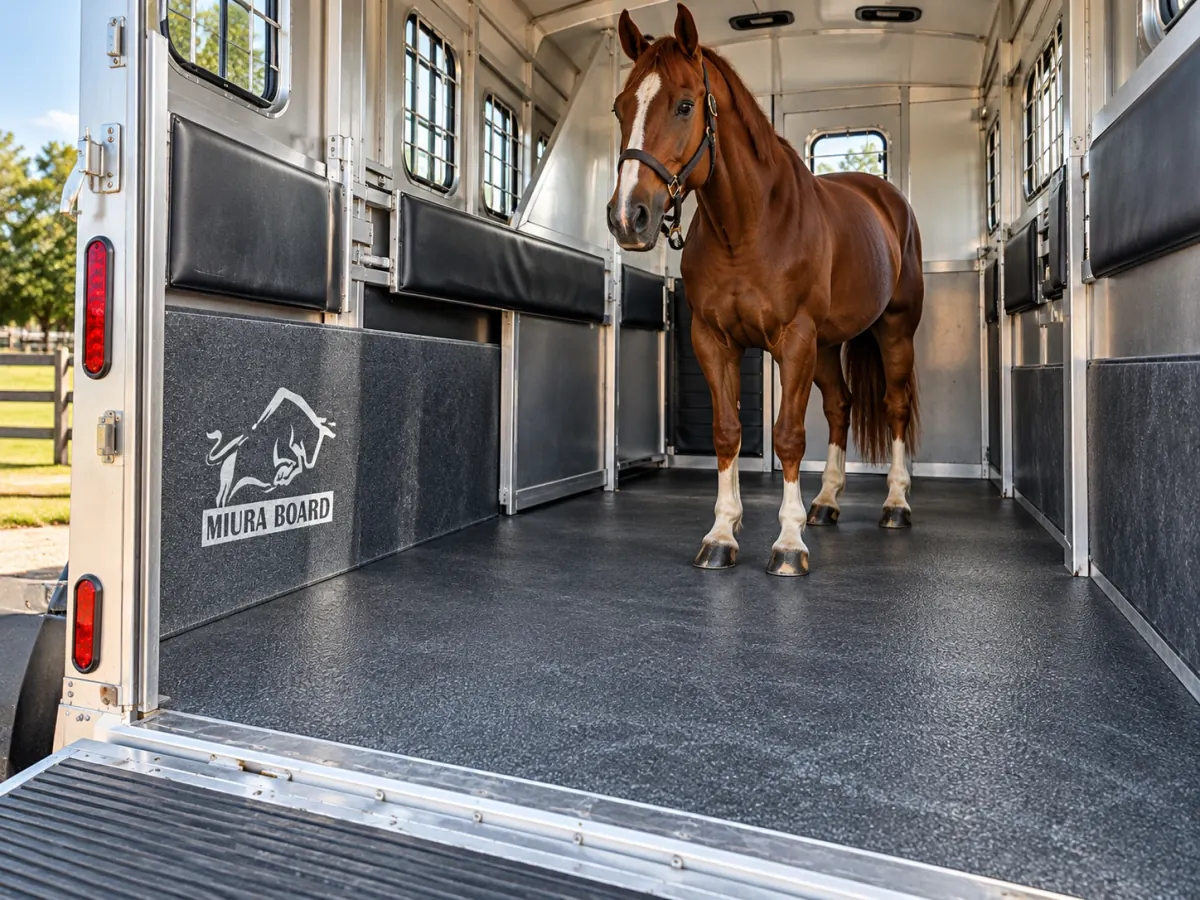
Horse trailer flooring may be one of the best equine applications for Miura Board®. Think about what a horse trailer floor has to survive: urine, manure, spilled water, wet rubber mats, road spray, temperature changes and the concentrated weight of a horse standing on four relatively small hooves.
Wood trailer floors can deteriorate when moisture becomes trapped underneath rubber mats or enters from below, and rotten flooring in a horse trailer is a life-threatening situation for your horses! Miura Board® is used in demanding transportation flooring applications because it is nonabsorbent, highly resistant to abrasion and impact, and does not experience the rot, swelling or delamination associated with many wood-based materials.
For horse trailers, that means no urine rot and no water absorption in the board itself. Miura Board® still recommends appropriate horse trailer mats for traction, comfort and cushioning, and trailer owners should continue lifting mats periodically to inspect the entire floor, framing and supports.
But if you are replacing a horse trailer floor and are looking for an alternative to wood, Miura Board® is certainly worth investigating. One major benefit: a Miura Board® floor may outlast the rest of the trailer.
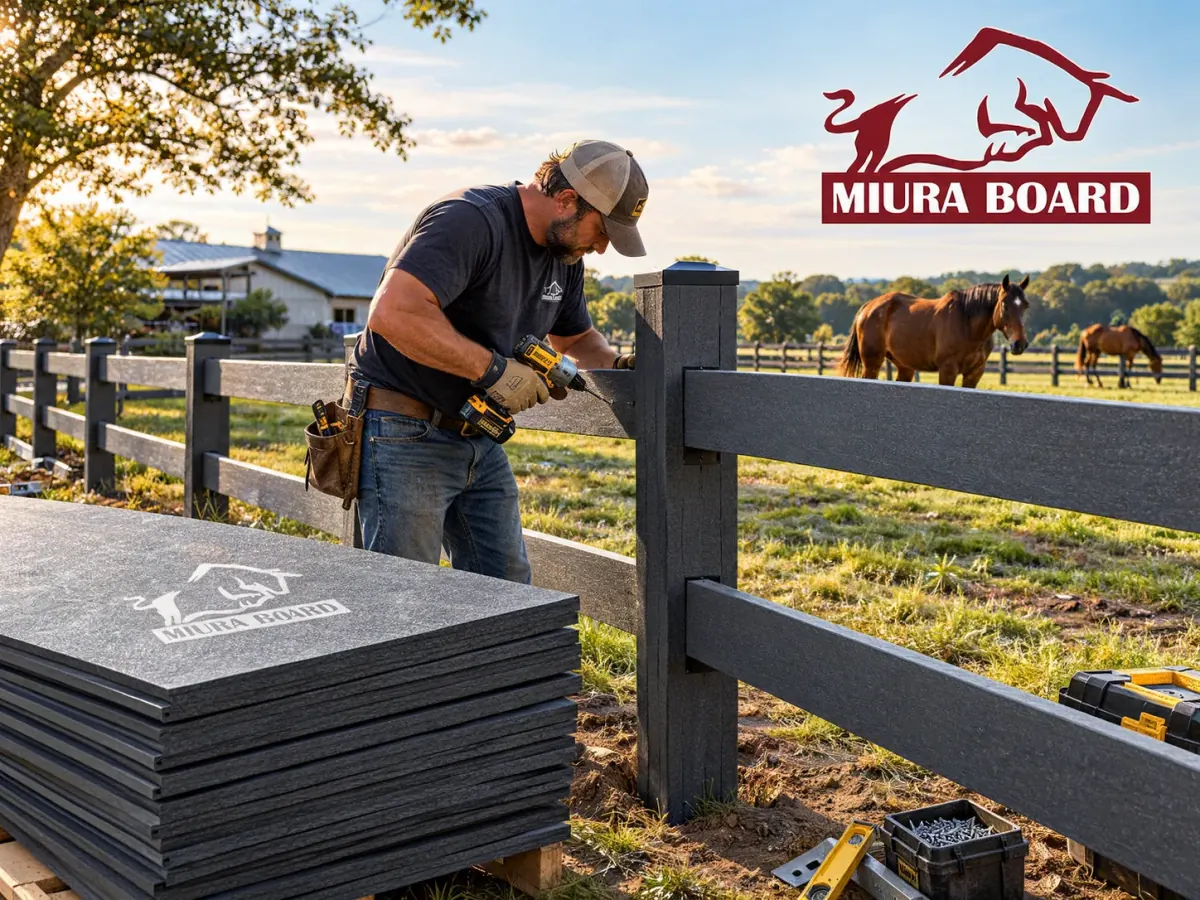
Yes. Miura Board® is well suited to horse fencing, gates and other equine and livestock applications. One of the frustrations with traditional board fencing is maintenance. Rain, irrigation, mud and weather eventually take their toll, and boards may need painting, staining, repairing or replacing. Miura Board® is also built to take abuse: kicks that would crack a wood board won't break it.
Miura Board® does not rot like wood, is nonabsorbent, is impervious to termites and fungi, and does not splinter. That makes it especially useful for paddocks, corrals, mare motels, sacrifice areas, gates and fencing close to barns, where wood boards often take more abuse than they would along a quiet pasture perimeter.
As with every horse fence, the complete system matters. Posts, fasteners, fence height, board spacing and installation all contribute to safety. No single fence material replaces good horse-fencing design.
Miura Board® does not splinter the way wood does. That is an important distinction in horse stalls and fencing. A broken wooden board can leave sharp edges and long splinters exactly where you do not want them, right next to a horse.
Miura Board® is a dense, fiber-reinforced composite panel made for impact resistance. Its resistance to splitting and splintering like wood is a primary reason it is attractive for livestock environments. Horse people know one rule better than most: if there is something in a stall capable of causing an injury, eventually a horse may find it. Durable materials help mitigate those risks.
Miura Board® is considerably different from softwood lumber and is designed to resist the damage that occurs in demanding agricultural environments. It also does not contain the wood preservatives associated with chemical treated lumber, and it does not splinter.
Miura Board® does not claim that any building material is completely horse-proof. A determined cribber or chewer can surprise all of us. Habitual cribbing and chewing should still be managed appropriately, and high-wear areas may require additional protection or hardware. But for owners tired of replacing soft wooden stall boards that have been chewed and damaged, Miura Board® provides a solid alternative.
Ann Pruitt, Director, InfoHorse.comSeeing is believing. I thought we could visualize the toughness of this board, but when we got the sample sent to us by Miura Board®, we were quite honestly astounded. This is one tough board! As horse owners ourselves, all of us with horses that will happily chew wood, we could not imagine that a horse would even attempt chewing on Miura Board®. It is so impressive! Our staff has 100% confidence that Miura Board® will not disappoint, and there is every reason to believe it will last well beyond 25 years.
Yes. Miura Board® can be pressure washed, which is a major advantage in horse barns. Mud, manure, feed residue and barn grime can build up on any surface. The difference is that Miura Board® does not absorb the wash water or cleaning chemicals the way unfinished wood can. That makes routine cleaning much easier in stalls, barn aisles, wash areas, breeding facilities, veterinary areas and boarding barns.
Absolutely! This is something regular wood boards simply can't offer. Miura Board® is resistant to common agricultural cleaning and disinfecting chemicals and solvents, including quaternary ammonium compounds and caustic cleaners within Miura Board® specifications. That is particularly valuable in barns where biosecurity matters: boarding barns, breeding farms, quarantine stalls, veterinary facilities, rehabilitation barns and show barns where different horses may occupy the same spaces.
Wood can be difficult to clean thoroughly because liquids penetrate the grain, cracks and damaged areas. Miura Board® provides a non-porous surface that can be washed and disinfected easily. Of course, good barn biosecurity still depends on proper cleaning procedures and correct use of disinfectants. Miura Board® simply gives you a surface better suited to that job.
As a nonabsorbent fiber-plastic composite, Miura Board®, with proper cleaning, will not support rot, mold, fungi or termites. Because it has zero water absorption, it does not swell or deteriorate from moisture exposure the way wood products can.
This is especially important in humid climates and areas of the barn that stay damp. Consider the bottom of stall walls, exterior barn walls, areas near water buckets, wash racks, trailer floors and fencing close to the ground. Those are exactly the places where traditional lumber frequently shows its age first.
Miura Board® does not require painting or sealing to protect it from rot. That can eliminate a considerable amount of the ongoing maintenance that comes with lumber that needs to be stained, painted or sealed periodically.
That does not mean you will never need to touch it. This is still a horse barn: manure, mud, dust and feed will stick to it, and you will still need to clean it. But washing Miura Board® is very different from replacing a rotten wood board.
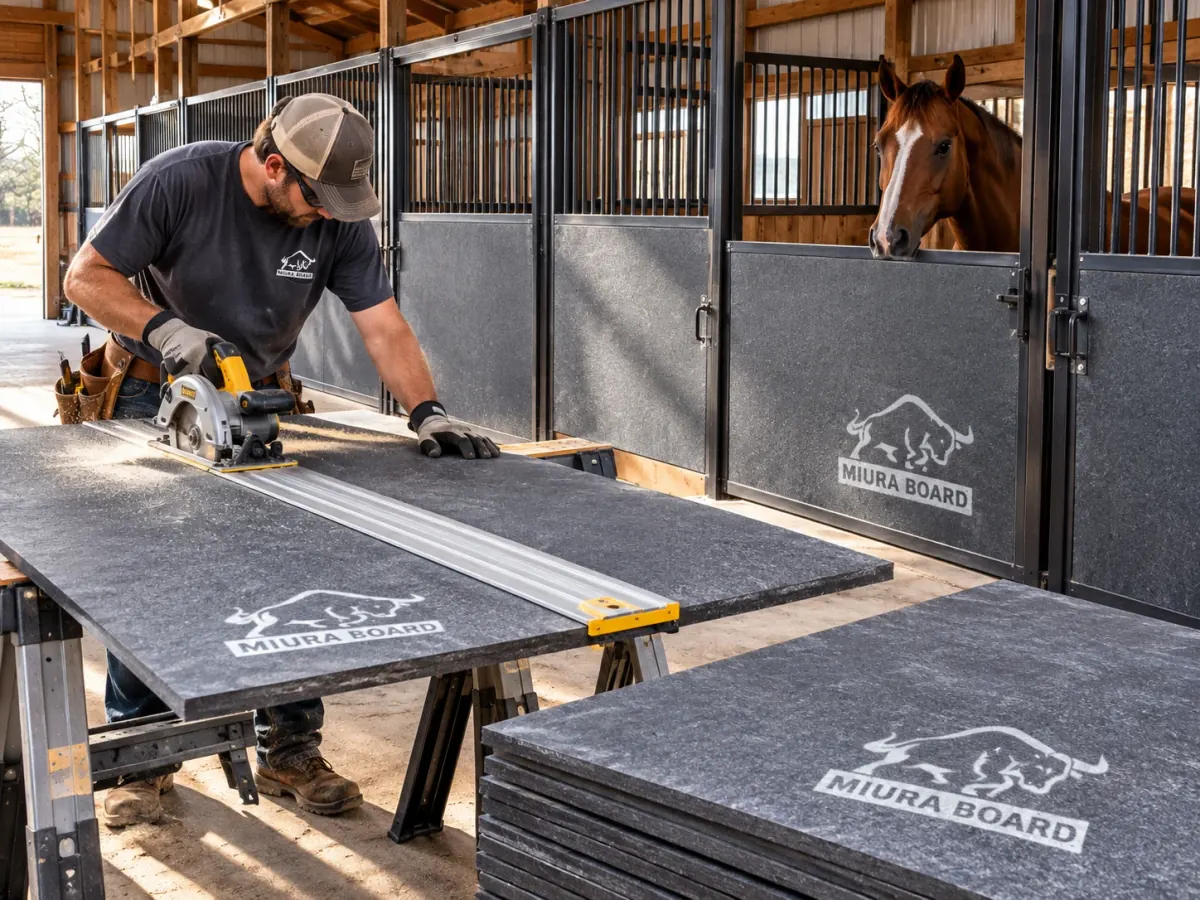
Yes. One of the useful characteristics of Miura Board® is that it can be worked with conventional woodworking tools. It can be cut, drilled, milled, sanded, nailed and screwed. Standard Miura Board® panels are 4' x 8', in thicknesses from ¼" to 2". Custom-length panels or cut-to-size boards are available by special order, though minimum order quantities may apply.
That gives barn builders considerable flexibility: 4' x 8' panels can be cut for stall partitions, kickboards, trailer applications, barn walls, gates and other custom projects. As with any structural material, follow Miura Board® recommendations for thickness, support spacing and fastening.
Cutting tip: let the blade do the work. Cutting speed is critical; if you push the saw or router too quickly, Miura Board® burr can melt instead of cutting cleanly.
Miura Board® is rated for a service life of 25 years or more in agricultural environments under appropriate conditions. That is an important number, because the real cost of a barn material is not simply what you pay the day you buy it. You also have to consider how many times you may have to replace it.
Removing rotten lumber, buying new boards and paying someone, or spending your own weekend, to do the same job again all has a cost. A material designed for long service life looks very different when you consider the cost over many years of horse ownership.
Yes. Miura Board® is made from 100% recycled material, including recycled plastics combined with reinforcing fibers. Material that might otherwise become waste instead becomes a durable building product designed to remain in service for many years. For horse owners who care about sustainability but still need something tough enough for a working barn, that is an appealing combination. As the company puts it: Cut Waste, Not Trees™.
Miura Board® has potential uses throughout an equine property: horse stall walls, stall kickboards, stall flooring, flooring beneath rubber mats, horse trailer flooring, barn partitions, aisle walls, horse fencing, paddock fencing, corrals, mare motels, gates, wash areas and agricultural storage applications.
The common thread is simple: these are places where horse owners traditionally use wood, but where water, urine, manure, impact and weather can eventually destroy it.
For many applications, yes. Plywood is convenient and familiar, but it is a wood product and can delaminate and deteriorate when moisture reaches it repeatedly. Miura Board® provides a waterproof, non-porous alternative that does not rot or delaminate from water exposure, which matters most where plywood has historically struggled and moisture is difficult to eliminate completely.
Whether you are building a new barn, renovating stalls or replacing deteriorated lumber, Miura Board® is worth considering anywhere you want water resistance, impact resistance, easier cleaning and less concern about rot and wood splinters.
Horse owners have used lumber for generations because it was familiar, readily available and easy to work with. But familiar does not necessarily mean best for every part of a modern horse barn. When you are building or replacing something that has already rotted once, it makes sense to ask a different question: Do I really want to replace it with the same material again and again?
Miura Board® keeps inventory in Miami, Florida and Pilot Point, Texas, and can ship anywhere in the world! If you are replacing rotten stall boards, planning new horse fencing, upgrading a trailer floor, or building a barn you do not want to keep repairing, Miura Board® is worth a serious look: a material designed to stand up to horses, moisture, urine, weather and years of hard use.
Miura Board® is a 100% recycled, fiber-plastic composite panel made from recycled plastics combined with reinforcing fibers. It is designed as a durable alternative to wood, plywood and plastic. For horse owners the appeal is simple: it does not absorb water, does not rot from urine or moisture, does not splinter, and can be washed, pressure cleaned and disinfected. The company's own slogan is Cut Waste, Not Trees™.
Composite boards do not rot where wood and plywood fail. Wood and plywood absorb urine and water, so they swell, delaminate and rot, especially under stall mats and along the bottom of walls. Miura Board® has zero water absorption, is impervious to termites and fungi, and does not split or splinter when kicked. It also needs no paint or sealer to protect it from rot, which removes much of the upkeep that lumber requires.
Standard Miura Board® panels are 4' x 8', in thicknesses from ¼" to 2". Custom-length panels and cut-to-size boards are available by special order, though minimum order quantities may apply. The panels can be cut, drilled, milled, sanded, nailed and screwed with conventional woodworking tools. Cut slowly and let the blade do the work, because pushing a saw or router too fast can melt the burr instead of cutting cleanly.
The best horse trailer floors are non-absorbent, so urine and water cannot rot them under the mats. Miura Board® is used in demanding transportation flooring because it is nonabsorbent, highly resistant to abrasion and impact, and does not rot, swell or delaminate like many wood-based materials. Keep using trailer mats for traction, comfort and cushioning, and lift them periodically to inspect the floor, framing and supports. A Miura Board® floor may outlast the rest of the trailer.
Yes. Stable flooring, livestock flooring and flooring beneath mats are among Miura Board® equine applications. Urine and moisture that work under rubber mats stay trapped against the floor, which eventually rots a wooden subfloor. Miura Board® does not absorb water and will not rot from that exposure. Match the panel thickness, framing, support spacing and installation method to the load the floor will carry.
Yes. Miura Board® is well suited to horse fencing, gates, paddocks, corrals and mare motels. It is considerably tougher than softwood lumber, contains none of the preservatives used in chemically treated lumber, and does not splinter. The company does not claim any material is completely horse-proof, so habitual chewers and cribbers should still be managed. Posts, fasteners, fence height, board spacing and installation all contribute to a safe fence.
Yes. Miura Board® can be pressure washed and is resistant to common agricultural cleaning and disinfecting chemicals, including quaternary ammonium compounds and caustic cleaners within the company's specifications. Because the surface is non-porous, wash water and disinfectant do not soak in the way they do with wood grain and cracks. That makes it valuable for boarding barns, breeding farms, quarantine stalls, veterinary and rehabilitation facilities, and show barns.
Miura Board® is rated for a service life of 25 years or more in agricultural environments under appropriate conditions. That changes the real cost of a barn material, because it saves replacing rotten boards again and again. The company keeps inventory in Miami, Florida and Pilot Point, Texas and can ship anywhere in the world. Request a sample or a quote through the contact details on this page or at miuraboard.com.
Explore more from the InfoHorse.com directory




Explore expert guides on topics related to your business
By Ann Pruitt
By Karen Elizabeth Baril
By Karen Elizabeth Baril
By Karen Elizabeth Baril
By Bob Pruitt
By Karen Elizabeth Baril