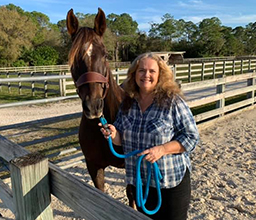
Here are a few questions you need to ask yourself: What is my emergency or evacuation plan?
Do you have an evacuation route for getting out of your given area, your home or ranch?
If you own a ranch or boarding facility, do you have an evacuation plan and traffic plan posted?
Do you practice with your family and boarders quarterly (or at least twice a year)?
Do I have proof of ownership and current photos of my animals?
Emergency Preparednessfor Horse Owners by EquestriSafe
Preparing horses for an emergency starts with a written evacuation plan and route, proof of ownership with current photos, and copies of veterinary records kept both under your truck seat and in your transporting trailer. Assemble a grab-and-go kit that includes identification for every horse—an ID band or evacuation collar—plus a halter and lead rope for each animal, two to three days of medications and feed, a flashlight with extra batteries, a battery-operated radio, water buckets, a fire extinguisher, and contact information for you and your veterinarian, and practice the plan with family or boarders at least twice a year.
Before Emergencies Happen
It’s not a matter of if; it’s a matter of when an emergency situation will happen to you! With all of the wild weather around the country, (floods, wild fires and tornados), somewhere there are horses and other animals that have gone missing and may never return; homes that are threatened or have been destroyed and lives changed forever.
Each year the Aspc, Hsus, local animal rescues, shelters and organizations provide information how to be prepared, what to gather quickly for an emergency and how to prepare yourself and your family members whether 2 legged or 4 legged. Here are a few questions you need to ask yourself:
What is my emergency or evacuation plan?
Do you have an evacuation route for getting out of your given area, your home or ranch? If you own a ranch or boarding facility, do you have an evacuation plan and traffic plan posted? Do you practice with your family and boarders quarterly (or at least twice a year)?
Do I have proof of ownership and current photos of my animals? A proof of ownership, Veterinary records and Identification for ALL your animals is a Must! I suggest that you have copies of veterinary records & proof of ownership for your animals under the seat of your truck and a 2nd copy in your transporting trailer.
Other essentials; First Aid kit, medications, supplements and adequate feed supplies are also necessary in the event you need to leave my home location for a period of time?
The time to really think about these things is when you don’t need them. That time in “anytime” during the year. Take a day and collect your inventory, move items for easy access when you are in a hurry. You may also want to have a checklist visible in your barn as to what you need when you evacuate so that you can make sure not to forget something important
Planning ahead of an emergency is so very important; relocating horses, traveling long or short distances, from fires, flood , tornados, and hurricanes; emergency planning needs to be considered for even show days, trail rides, camping, hunting, and endurance races. I can’t think of a situation where planning should not be a part of your preparedness.
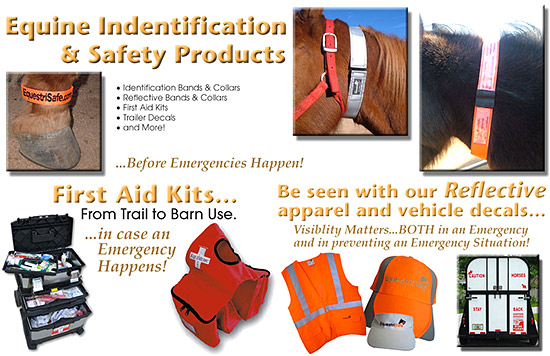
Here are some basic items to have in your emergency grab and go kit: Identification for your horses – either an ID band or Evacuation Collar Flashlight with extra batteries Radio – battery operated Medications & feed for 2-3 days Halter & lead rope for every horse Contact information for you, veterinarian and other contacts Feeding instructions & restrictions Fuel in your vehicles Fire Extinguisher Water buckets
Written by: Teresa Spencer; author, speaker, horse owner. EquestriSafe, owner (a company dedicated to horse safety) and California Horse Barns. Proud member of Csha, Equestrian Trails – Corral 138, AQHA, American Equestrian Trade Association, AQHA & APHA For more information on disaster planning, you can contact us ... see below...
Sponsored Content — Contact information provided by the sponsor
💬Questions Readers Commonly Ask (FAQ)
What should I do right now to be ready for a horse emergency?
Per EquestriSafe: emergencies are a matter of when, not if. Every year floods, wildfires, and tornadoes leave horses missing and homes destroyed. The practical action is to build a grab-and-go kit before you need it. The article's recommended kit:
ID for every horse — ID band or evacuation collar
Halter and lead rope for every horse
Flashlight with extra batteries; battery-operated radio
2-3 days of medications and feed
Water buckets and a fire extinguisher
Fuel in the vehicles, not waiting for the gas station
Contact info for owner, vet, and other emergency contacts; feeding instructions and restrictions
Take one day this month to assemble the kit and stage it for fast access. The time to do this is when you don't need it.
How do I make an evacuation plan that will actually work under pressure?
Per EquestriSafe: the test of an evacuation plan is whether everyone in the barn — family, boarders, hired help — knows it without thinking. Practice quarterly, or at least twice a year. A plan you've never rehearsed is a wish, not a plan.
The article's planning questions:
What is your evacuation route out of your area, home, or ranch?
If you run a boarding facility, is the evacuation and traffic plan posted?
Do you have proof of ownership and current photos for every animal?
Where are your veterinary records stored — and is there a second copy somewhere else?
Per EquestriSafe: keep one set of records under the truck seat and a second set in the trailer. Two locations beats one because the truck and trailer can be in two different places when the call comes.
How do I prove a horse is mine if I get separated during an evacuation?
Per EquestriSafe: proof of ownership is a must-have, and the time to assemble it is now, not at the moment of crisis. The components:
Current photos of each horse from multiple angles, including any distinctive markings
Bills of sale, registration papers, microchip records if applicable
Veterinary records including Coggins and vaccination history
A physical ID band or evacuation collar on the horse during the actual evacuation
Per EquestriSafe: store one set under the truck seat, a second set in the transporting trailer, and ideally a third copy with a friend or family member outside your immediate area. After a major weather event, recovery facilities will ask for documentation before releasing a horse to anyone — the owner who shows up with paperwork moves faster than the owner without it.
Where should I keep my emergency checklist so it actually gets used?
Per EquestriSafe: post a visible checklist in the barn. Under stress, you will forget things you'd never normally forget. A printed checklist at eye level by the tack room or feed-room door is a lifeline — not a redundancy.
The article's principle: when you're collecting your inventory, also move items into easy-access positions. A halter on a hook by the stall door is reachable in thirty seconds; a halter at the bottom of a bin in the back is not. Walk the barn at a normal pace and ask, "if I had three minutes to evacuate, could I find this?" Anything that fails the three-minute test gets relocated. Per EquestriSafe: planning ahead applies even to show days, trail rides, camping, hunting, and endurance races — not just home-base emergencies.
When does emergency planning fail, and how do I avoid those failure modes?
Per EquestriSafe: most plans fail in three predictable ways.
Plans that exist on paper but were never practiced. Quarterly practice — or at least twice a year — is the difference between a plan and a fantasy.
Plans that assume the truck is fueled and the trailer is hitched. Both should be staged closer to ready than not. Fuel in vehicles is on the article's grab-go list for exactly this reason.
Plans that don't account for boarders and bystanders. If you run a facility, the evacuation and traffic plan needs to be posted where every boarder sees it, and rehearsed with them.
Per EquestriSafe: the time to think about these failure modes is during a quiet week, not when you smell smoke. Walk through one failure scenario per quarter and patch what you find.
📋
Recommended Products
Curated picks from across InfoHorse.com — most relevant first