


The Ground Your Horse Works On – Your Arena Should Not be an After Thought
Bad arena footing can contribute to stone bruises, abscesses and slow ligament damage owners may blame on training or attitude. How to read the ground your horse works on, and what it costs when nobody did it right
Different problems every time. Same lesson every time.
You can see the fence. You can see the gate and the letters and the rail. You cannot see the part that matters. It is under the surface, and it was decided before anybody ever rode in there.
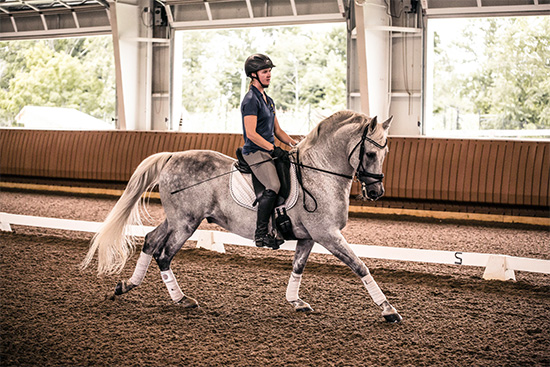
Your horse can see it. He has been telling you about it. Horse Arenas at InfoHorse.com
Your horse has already given you his report
Most owners never think about the arena. They think about the horse in it.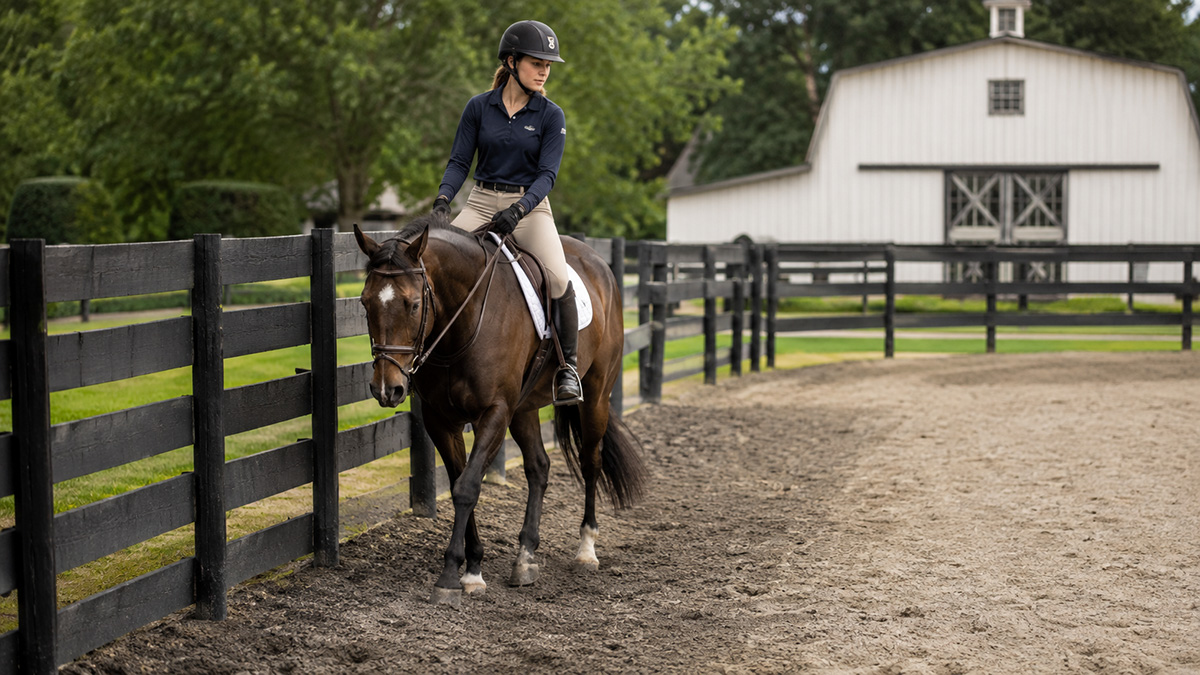
The horse who drifts off the rail at the same corner every single time. The horse who will pick up one lead going one direction and argue about the other. The horse who gets short and quick through the turns and will not stay round. The horse who plants his feet at the gate.
We call that attitude. We call it a training hole. We call the trainer, or we call the saddle fitter, or we change the bit.
Sometimes it is the ground.
A horse may become reluctant to step confidently onto footing that has hurt him. He does not know how to file a complaint. He tells you the only way he can, which is with his body, and we usually answer by asking him to try harder.
Before you spend money on a training answer, walk the ring on foot. It is free.
An arena is not a piece of ground with a fence around it
It is a road. It is built much the same way.
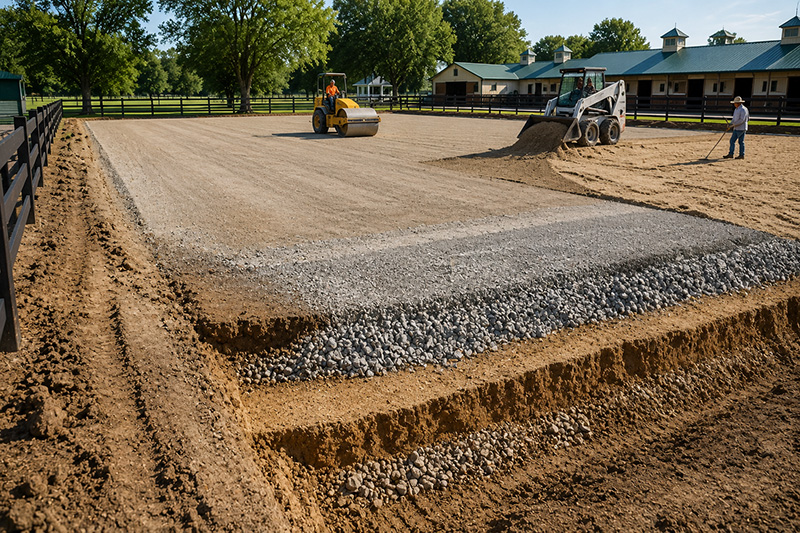 There is a subgrade, which is native soil stripped of topsoil and organic material, graded and compacted. There is a base, which is engineered aggregate, compacted and leveled, often with a separation layer between it and the dirt below. And there is footing, which is the last few inches, the only part anybody ever looks at.
Most arenas in this country are the last few inches. Somebody flattened a spot and hauled in sand.
That may work for a while.
I am not going to walk you through base construction here, because we already have good material on that from people who build arenas for a living. What I want you to understand is simpler. The surface your horse touches is the end of a system, and when the system is wrong, no amount of work on the surface will truly fix what is happening underneath it.
The one mistake you cannot fix easily later
Footing can be amended. Additives can be added. Rocks can be screened out, painfully and repeatedly. A roof can go up ten years after the fact. Almost every arena problem has a purchase order attached to it somewhere.
Grade is different.
You cannot truly correct a bad grade from the surface. Fixing it usually means removing footing, getting back to the base or subgrade, and rebuilding the drainage and elevation correctly. At that point, you are not maintaining an arena anymore. You are renovating one.
That is why the arena belongs on the plan on day one, sitting right next to the barn and the house, and not penciled onto whatever flat ground is left when everything else is placed. It is the largest flat footprint on most horse properties. Where you put it helps decide where water goes for everything around it.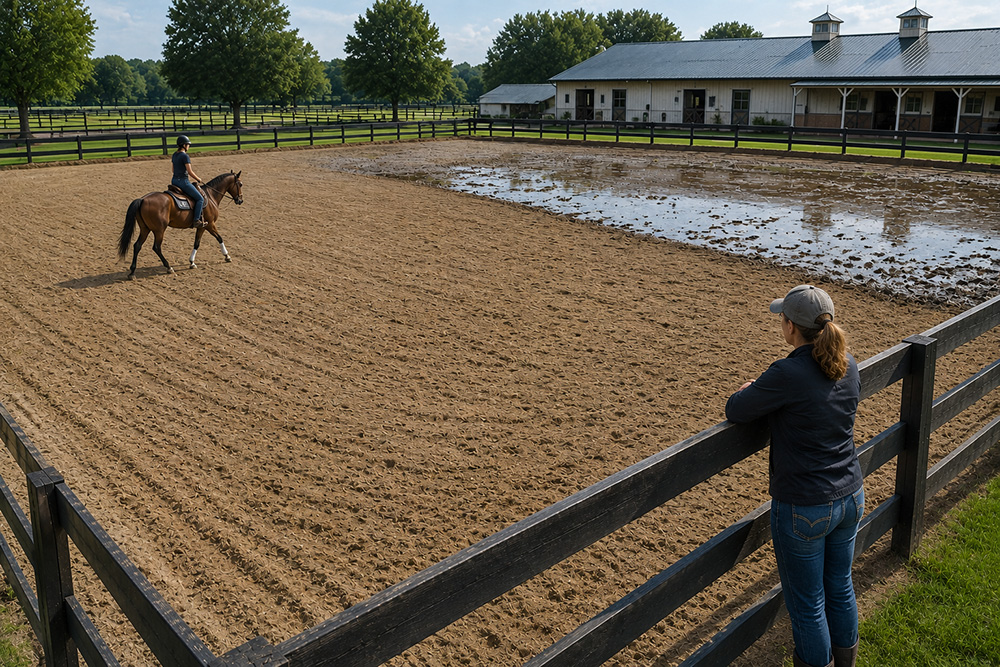
Here is what a bad grade looks like in practice. It rains, and half the ring holds water for a week. Everybody rides the dry half. The dry half packs into a hardpan. The wet half sits saturated, may soften the material beneath it, and can wash fines toward the low side. Inside one season you may feel like you own two arenas with a seam down the middle.
Then come the hoof problems from horses standing wet, and the mosquitoes, and the riding days you lost.
You cannot drag your way out of that. You cannot water your way out of it. The underlying problem is grade and drainage, and fixing those after construction is a much bigger job.
An arena can seem to make its own rocks
This is the part almost nobody explains to a first-time owner.
You may not have a rock problem you can clean up on a Saturday. You may have a ring that keeps bringing more rock to the surface.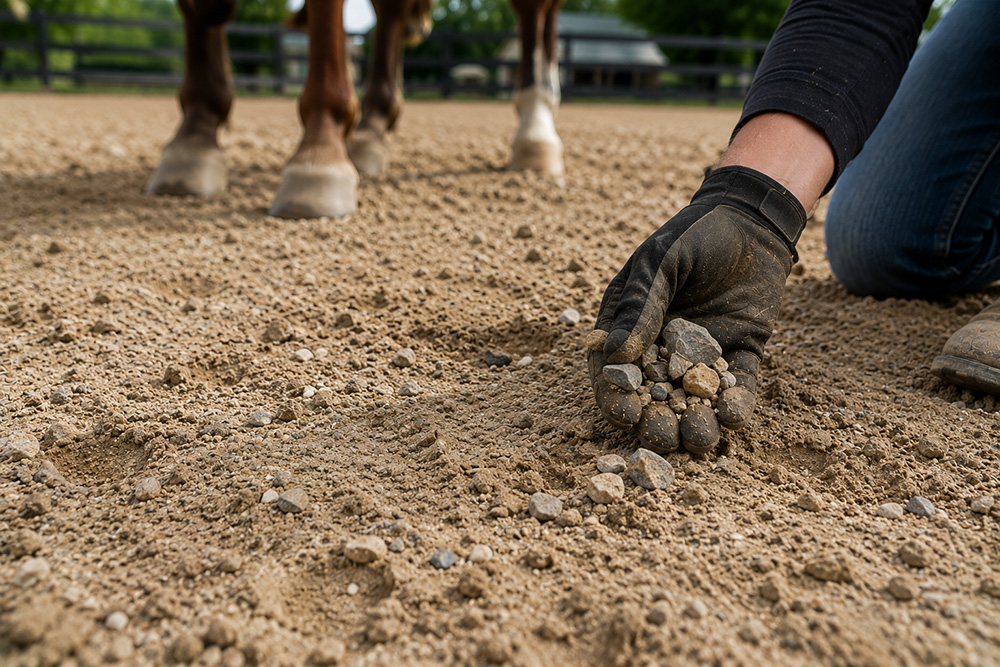
Freeze and thaw can move material. So can vibration, hoof traffic and repeated dragging. Over time, mixed materials can sort themselves, with finer particles working downward and larger pieces becoming more noticeable at the surface—the same general reason a jar of mixed nuts often ends up with the big ones on top. The stone you pull out in April may have a replacement waiting below it.
There are several ways those rocks get in there, and each one has a different answer.
Unwashed or unscreened sand can bring them in on day one. Native soil mixing upward through a poorly separated base can keep supplying them. Base aggregate can begin appearing when footing becomes too thin. And cheap fill hauled off a construction site can contain things a good deal worse than rocks.
Now the part that costs you.
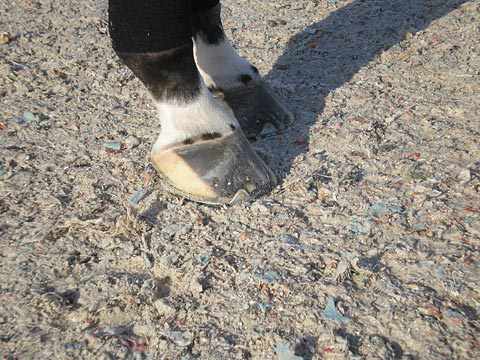
A stone bruise is an injury to the sensitive tissue beneath the sole. Some bruises resolve. Others can develop into an abscess several days later. When that happens, it may mean soaking, wrapping, treatment, time off and a horse coming back out of condition.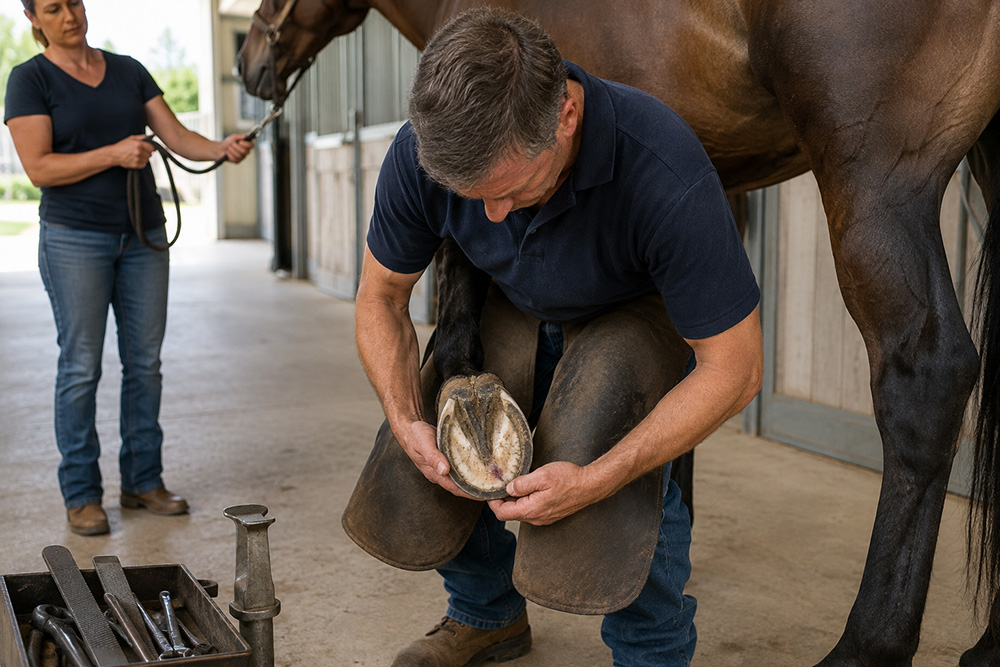
A shod horse can have another problem. A stone that becomes lodged between the shoe and sole may be unable to work its way free easily and can continue putting pressure on the foot.
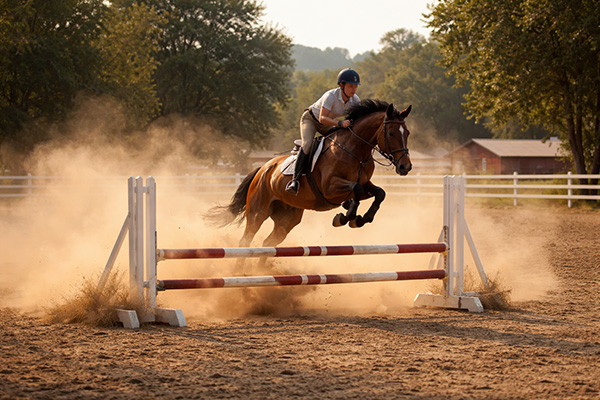
And a horse landing off a fence meets whatever is underneath him with considerably more force than a horse simply finding it at the walk.
Here is the part that ought to make you angry. Your farrier may get blamed for that abscess. Your veterinarian may be called for a lameness workup. Neither one caused the arena problem, and unless the source is corrected, your arena may do it again.
Adding more sand is not the fix
When people finally admit something is wrong, this is what they do. They order more sand.
It feels like progress. It is cheap compared to real work. And sometimes it buries the problem literally instead of solving it.
Adding footing to a bad arena is putting a thicker pad under a saddle that does not fit. It changes what you feel. It changes nothing about what the horse is dealing with.
Understand this one thing and you will never make the mistake.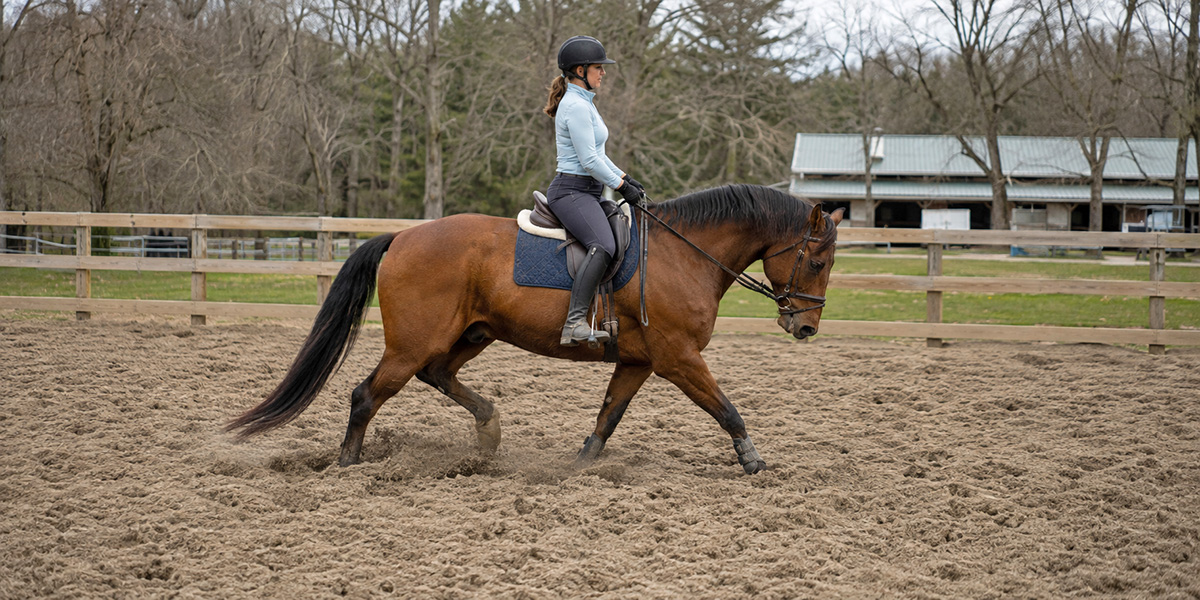
Cushion is not depth.
They are two different qualities and the whole problem lives in the confusion between them.
A sound landing needs the hoof to decelerate and find support. In appropriate footing, the foot sinks some, finds resistance, and loads. In excessively deep or loose footing, the foot may continue traveling farther before it finds support. That can increase the range of motion and the work required from the soft tissues of the lower limb, including the flexor tendons and suspensory apparatus.
Every stride. All session.
Turns can make the problem more obvious.
In a turn, the hoof needs enough traction and stability to support the horse as he changes direction. Footing that is excessively deep or loose can shear beneath the foot instead. The limb may load less consistently, potentially increasing stress on soft tissues and joints over repeated work.
Those are not necessarily dramatic injuries that show up as a horse suddenly three-legged lame on Tuesday morning. Repetitive strain may show up much more quietly—as soreness, shortened movement, reluctance to work or a horse who is simply a little off.
There is the hind end pushing through it too, which means additional work for the entire horse. And there is plain fatigue, because traveling through deep footing takes more effort. A tired horse does not move or land as efficiently, and fatigue itself can increase injury risk.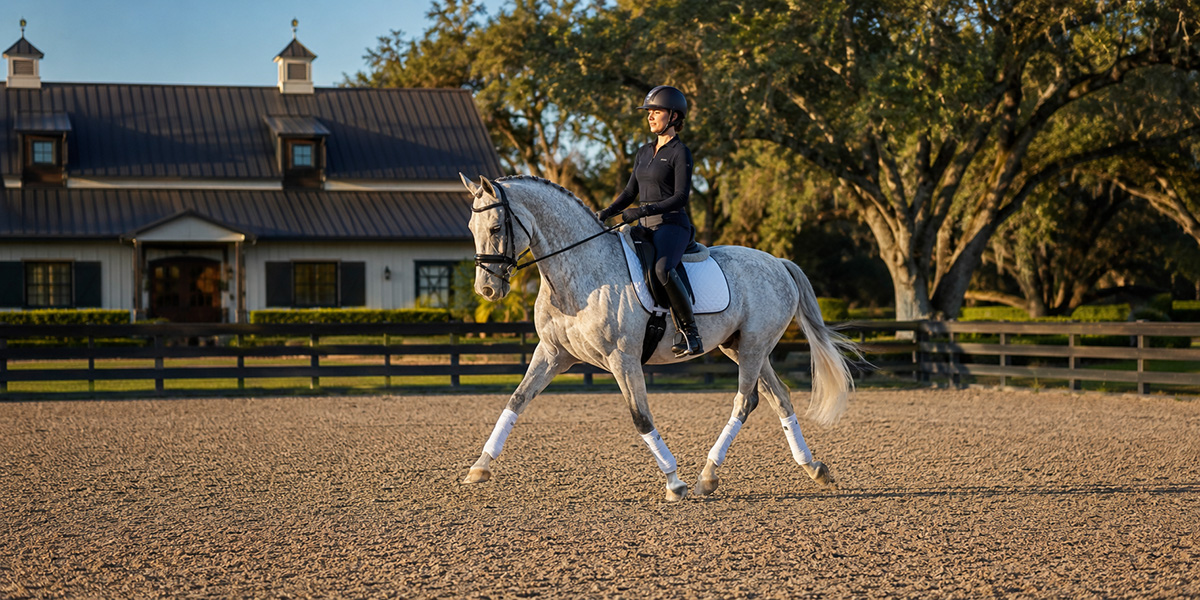
Owners misread that fatigue as well. The horse gets dull. He stops coming through from behind. He does not want to go forward. That gets called attitude, or a breathing problem, or a feed problem.
Sometimes it is the sand.
Meanwhile the rocks may still be coming. They are buried for one season and then work their way back toward the surface, and now you own a ring with rocks and bad depth both. The base is hidden, so you may not notice it deteriorating until the problem is well underway. Drainage can become worse if repeatedly adding footing changes the relationship between the arena surface and the surrounding grade. And a drag cannot correct an underlying base or drainage problem simply by moving the top layer around.
Removing excess footing costs money too. People add sand because it is the move that feels cheap, and sometimes it is the move that guarantees they pay twice.
How to read an arena you did not build
Most people reading this will never break ground. You board, or you are shopping for a property, or you haul in to a trainer once a week. You still need to be able to walk into a ring and read it, because your horse is going to work in it either way.
None of this costs anything.
Look at a hoofprint. A clean print with an edge you can read usually indicates that the surface is supporting the hoof reasonably well. A deep crater with the walls sliding back in deserves a closer look.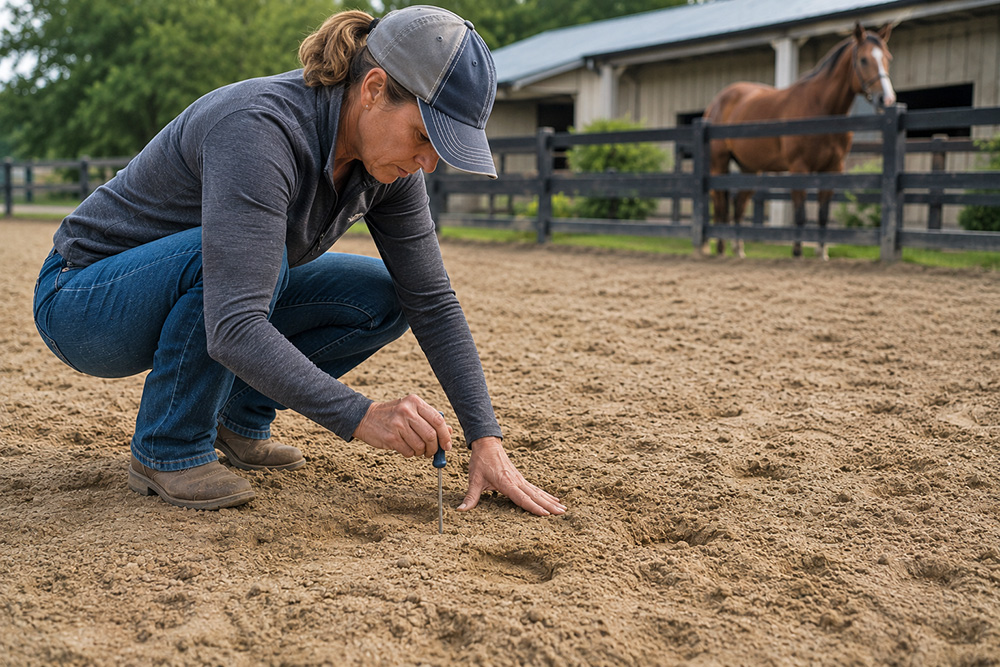
Push a probe down until you find the firmer layer beneath the footing. A screwdriver works. There is no single correct depth for every arena because discipline, footing material, moisture and base construction all matter, but if you are repeatedly sinking well beyond the intended footing depth before finding something firm, you have a conversation to have with somebody.
Walk the rail. If footing has piled into a berm along the fence, that berm can act like a dam and interfere with water leaving the ring.
Go look the day after a hard rain. This is one of the most useful things you can do. Where does the water stand, and how long does it stay?
Check the gate and the corners. Traffic concentrates there. If the gate area is hard as a road while the rest of the arena is soft, you already know the footing is not consistent.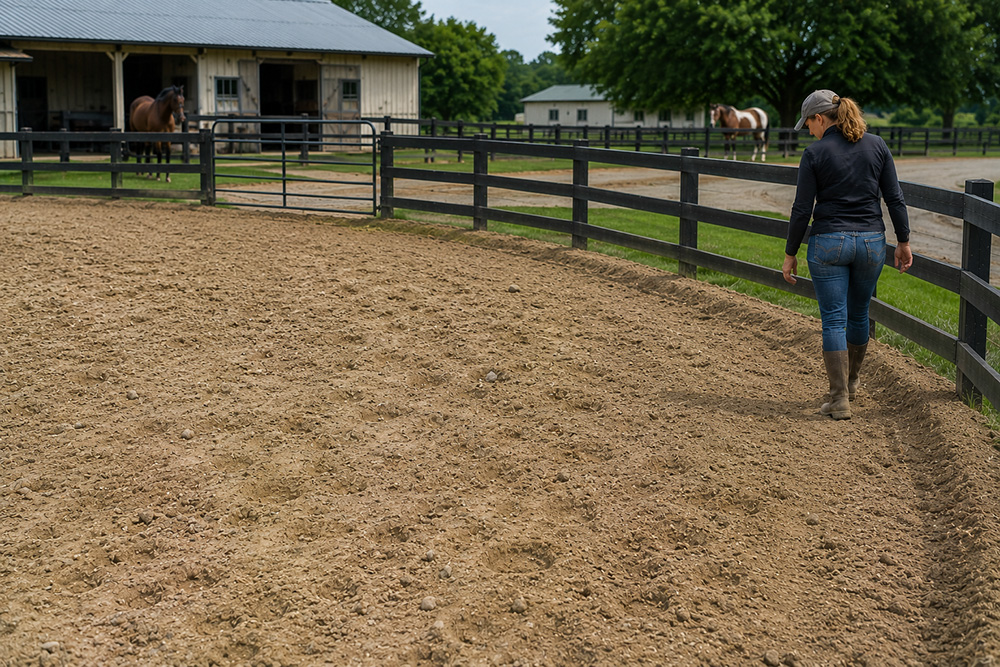
Look for obvious color and moisture differences. A ring that stays darker or wetter on one side than the other may be draining unevenly, and those sections may ride like two different surfaces.
Kick around near the rail and along the tracks and see what you turn up. If you repeatedly find stone, ask when the base went in and what is underneath the footing.
And listen. Good, supportive footing generally produces a softer, more muted hoof sound than a very hard, compacted surface.
What good ground actually feels like
It is worth saying plainly, because a lot of owners have never ridden on it and do not know what they are aiming at.
Good footing is consistent from one end to the other. It gives a little and then supports. It releases the foot cleanly instead of sucking at it. It does not change character dramatically between the corner and the long side. It does not turn to soup after every rain or to concrete after a dry week. And with proper maintenance, it remains reasonably consistent from one ride to the next.
A horse on good ground often moves differently. He can reach. He can go forward. He is not spending every stride trying to manage an inconsistent surface, so he can pay attention to you.
Roof, cover, or open sky
All three can be excellent. All three can be useless.
What separates them is not necessarily the budget. A modest outdoor ring on a proper base with good drainage can out-ride an expensive indoor built on poor ground. Money spent above the surface cannot rescue major mistakes underneath it.
An open outdoor arena means weather owns more of your schedule. That is the honest trade, and for a great many owners it is a perfectly good one.
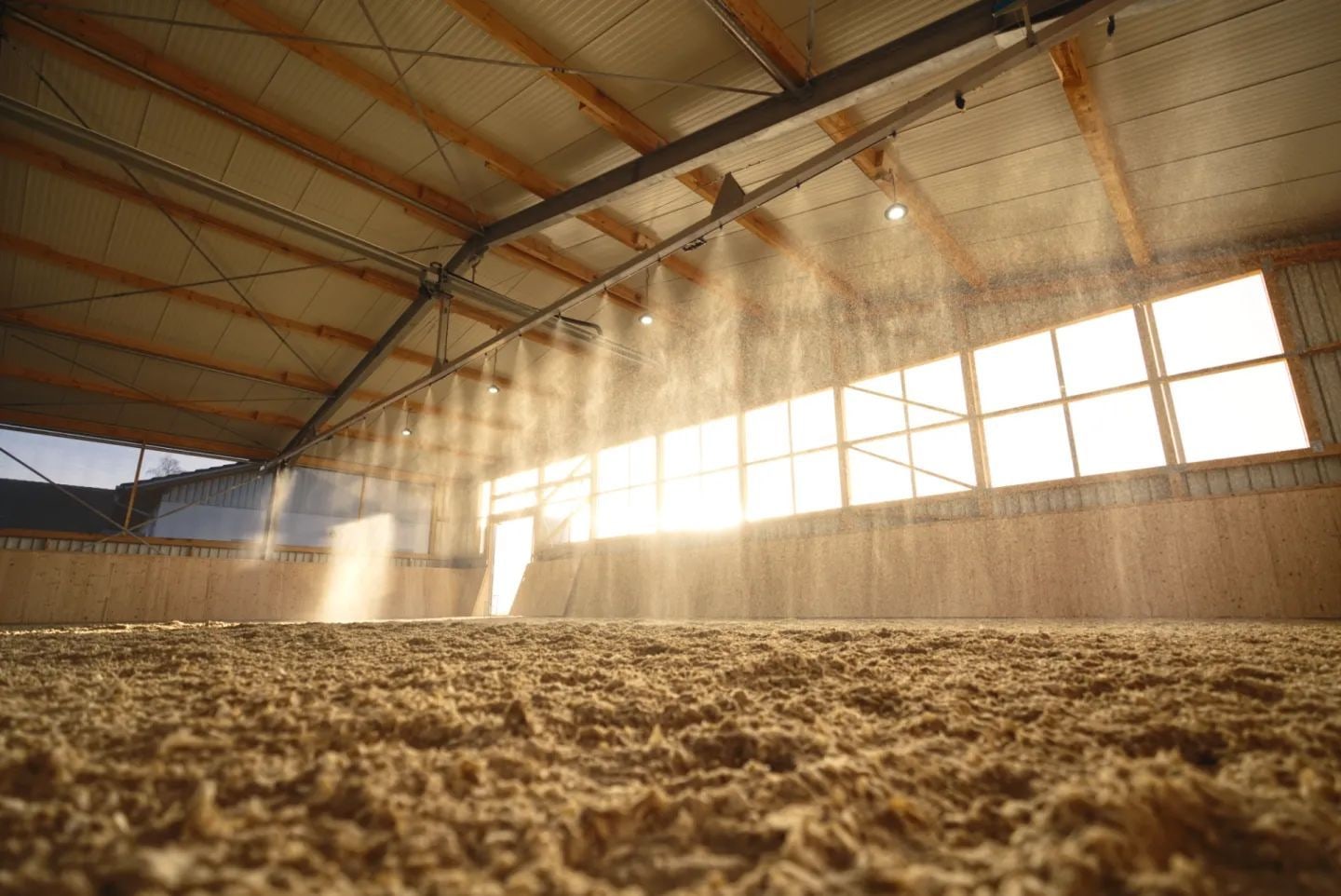
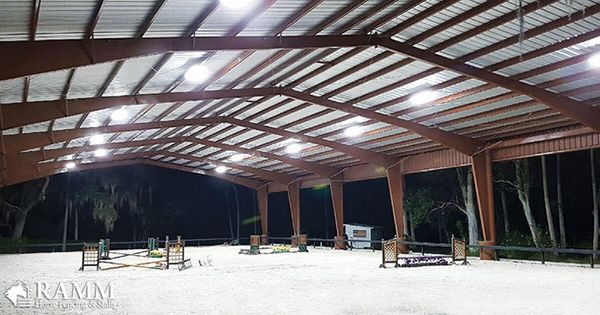
A covered arena buys you something people undervalue. It is not mainly about keeping the rider dry. A roof gives you far more control over how much rain reaches the footing, which makes moisture management considerably easier and can protect the surface from repeated saturation and erosion.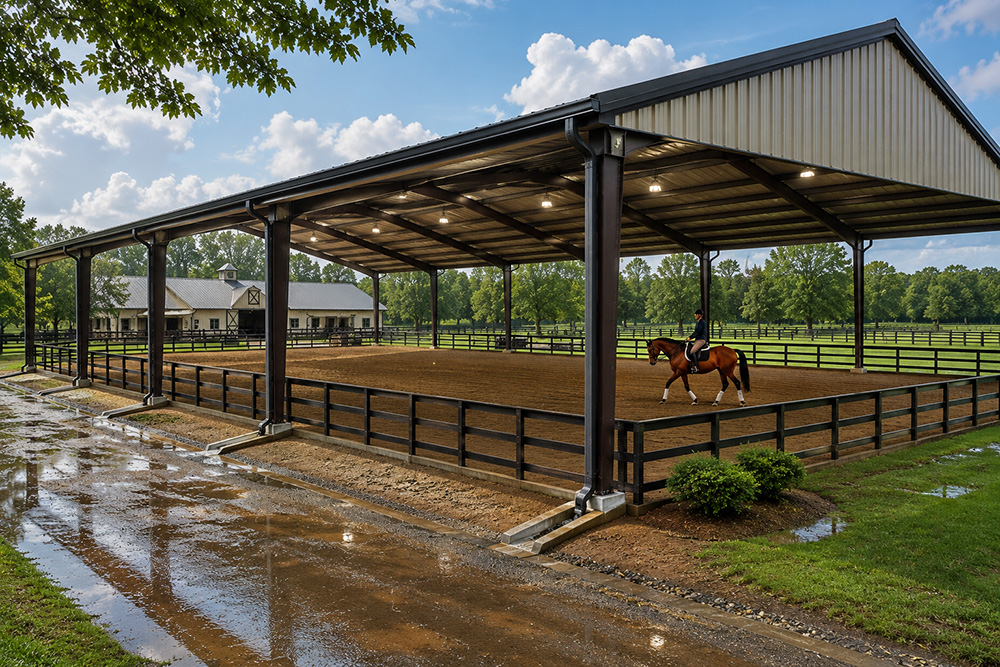
A roof is footing insurance.
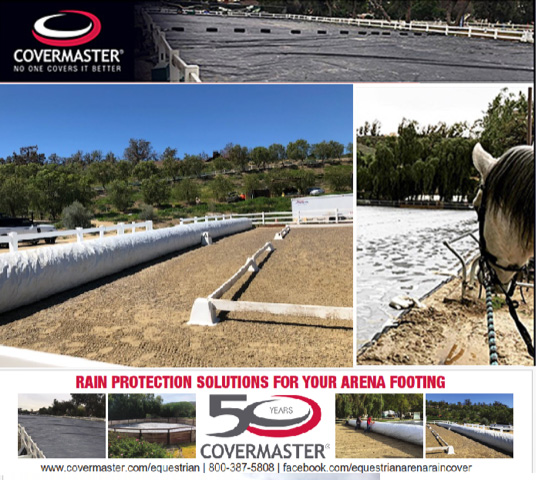
If a permanent roof is not practical, some facilities use temporary or specialized arena-surface protection systems during events or severe weather, although these are very different from constructing a true covered arena and need to be selected for the particular application.
An indoor adds protection from wind and winter weather, and it brings its own problems along. Ventilation, condensation, dust and light all matter. Poor lighting can make horses less comfortable in certain areas, and poor ventilation can create respiratory concerns for horses and people.
If a roof is in the budget, one detail gets skipped more than it should.
Gutters.
Roof runoff dumped directly beside the arena pad can erode the perimeter, saturate surrounding soil and eventually compromise drainage or the edge of the base. It can do that to a beautiful new building.
When to bring in somebody who does this for a living
There is a reason the horses at the top of every discipline, English and Western both, generally work on surfaces that receive serious professional attention. It is not vanity. Those animals represent substantial investments, their careers matter, and people protecting those careers do not leave the ground entirely to chance.
The same logic works at our level. It is just smaller numbers.
An arena consultation may cost less than one significant lameness workup and a long layup. If you are building, bring the arena into the site plan at the beginning, alongside the barn, and have somebody who understands arena construction look at your dirt before anybody moves it.
If you already have a ring that rides badly, a good assessment can tell you whether you are looking at an amendment or a renovation. An amendment might involve adjusting the footing material, moisture or grooming program. A renovation means dealing with what is underneath.
Those are very different projects with very different bills.
Guessing at that on your own is how people sometimes spend renovation money on surface fixes and get very little for it.
Ask what is under there. Ask about the separation layer. Ask about slope and where the water goes.
If nobody can answer, that is your answer.
A little more at the start
An arena is a long-lived thing. Built right, it can outlast the horses you built it for and probably the truck you hauled the sand in with.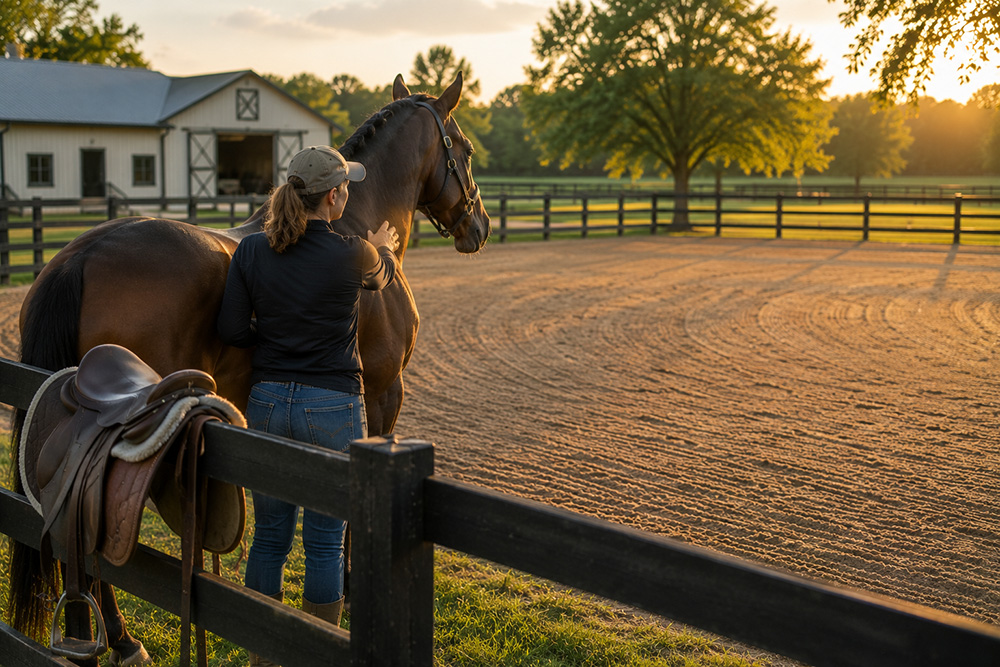
Built wrong, it is a slow tax.
You pay it in veterinary bills you did not expect, in a farrier trying to understand why this horse keeps bruising, in weeks off in the middle of your season, in maintenance that never seems to solve the problem, and sometimes in a good horse who quietly stops offering you his best because the ground has taught him to protect himself.
A little more thought, a little more time and sometimes a little more money at the beginning can change all of that for twenty years.
The horse does not care what it cost.
He cares what it feels like under his feet, and he is going to tell you either way.
Questions Readers Commonly Ask
How do I know if my arena footing is too deep?
Look at the hoofprints and examine how the surface behaves when the horse travels through it. A readable hoofprint that holds its shape is very different from a deep crater whose walls immediately collapse back into it.
There is no universal ideal depth for every arena. Discipline, footing material, moisture, horse size and base construction all matter. Many general-purpose arenas use footing measured in inches rather than great depth. If you are repeatedly sinking far into loose material before finding firm support, have somebody experienced with arena surfaces assess it rather than simply adding or removing material based on a number alone.
Why does my arena keep producing rocks after I clean it out?
Because material within an arena can migrate and sort over time. Freeze-thaw cycles, hoof traffic, dragging and vibration can contribute, while thinning footing may also allow aggregate from the base to become exposed or mixed upward.
If stone keeps appearing, investigate where it is coming from. Possible causes include contaminated footing, insufficient separation between layers, deterioration of the base or footing that has simply become too thin.
Cleaning the surface treats the symptom. The source may be underneath.
Can a stone bruise really put my horse out of work for weeks?
It can. A stone bruise injures sensitive tissue beneath the sole. Some resolve relatively quickly, while others may progress to an abscess or require enough recovery time to interrupt training.
If a horse becomes suddenly lame or develops persistent hoof soreness, have your farrier and veterinarian determine what you are actually dealing with rather than assuming every sore foot is simply an arena bruise.
Is adding more sand a reasonable short-term fix for a bad arena?
Sometimes additional footing is appropriate when a professionally evaluated surface has simply become too thin. But adding sand blindly to an arena with drainage, base, contamination or grading problems can make the situation worse.
Too much loose material can increase the effort required for movement, bury evidence of problems underneath, make depth inconsistent and leave the original drainage or base problem untouched.
Find out what is wrong before ordering another truckload.
Do I need a covered arena?
It depends on your climate, riding schedule and budget. A well-built outdoor arena with good drainage can provide an excellent riding surface.
A covered arena offers something beyond rider comfort: substantially greater control over rainfall reaching the footing. That can make moisture management and surface consistency easier, particularly in climates where repeated rain regularly interrupts riding or damages the arena.
But a roof does not rescue a bad base.
Build the ground correctly first.
Should I talk to an arena builder if I am not building an arena?
If you have a ring that consistently rides badly, yes.
An experienced arena professional can help determine whether you are looking at a surface-management issue—possibly footing, moisture, additives or grooming—or a structural problem involving drainage, grade or base construction.
Those are very different projects with very different costs, and guessing wrong can get expensive.
How can I tell if the arena at my boarding barn is any good?
Go look the day after a hard rain and see where water stands and how long it stays. Walk the rail and check for piled footing that may interfere with drainage. Look at the gate and corners for hard or compacted areas. Watch for sections that remain noticeably wetter than the rest.
Turn the surface over near the tracks and see whether you repeatedly find stone. Watch how deep the horses sink and whether the footing moves underneath them through turns.
Then watch your horse.
The arena is underneath him every stride he takes.
He may be giving you information about it before anyone else does.