

Equine EnergyRequirements
By Dr.
Kristina Hiney, PhD – Omega Fields® Equine Nutrition Advisor Determining equine energy requirements for a horse is not only a function of the weight of the horse, but also their body condition and function as an athlete.
A horse’s daily energy requirement—meaning calories, measured in megacalories—depends on its body weight, body condition, temperament, and workload. A mature 1050 lb horse at maintenance needs about 14.5 Mcal per day, while a more active or nervous horse can need roughly 20 percent more energy than an inactive one just to hold the same weight.
When referring to energy in horses, it is important to know that it means calories, not how the horse feels or acts. There are many other factors that influence a horse’s overall attitude, and while certainly how many calories he consumes is part of it, it is not the entire picture. In the equine world, due to the horse’s body size, energy requirements are listed in megacalories (Mcal). One Mcal is equivalent to 1000 kilocalories (kcals). To make it relatable, the average woman between 31 and 50 years of age who is moderately active is recommended to consume 2000 kcal/d. That would be equivalent to 2 Mcal for a horse.
So how much energy or calories does an average horse need to consume per day? Well, first average needs to be defined. When discussing energy requirements, we usually begin with the animal’s maintenance requirements. Maintenance is defined as a mature horse not undergoing any exercise program or reproducing. Essentially the average,older horse just out hanging around. Numerous researchers have studied the energy requirements of horses, and as a result, there are equations to calculate exactly how much a horse needs to eat.
For example, the maintenance requirement of an average 1050 lb horse would be 14.5 Mcal/d. These numbers are derived from the body weight of the horse multiplied by the energy required to maintain one kilogram of that horse’s body weight. Now, the point of this discussion is not to hand calculate how many Mcals each horse needs to eat per day, but to understand what factors horse owners have control over that will alter how much energy a horse needs.
However, even average horses are not always average. The defined maintenance requirements are based on horses in a moderate condition – those horses between a score of 5 and 5 ' . If the horse is overly fat, he needs less energy to keep him at the same weight. Fat tissue is metabolically less active than lean tissue, or muscle. Therefore, a 1100 lb horse who is fat actually needs to eat less than a 1100 lb fit horse to maintain the same weight.
Easy keeper or not?
Even a horse’s overall temperament will change its energy requirements. Hotter, or more nervous horses take a lot more feed to keep weight on, while those with a more laid back attitude need less feed. Typically those horses that were selected to have a more laid back personality, such as stock breeds or draft horses, fall into that easy keeper category vs horses who were selected for speed (think Thoroughbreds).
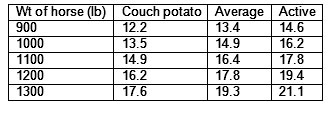
On average, a more active horse (youngsters in pastures, nervous Thoroughbreds) will need 20% more energy than an inactive horse to maintain its weight. So let’s say we have a 1100 lb laid back, fatty American Quarter Horse vs an active, lean 1100 lb Thoroughbred mare. Our laid back horse needs 14.8 Mcal/d while our active girl requires 17.8 Mcal/d (see Table 1 to estimate your horse’s maintenance requirement).
She will need to eat 3 Mcal/d more than our couch potato. That’s even before she is put into work!
Consider the Weather! The second major variable in the maintenance requirement for a horse is the weather. The calculated maintenance requirements are based on an environment that requires no energy by the horse to keep themselves warm. This is called the thermoneutral zone. Horses do quite well in cold temperatures if they have become accustomed to them. Cold adapted horses do well in temperatures as low as 5' Fahrenheit.
However, horses will have trouble keeping warm if the weather suddenly changes and if the horse hasn’t grown the proper hair coat. But all horses, even fuzzy Northern ones, will have trouble if they do not have protection from the wind or from rain, especially sleet. This chills a horse rapidly when the fluffy, protective insulation of their hair coat is slicked down to their body.
Below 5 ' F, a horse needs to use energy to keep warm, and that temperature is referred to as the lower critical temperature. So how much energy does a horse need to stay warm? On average, for every drop in temperature of 14 ' F below the lower critical temperature, they will need 20% more energy. Let’s say the temperature drops to -10 F ' and we are feeding our energetic girl. She will now need 21.4 Mcal/d for maintenance, an increase of 3.6 Mcal/d over her normal maintenance requirements.
Gaining weight for winter. There are additional strategies to take to prepare horses for winter weather, other than providing adequate shelter and letting them grow a hair coat. Adipose tissue, or fat, helps insulate horses against the chill of the winter weather, just like in polar bears. If the higher strung mare is also thin, about a condition score 4, it would exacerbate her heat loss.
Therefore, she should be fed to gain weight prior to winter. To change body condition scores in horses by 1 value (ie a 4 to a 5), they really have to be fed, especially if you want to put that weight on more rapidly. If the goal is to put weight on the mare in as little as 60 days, we would have to increase her caloric intake by 5.3 Mcal/d, or 30% of what she was consuming.
If our goal is a little more gradual, let’s say over 4 months, her diet would be increased by 2.7 Mcal/d or 16% of her current intake.
Not sure how much your horse weighs?
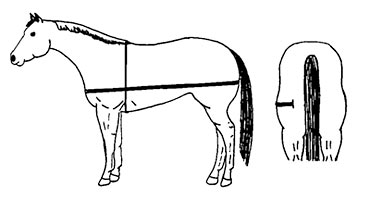
Weight tapes are available at most feed stores at a fairly nominal price ($2-3). But for even more fun (great for kids and 4-H activities) you can do it yourself with a string and a measuring tape. Use one string to measure the distance around your horse’s heartgirth (HG). Make sure your horse is standing square and your string is around your horse perpendicular to the ground. Then measure the length of your horse’s body (BL) from the point of his shoulder to his buttock, just like you were measuring for blanket fit.
Again, be sure your horse is square and that your string is held level to the ground. Measure your two strings in inches using your tape measure. Then use this simple formula Wt of your horse (lbs)= (HG)2 x BL330
Now you know how much your horse weighs!
Quick tip. While energy sources have not been discussed, a great way to put weight on horses is to add fat to the diet. Fat has 2.25 x the amount of calories per lb compared to anything else fed to horses. Need to put weight on before winter? Check out some fat added feeds, or fat sources. These add calories more quickly than just increasing how much your horse is eating. Typical fat sources of horses include stabilized rice bran, or vegetable oils that can be top-dressed on your current feed.
Many equine feed companies offer fat-added feeds that may be cheaper and more convenient than top-dressing your own feed. Additionally, many companies now offer fats with additional health benefits, mainly through the additional of omega-3 fatty acids. Most commonly these include ground flaxseed as it is highly palatable to horses, and is the richest plant source of omega-3.
Stabilized ground flaxseed is safe and convenient. Fish oil, the richest animal source of omega-3, also provides a high level of omega-3 fatty acids, but has limits in its acceptability by the horse and practicality.
Table 1. Energy requirements for maintenance (Mcal/d) based on average activity level.
For information on premium stabilized ground flax supplements that are rich in natural Omega-3 to help maintain a shiny healthy coat, strong solid hooves, and top performance – and for clear and concise labels – for horses in all life stages – please click on Horse Health Products Omega Fields’ mission is to offer the finest quality, most nutritious products at a fair price and provide outstanding customer service. We want our customers to have exceptional experience with our products, our staff, our websites, and our retailers. Order online 24/7/365 – omegafields.com Call toll-free – 1-877-663-4203.