

Horse Evacuation,Emergency Plan for the Horse Owner : When it’s Time to Go!
We need a disaster plan to evacuate our horses in emergencies. Robert Pruitt
The heart of a horse evacuation plan is leaving early—at least 48 hours before a predicted hurricane—with a written plan you’ve practiced before disaster strikes. Arrange destinations such as fairgrounds, horse show facilities, or a neighbor’s property in advance, keep at least three days of grain and hay on hand, and store your horse’s paperwork, including a current coggins test, identifying markings, and proof of ownership, in a watertight bag. If you must leave horses behind, put them in a safe pre-selected area with enough hay and water for 48 to 72 hours, and never rely on automatic watering systems.
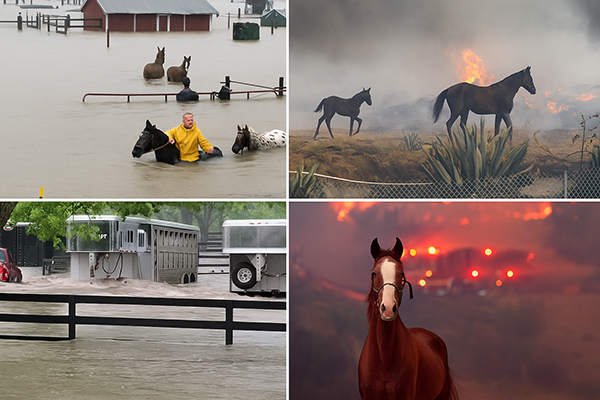
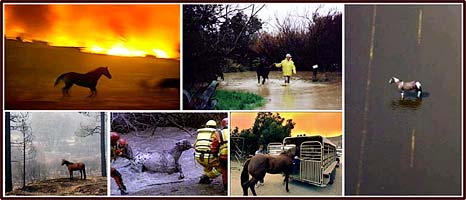
Fires, floods and other natural disasters happen every year. What do we do with our horses? Horses are very and large and emotional animals, if you wait for the emergency to happen, when panic is in control of the moment, it may be too late for your horse.
Being prepared in advance
can lower fear levels as well as prevent the human disaster of people becoming hurt or worse as they try to save their animals.
Our horses are going to feel your anxiety and stress ...everything is going to take longer than it normal. During an emergency, it is not unusual for horses to be unwilling to leave their stalls or corrals. Be difficult to load in a trailer...if a trailer is even available. If fire or flood is a threat your horses must be led to a secure area. Have an emergency plan and practice it before the disaster occurs.
Remember all your family and pets should be included in the evacuation plan.
Be prepared to move your horse out of harms way. Leaving early is the Key to success! If you have decided to evacuate before a hurricane arrives then don’t delay. Leave at least 48 hours before the storm is predicted. The worse thing that could happen to you is to be caught in traffic on the road when the storm or fire arrives. Your horse trailer and truck will not survive the power of a hurricane and you are not going to outrun a firestorm.
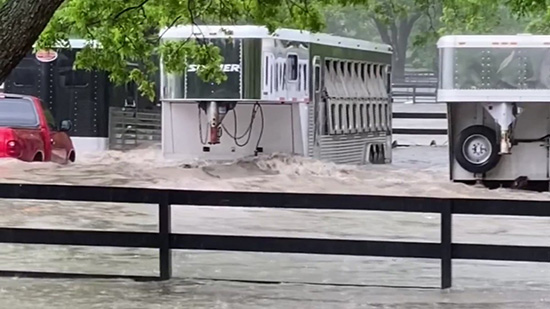
Your horses food and water should be in a waterproof container if possible. Big plastic trash cans with matching lids might work out for your hay and grain and 50 gallon plastic water barrels for fresh water. Remember power may not be available for some time after a disaster. After the Emergency there may be no fresh water available to livestock; you should have prepared a food and water supply for your animals that is kept clean and dry for your return. Some horses do poorly if they feed is changed rapidly. Always have at least 3 days grain and hay on hand.
Fire is the single greatest threat to horses in
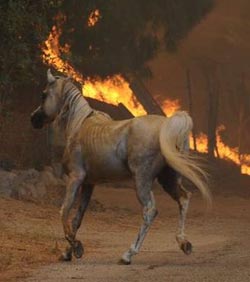
barns and corrals.
Be sure you have a fully charged and working fire extinguisher and keep flammable materials away from the horse barn’s breezeways. Plant material and debris should be cleared around horse housing areas. Hay bales should be stored in a separate area or building. If you don’t own a horse trailer then it is a good idea to have several (more than 2) people asked in advance, prepared to help move your horses in an emergency.
If you have a horse trailer how well does your horse load into it? Practice trailer loading with your horse to develop the confidence the horse and you need to get him loaded when the pressure is on. Consider buying horse panels or a portable corral that can be attached to your horse trailer. If necessary these panels can be a safe place to stable your horses should you have to travel a longer distance to find safety. You can secure your horse almost anywhere if you have a portable stall or fence , and a horse trailer with your hay and water.
Where are you going to take your horses?
If the emergency is a local one, like a local creek flooding you may be able to take your horses to a neighbor’s property. For bigger events you should contact horse show facilities and fairgrounds before a disaster to see if they have stalls that may be available during an emergency. Your truck and trailer should be full of gas and well maintained before you make an attempt to leave. Rental Stables may help keep horses temporarily in their round pens or arenas. Develop these relationships in advance. Call them to let them know you are on your way and the route you plan to take. Familiarize yourself with several evacuation routes to your destination.
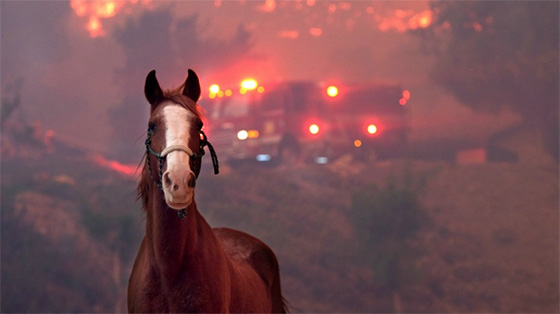
Keep your horse paperwork where you can find it.
This is very important. Keep the information in a watertight bag or box. You will need a current coggins test. A drawing with your horses identifying markings, tattoos, microchip ID, special scars and any other permanent identification, name and phone number of your Veterinarian, as well as your personal contact information should be part of your paperwork package. You will need to show some kind of proof of ownership in order to pick up your horse when the emergency is over. Take a picture of your horse with yourself or family member standing near as more proof of ownership and keep it with your ownership information.
Other items that you should have at hand: Keep a web type breakaway halter with your horse’s name; your name and phone number and a different emergency phone number written with a waterproof sharpie type marker. Another way to keep your horse identified in addition to the identity halter would be to have some wide white ribbons with your contact information written. The identity ribbon can be quickly braided into the horses tail and mane to be a redundant way to identify your horse.
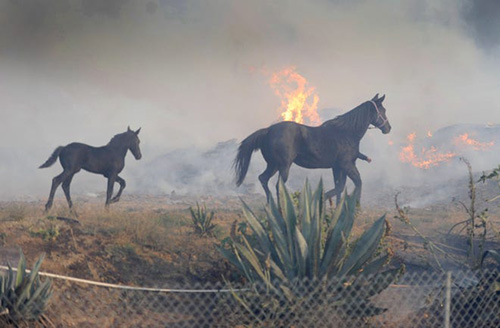
Bring a portable first aid kit, don’t forget medications your horse may be taking. Equine First Aid Kit Anyone who owns a horse should own a well-stocked First Aid Kit. Start by buying a plastic bucket that has a lid and place all of the first aid supplies in the tightly sealed container. The following are first-aid supplies that are essential to a well-stocked First Aid Kit.
These supplies should be kept in all First Aid Kits Should Include
Stethoscope You should check and measure heart rate and gut sound when horse is well to make a comparison when the horse is ill. Normal rate for adult horse is around 30 to 40 beats a minute and significantly higher for a nursing Mare and a Foal is around 60 to 80 beats a minute.
Iodine Solution Diluted An Iodine Solution that is properly diluted is Betadine. Any fresh wounds should be flushed out with this solution.
Hydrogen Peroxide Only use Hydrogen Peroxide to flush deep wounds or punctures only.
Neosporin and Nolvasan These are topical antiseptic ointments that fight bacteria and promote healing. These should be used twice daily after a veterinarian has seen the wound.
Saline Use to flush wounds after using anti bacterial washes and before wrapping.
Sterile Gauze Sponges Use these when cleaning the wounded area with a Diluted Iodine Solution.
Sterile Gauze Roll and Self-Adhesive Tape The Self-Adhesive Tape holds the Gauze to the wound. The tape is easily applied and removed. A few good brands are: Kling, Elastikon, Flexus and Vet-Rap.
Blunt-tipped Bandage Scissors These come in handy for removing bandages.
Topical Eye Ointment Non-steroidal Eye Ointment comes in handy when a horse injures his eye, and a veterinarian is not immediately available.
Rectal Thermometer Use with a string attached to prevent loss into the rectum or dropping and breaking it. An adult horse's normal temperature is between 99.0 and 101 degrees F. A foal is usually between 100 and 102. You should have some alcohol in your first aid kit to disinfect the Thermometer.
Inject able Sedative and Pain Killer Keep a small dose of each available. They come in handy in situations such as colic or for horses that are unwilling.
Electrolytes For use if dehydration is suspected.
Other Supplies That Should be Included:
Cold packs instant type for first aid Disposable diapers (2 or more for bleeding) Knife is useful for many things including cutting rope and bandages etc. Latex gloves Lubricant like ky jelly to aid thermometer insertion. Scissors Tweezers Twitch for distraction if necessary. Digital thermometer Duct tape Use on hoof Easy-Boot Use on hoof Stethoscope Twitch Hoof Pick Fly Lotion Wire cutters Electrolytes Flashlight
Bring a three-day supply of food and water to be loaded into your horse trailer in case of a longer evacuation or temporary stay at a park etc. Your disaster plan should be in writing and your neighbors and extended family should have a copy. Include flashlights and extra batteries with area maps. Do not put a copy of the horse's coggins test on the horse. A coggins test is a passport out of state for horse theives. If you find a loose horse remember he is probably frightened so be sure to use caution. If you are trying to rescue horses in your area remember never work alone.
When you are able to return to your home be sure to check for safety. Are fences or power lines down? Look for sharp objects and dangerous obstacles before you release your horses into their homes.
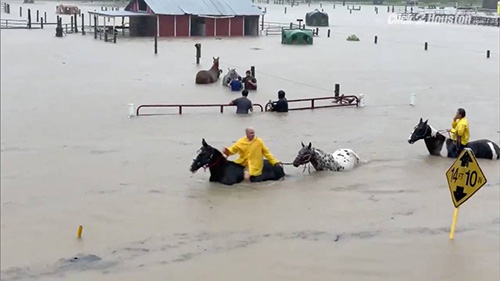
If you must leave your horses, leave them in the safe pre-selected area. Leave enough hay and water for 48 to 72 hours. Do not rely on automatic watering systems.