

I have heard it on the trail more times than I can count. A horse jumps sideways at nothing. The rider hauls him back, gets after him with a spur, and says it out loud.
"You idiot."
That bothers me. It has bothered me for fifty years.
Because the horse did not spook at nothing. He spooked at something. You just couldn't see it, hear it, or smell it. He could.
He Doesn't Get to Check First
Understand what a horse is before you judge what a horse does.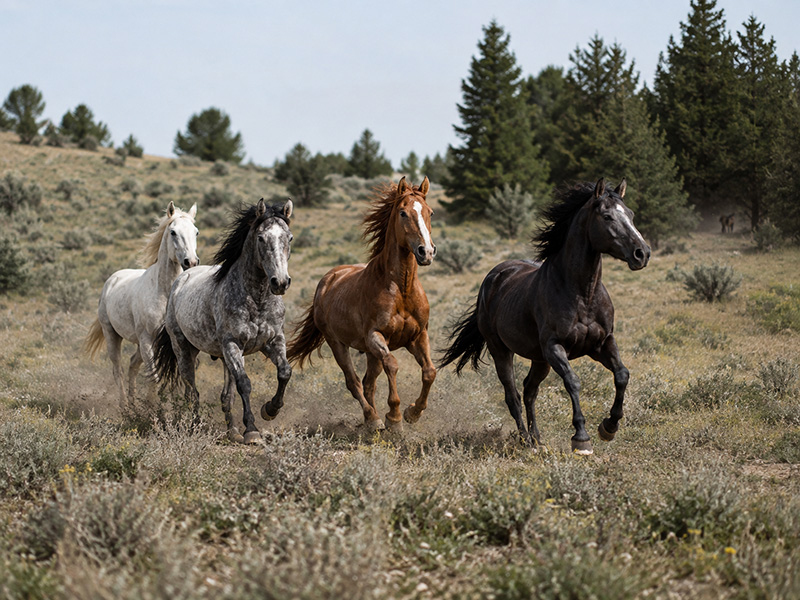
A horse is a flight animal. He is prey. For millions of years, every ancestor he had made a living by leaving before the thing in the brush finished making up its mind. The horses that stopped to investigate, that held their ground and waited for better information, are not anybody's ancestors. They got eaten.
That is not a character flaw. That is the design.
We ask a horse to do something no prey animal was ever built to do. We ask him to detect a threat and then stand still and think about it. He doesn't have that gear. The signal comes in and the feet move. The evaluation happens afterward, if it happens at all.
So when your horse jumps, he is not being dramatic and he is not being disobedient. He is doing the one job his body was assembled to do, and doing it fast enough to have kept his line alive.
What He Picked Up That You Missed
We are not equipped to referee this. Our senses are poor by comparison and, worse, we only run them part time. Your horse is doing threat assessment every second he's awake. You're thinking about the gate you need to fix.
Here is what he is working with.
Ears.
A horse hears higher frequencies than we do, and each ear swivels independently to place a sound. That rustle forty yards off in the cedar is a location to him. To you it is not even a sound yet. His ears are also the best gauge you own. A horse locked on with both ears is telling you exactly where to look, several seconds before anything else happens. Learn to read them and you'll stop being surprised.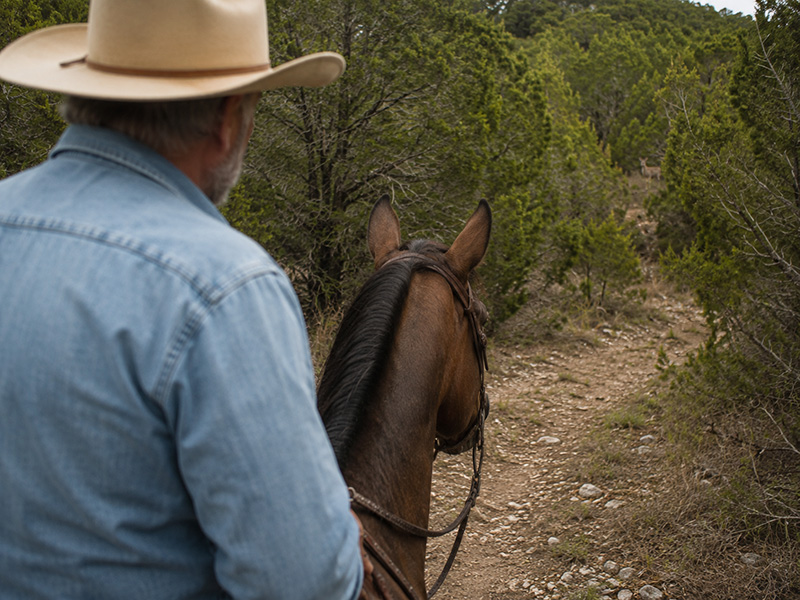
Motion, everywhere. His eyes sit on the sides of his head. He covers close to 350 degrees. That coverage is built to catch movement, not to identify it. This matters more than most riders realize: he frequently registers that something moved without ever resolving what it was. He can't zoom in. He can't ask. All he knows is that the world changed shape behind him and to the left.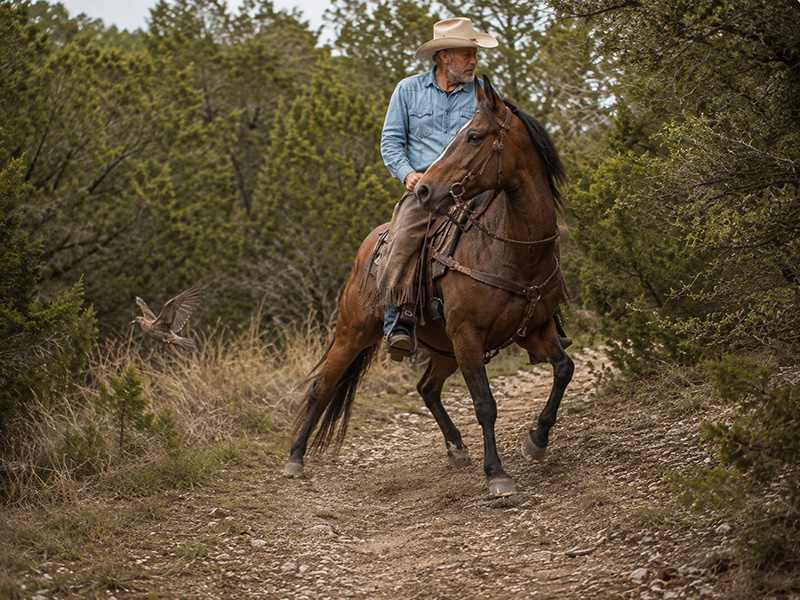
Light.
This one explains more bad behavior than anything else on the list. A horse sees better than we do in low light, but he adjusts to sudden changes in light far slower than we do. Coming off a sunlit trail into heavy timber, going from a bright arena into a dark barn aisle, stepping up into a trailer — for a few long seconds he is close to blind, and we are asking him to walk forward anyway. He isn't refusing. He can't see. Give him the time and most of that argument disappears.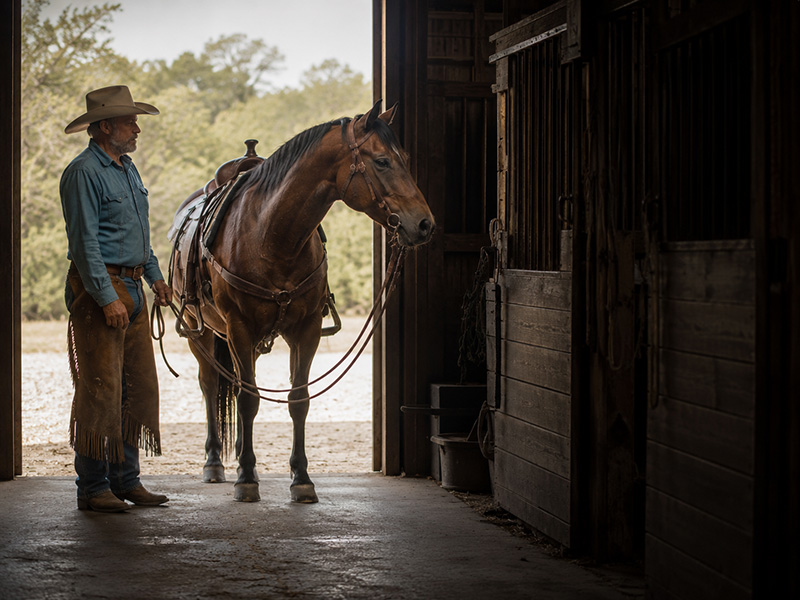
Color.
A horse is a dichromat. He sees roughly in blues and yellows. Reds and oranges wash toward green and muddy out. That orange marker you spot from fifty yards may not exist to him at all. And when it finally does resolve, it resolves suddenly, right in front of him.
Blind spots.
Directly behind him, and directly in front below his nose. That last one catches people. The object he studied from twenty feet away vanishes when he's standing over it. He knows it's down there. He just lost it. Then he steps and it comes back.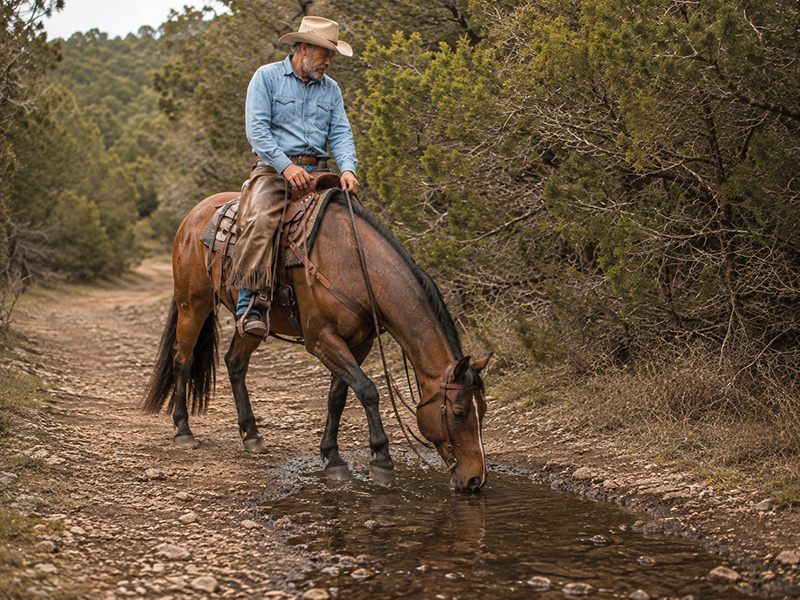
Add it up. Better hardware, running full time, feeding a nervous system designed to move first. You are riding a very good instrument operated by an animal who is not permitted to wait for confirmation.
The Part Nobody Accounts For
Here is where I disagree with most of what gets said about this.
There is no such thing as a spooky horse and a non-spooky horse. There are horses that have met a thing and horses that haven't.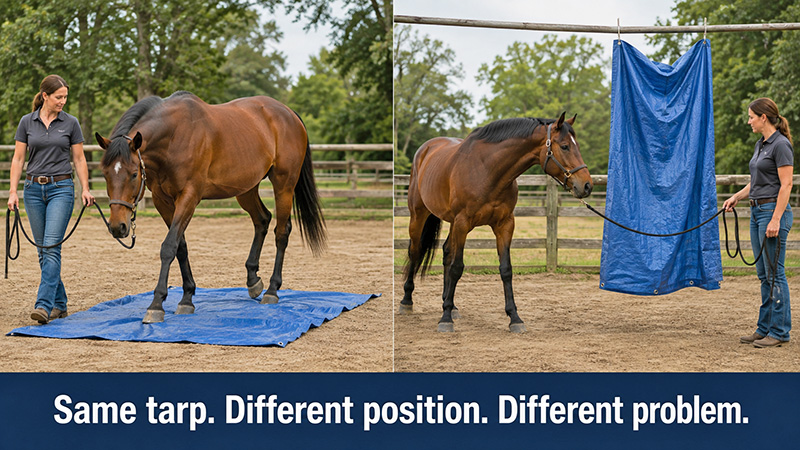
Every horse is exactly as reactive as the gap between what he has been introduced to and what he runs into. Close that gap and he settles. That's it. That's the whole variable.
And the gap is narrower than people think, because horses do not generalize the way we assume they do.
A horse desensitized to a tarp lying on the ground is not desensitized to a tarp overhead. Different object.
The blue barrel he has ignored at the end of the arena for a month becomes a brand new item the day you move it to the other end. Different object.
A slicker he's fine with on your body is a different thing entirely coming off the back of a saddle.
Every time a rider says "he knows better than that," what they usually mean is that they assumed a transfer that never took place. The horse did not know better. He had never met that particular version of it.
So Stop Correcting. Start Introducing.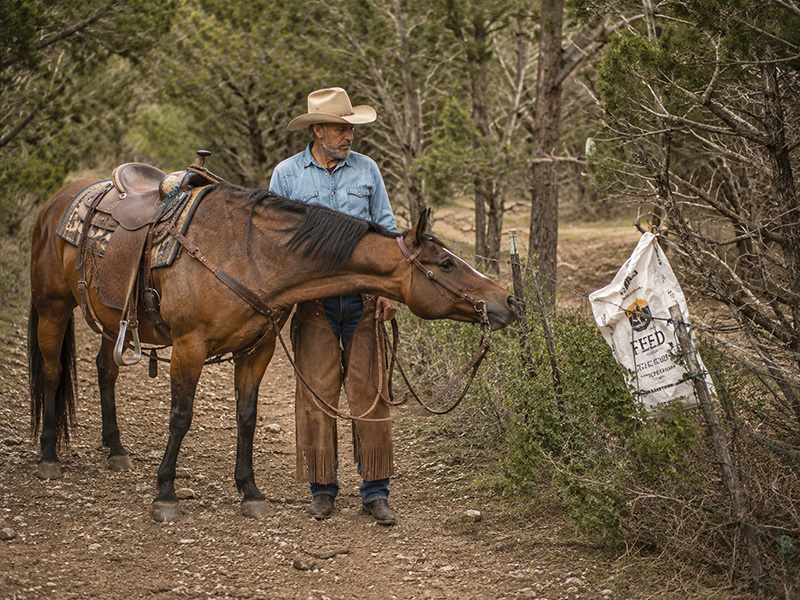
If all of the above is true, then getting after a horse for spooking is worse than useless. It's backwards.
You have a prey animal who just detected something real, could not identify it, was not built to stand and evaluate it, and had never encountered it before. And your response is to punish him at the exact moment the strange thing appears — teaching him that the new object and pain arrive together.
You have made the next one worse.
Try the other thing. When your horse spooks, he has just handed you information. He has told you there is something out there and he has told you he hasn't met it. Both of those are useful.
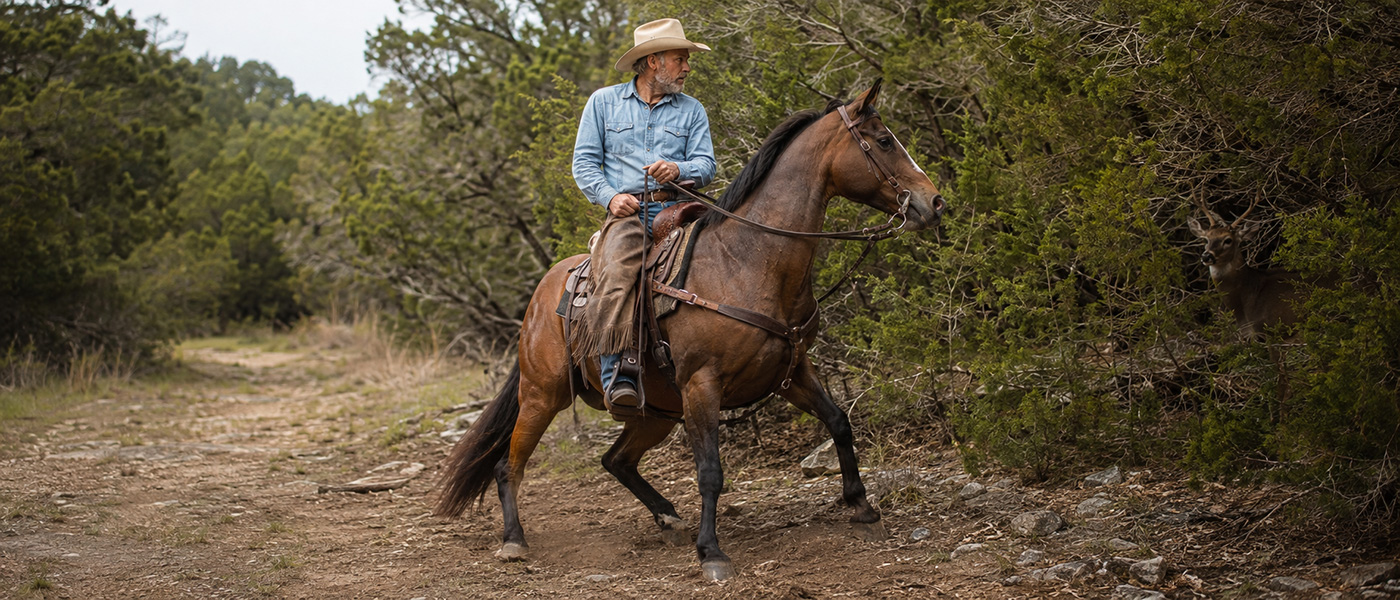
Go look. Half the time you'll find it — a deer bedded down, a downed limb that wasn't there last week, a plastic bag in the fence, a snake. Now you know what he was reacting to, and so does he.
The other half of the time you'll find nothing, and that's fine too. Nothing you could find. He heard it or smelled it and it left. He was still right.
Either way, let him look. Let him put his nose on it if he can. That one minute buys you more than an hour of drilling, because you didn't correct a reaction, you closed a gap. Do that enough times and people will start telling you what a quiet horse you have.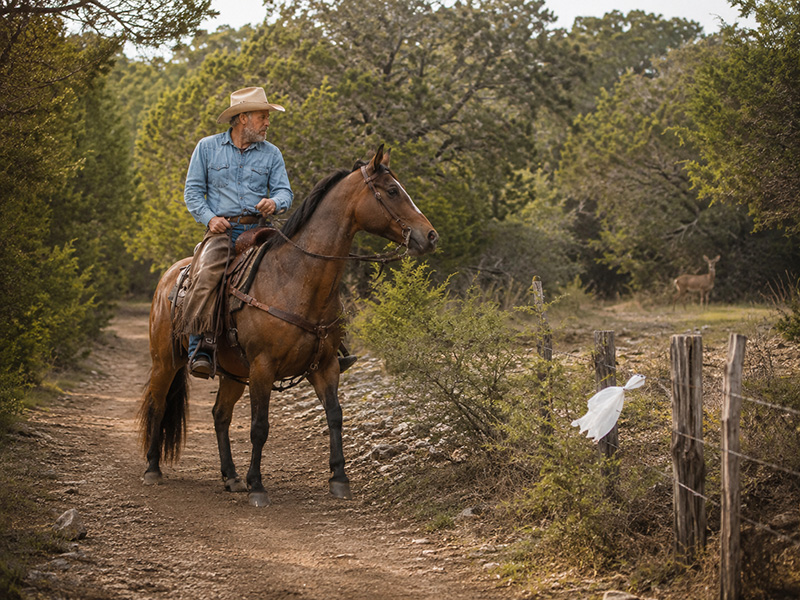
He was never spooky. He just hadn't met much.
One Last Thing
Fifty years in, I've come around to thinking the whole framing is wrong. We keep asking why the horse reacted. The better question is why we assume our version of the world is the complete one.
Henry Beston put it better than I can, and he wasn't even writing about horses:
For the animal shall not be measured by man. In a world older and more complete, gifted with the extension of senses we have lost or never attained, living by voices we shall never hear. They are not brethren, they are not underlings, they are other nations, caught with ourselves in the net of life and time.
Your horse is not an idiot. He is a nation with better ears.
I started thinking about all of this tonight when Zoey did not want to come into the barn.
Men were working outside, welding and building a new shelter for a couple of family members who will be coming to our stable. There was machinery, unfamiliar movement, sharp noises and the smell of welding. Bubba, Blaze and Sugar came into the barn and settled down. They had experienced construction around a barn before.
Zoey had not.
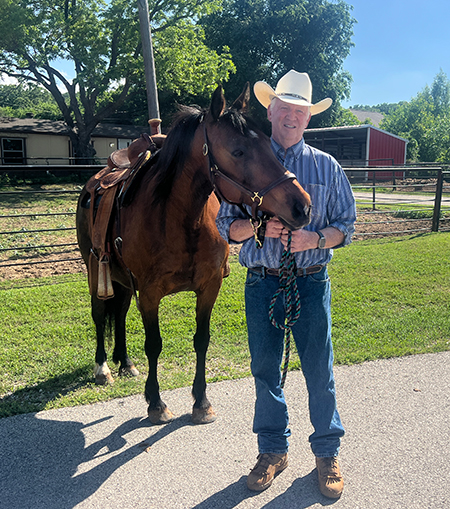 She has only been with me for three months, and she came here from Canada. I do not know everything she encountered before she arrived, but tonight she made it very clear that this was new to her. She was not being stubborn. She was not trying to win an argument. She was telling me that she did not understand what was happening around that barn.
So I did not turn it into a fight. I quickly cleaned her up and turned her back out with the other horses in the sixty-acre pasture.
There will be time to introduce her properly to construction noise, welding and activity around the barn. Tonight was not the time to force the lesson.
Zoey was not an idiot.
She noticed something the other horses had already learned not to fear.